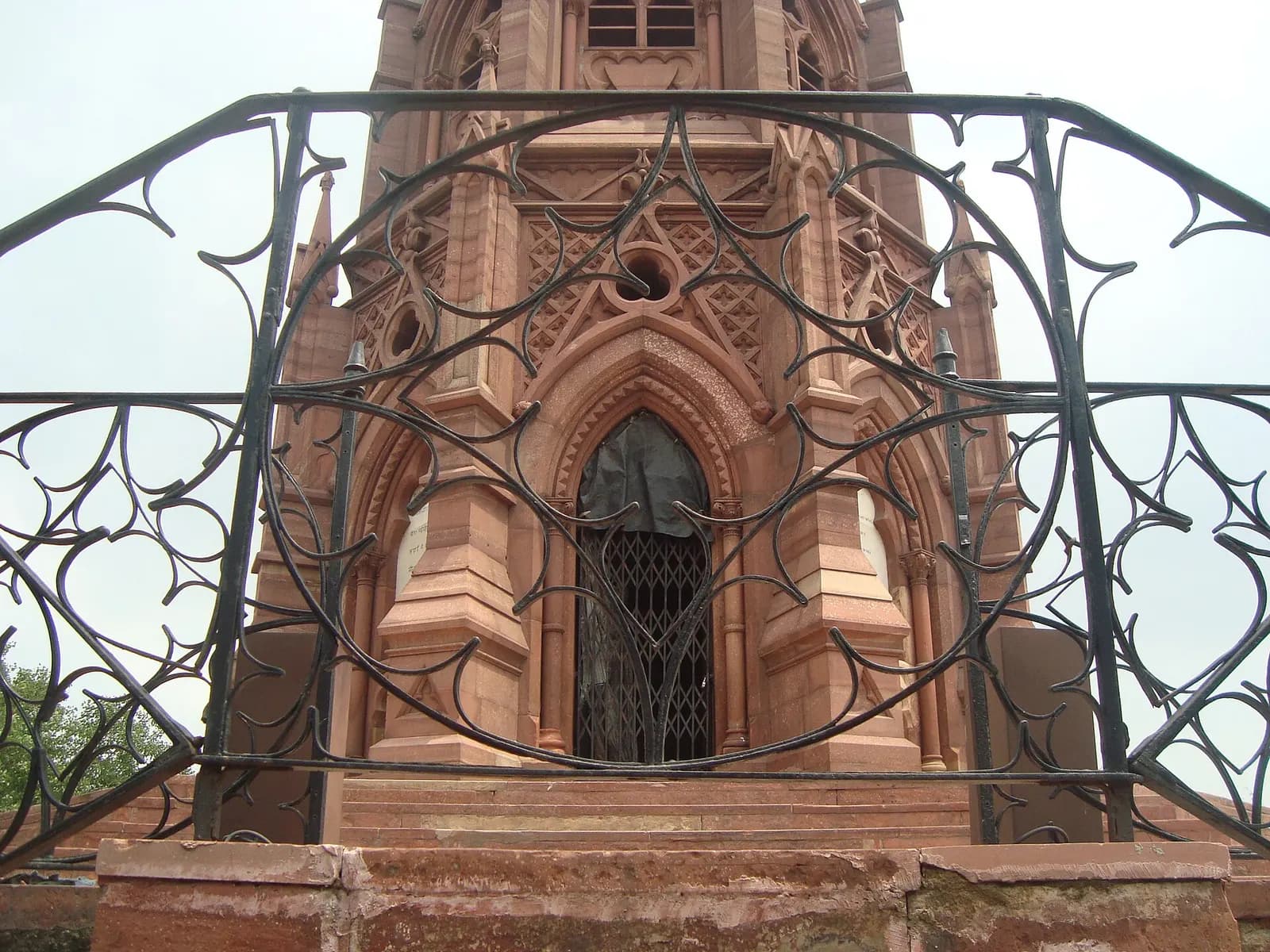
Mutiny Memorial (Ajitgarh) Delhi: History, Timings and Guide
Visiting the Mutiny Memorial or Ajitgarh, on Delhi's Northern Ridge? Its 1857 history, the renaming, the Gothic tower, timings, free entry and nearest metro.
In a Nutshell
“The Mutiny Memorial, now officially called Ajitgarh, is a striking Victorian Gothic tower on the Northern Ridge in Civil Lines, Delhi, built by the British in 1863 to commemorate the soldiers of the Delhi Field Force killed in the Siege of Delhi during the 1857 uprising. After independence it was renamed Ajitgarh and given a new plaque recasting the Indian "enemy" of the original inscriptions as martyrs for freedom. A free, atmospheric and lesser-known monument set in the Ridge forest, it is open daily and reached from the Vishwavidyalaya metro. It features on our Delhi tours, run by a unit of Experience My India.”
The Mutiny Memorial is one of Delhi's most atmospheric and historically layered monuments, a tall red Gothic spire rising out of the quiet Ridge forest, telling the story of 1857 from two sides, the British who built it and the free India that reclaimed it. For history lovers and those drawn to the city's offbeat, evocative corners, it is a fascinating stop. Our team at Delhi Agra Tour Packages sometimes includes it on a Ridge or 1857 heritage trail and it adds an unusual dimension to a wider Golden Triangle tour through the capital.
I am Abhay Sharma, Delhi born and a Golden Triangle guide since 2015 and I enjoy bringing history-minded guests here, because few monuments capture the complexity of 1857 and of how India has reinterpreted its colonial past, quite so vividly. This guide gathers everything I would tell a visitor beforehand, checked against current information, including the history, the timings, the safety notes and how to reach it.
Details
Mutiny Memorial at a glance
| Detail | Information |
|---|---|
| Location | Kamla Nehru Ridge, Civil Lines, North Delhi |
| Built | 1863, by the British Public Works Department |
| Renamed | Ajitgarh, in 1972 |
| Commemorates | The Siege of Delhi in the 1857 uprising |
| Style | Victorian Gothic Revival, a red sandstone spire |
| Entry | Free; an open monument in the Ridge forest |
| Nearest metro | Vishwavidyalaya or Pul Bangash, then an auto |
| Time needed | About 30 to 45 minutes |
Mutiny Memorial timings
| Detail | Information |
|---|---|
| Open | Daily, 9:00 AM to 5:00 PM |
| Entry fee | Free |
| Time needed | About 30 to 45 minutes |
The Mutiny Memorial is open daily from 9:00 AM to 5:00 PM and a casual walk around it takes about thirty to forty five minutes. Being set in the isolated Ridge forest, it is best visited well within daylight hours and you should leave the forested paths before dusk. Timings can vary, so a mid-morning or early-afternoon visit is safest.
Entry fee
| Item | Information |
|---|---|
| Entry fee | Free for everyone |
| Tickets | None; no counters or digital passes |
| Facilities | None on site; no restrooms, water or food stalls |
How to reach the Mutiny Memorial
| From | Route |
|---|---|
| Vishwavidyalaya metro (Yellow Line) | A short 5 minute auto to the Ridge gate |
| Pul Bangash metro (Red Line) | Also an option, then a short auto |
| Civil Lines and Delhi University north campus | A short ride through the area |
| By auto | Drops at the small gate on Rani Jhansi Road |
What is the Mutiny Memorial (Ajitgarh)?
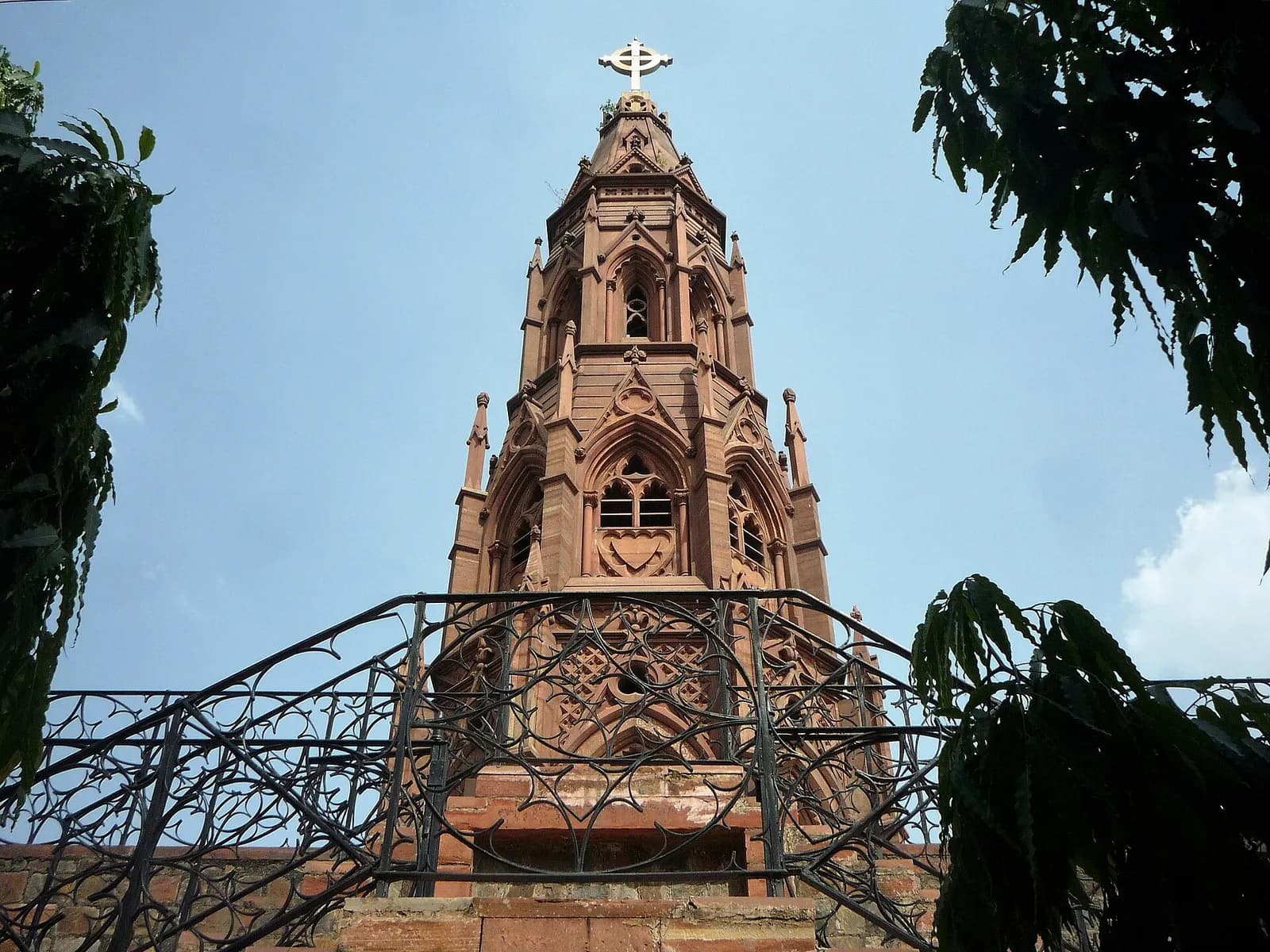
The Mutiny Memorial, officially renamed Ajitgarh after independence, is a tall Victorian Gothic tower standing on the crest of the Northern Ridge in the Civil Lines area of Delhi, built by the British in the 1860s to commemorate those who died fighting on the British side in the great uprising of 1857. Rising out of the dense green canopy of the Ridge forest, the dark red sandstone spire is a rare and striking example of Gothic Revival architecture in Delhi, visually quite unlike the Islamic and Hindu domes that define the city's skyline. Beyond its unusual form, its real fascination lies in its history and its dual identity: built as a British monument to the suppression of the revolt, it was reclaimed and recast after independence as a memorial to Indian martyrs, so it tells the story of 1857 and of changing historical perspectives, in one monument. Isolated, atmospheric and little visited, it is one of Delhi's most evocative offbeat historical sites.
Several things make it special and they are worth drawing out:
- A monument to 1857. It commemorates the Siege of Delhi, a pivotal episode of the 1857 uprising, on the very ridge where it was fought.
- A dual history. Built by the British as the Mutiny Memorial, it was renamed Ajitgarh and reinterpreted after independence as a memorial to Indian freedom fighters.
- Rare Gothic architecture. A striking Victorian Gothic Revival spire in dark red sandstone, unlike almost anything else in Delhi.
- A Ridge forest setting. Set deep in the quiet, green Northern Ridge forest, atmospheric and isolated.
- Part of a heritage trail. A core point on the Ridge 1857 heritage trail, linking it with the nearby Flagstaff Tower and an ancient Ashoka Pillar.
It is one of the most atmospheric and historically rich of the offbeat things to do in Delhi and a fascinating, lesser-known entry among the important monuments of Delhi.
History of the Mutiny Memorial
The Mutiny Memorial was built in 1863 by the Public Works Department of the British Raj and its purpose was commemorative: it was erected to honour the officers and soldiers of the Delhi Field Force, both British troops and Indian soldiers loyal to the British, who were killed during the Siege of Delhi between 30 May and 20 September 1857. That siege was one of the defining episodes of the great uprising of 1857, variously called the Sepoy Mutiny, the First War of Independence or the Revolt of 1857, when Indian soldiers and others rose against the rule of the British East India Company and Delhi, with the last Mughal emperor as a figurehead, became a central battleground. The British forces besieged and ultimately recaptured the city in bitter fighting and this memorial was raised to their fallen.
Its location was deliberate and significant. The spire was built on the rocky crest of the Delhi Ridge, the very high ground where the British forces had established their heavily fortified base camp from which to launch their counter-offensives against the Indian revolutionaries holding the walled city below. In other words, the monument stands on the ground from which the reconquest of Delhi was directed, which gives it a powerful connection to the events it commemorates. For much of its first century it stood simply as the Mutiny Memorial, a British monument telling a British version of 1857. Knowing this origin is essential to understanding the monument and the remarkable transformation it underwent after independence, described below, which turned a colonial war memorial into something very different.
From Mutiny Memorial to Ajitgarh: the renaming
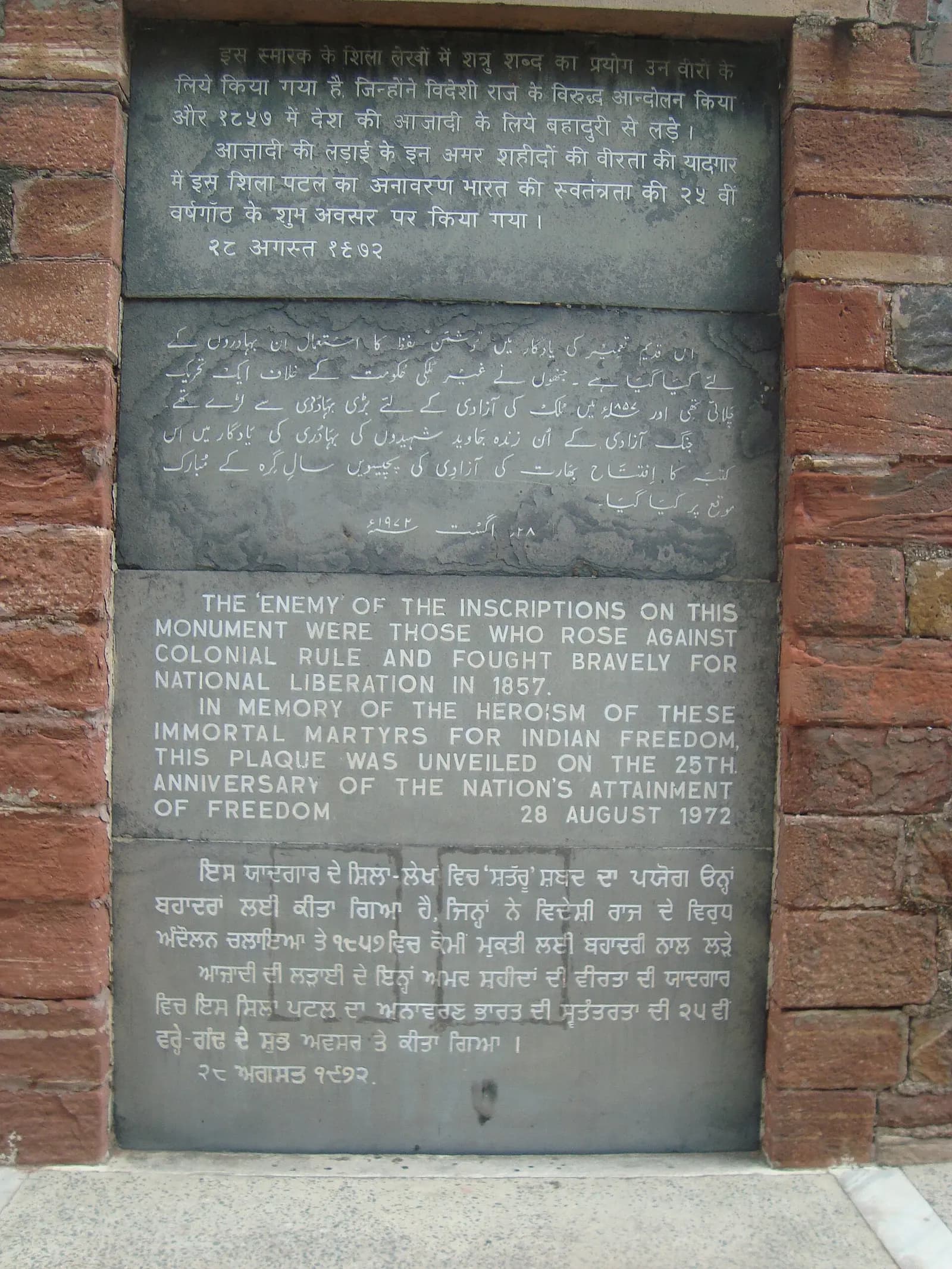
One of the most interesting things about this monument is how independent India chose to deal with a memorial built to honour the suppression of an Indian uprising and the answer was not demolition but reinterpretation. On 28 August 1972, around the twenty-fifth anniversary of India's independence, the Government of India officially renamed the monument Ajitgarh, meaning the Place of the Unvanquished or the Invincible Fort, a name that reframed it in the spirit of Indian pride and resistance rather than colonial commemoration. The original British inscriptions, which spoke of the fallen in the language of the Raj, were left in place as historical record, but the meaning of the site was decisively shifted.
Crucially, the Indian government added a prominent new marble plaque that completely recontextualised the monument. Its inscription states plainly that those whom the British had labelled the "enemy" on the original walls were, in truth, immortal martyrs for Indian freedom who rose bravely against colonial tyranny. In a single stroke, this turned a memorial to the defenders of British rule into a memorial that also honours the Indian revolutionaries who fought against it, holding both readings of 1857 in one place. This thoughtful act of reinterpretation, rather than erasure, is what makes the monument so compelling today: it stands as a rare, honest record of how history is written, contested and rewritten. For the visitor, reading the old British inscriptions alongside the corrective Indian plaque is the heart of the experience, a vivid lesson in the complexity of the 1857 story and in how a nation reclaims its past.
Architecture: the Gothic Revival spire
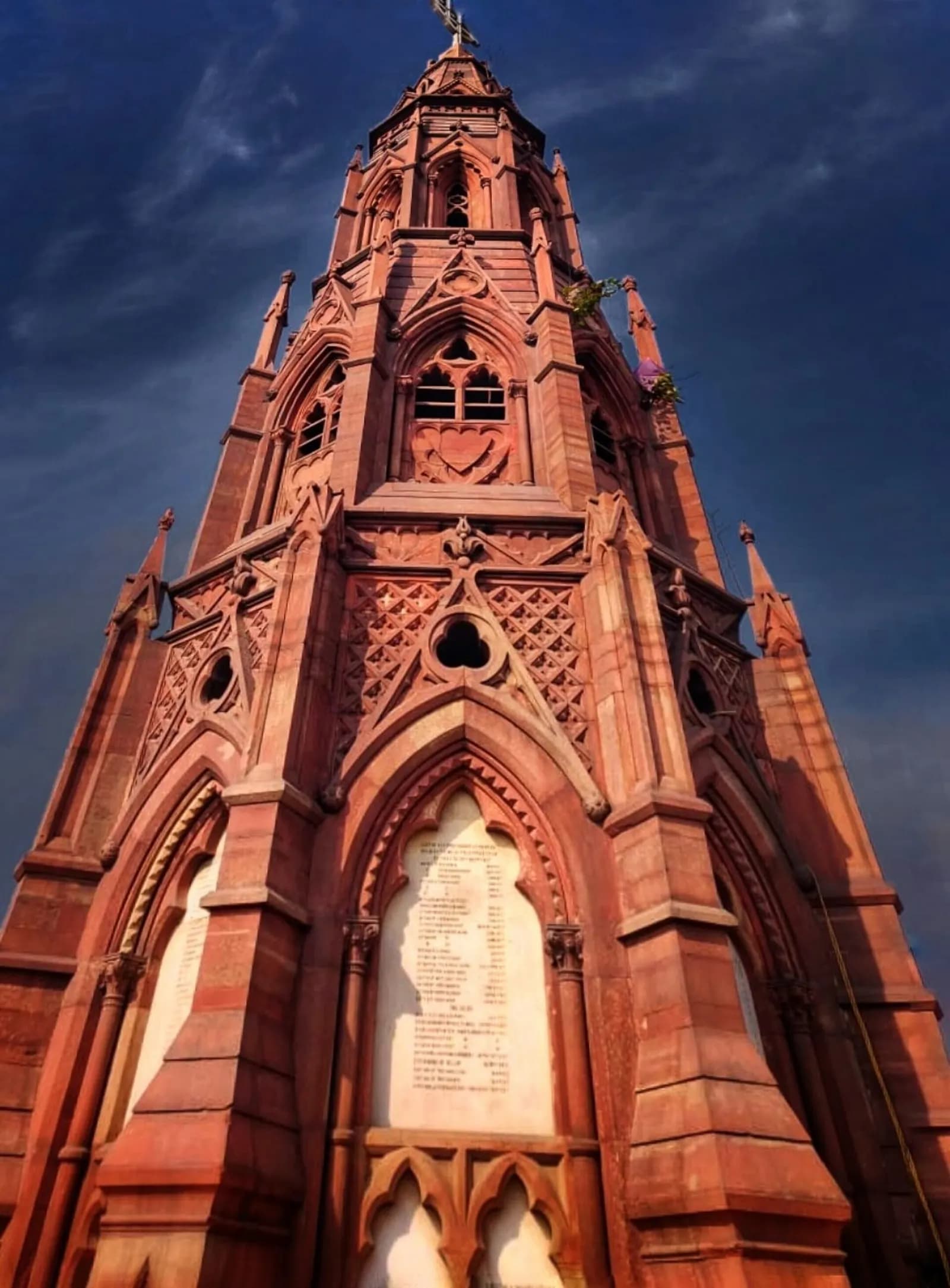
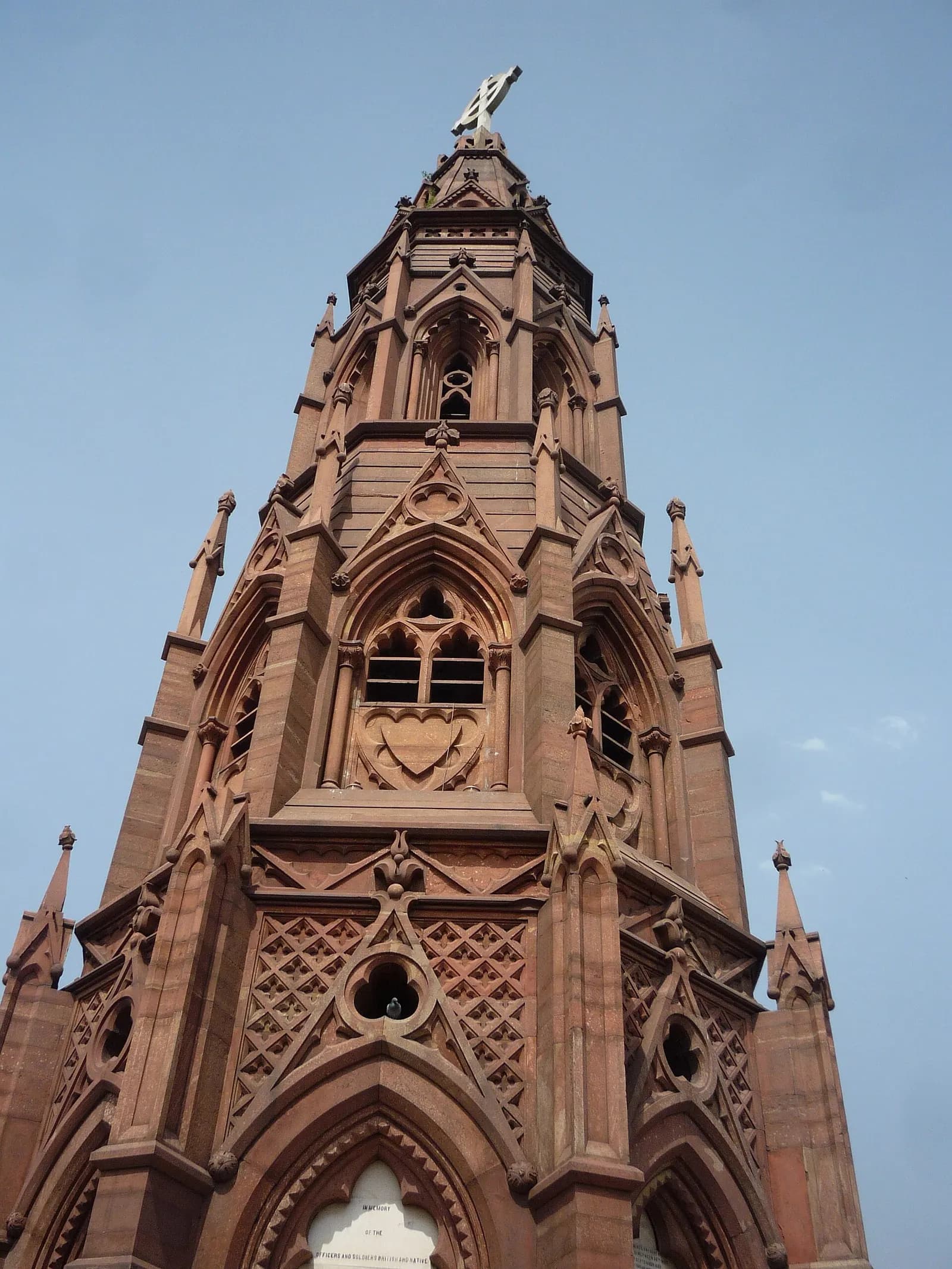
Architecturally, the Mutiny Memorial is a rare and striking example of Victorian Gothic Revival architecture in Delhi, which makes it visually distinct from the city's characteristic Islamic and Hindu domes and a notable curiosity in its own right. Built of dark red sandstone, it takes the form of a tapering, four-tier octagonal tower that rises some 33 metres, around 108 feet, high into the forest canopy of the Ridge, crowned at the very top with a traditional brick spire and a marble crucifix, the Christian emblem underlining its original British, commemorative purpose. The tall, pointed, Gothic silhouette rising out of the greenery is genuinely unusual for Delhi and gives the monument much of its atmospheric, slightly melancholy character.
The structure rewards a closer look:
- The octagonal tower. A four-tier tapering octagonal shaft in dark red sandstone, rising about 33 metres into the trees.
- The spire and crucifix. A brick spire topped with a marble crucifix crowns the tower, reflecting its British origins.
- The height. The tower was deliberately engineered to stand noticeably taller than the ancient Ashoka Pillar positioned about 200 metres further north along the same ridge.
- The spiral staircase. One face of the octagonal base holds an arched western doorway with a winding inner spiral staircase to the upper tiers, though this is currently locked to the public for safety.
The deliberate choice to build the tower taller than the nearby ancient Ashoka Pillar was itself a statement of imperial confidence, a reminder that the monument was conceived as an assertion of British power as much as a memorial. The Gothic Revival style, transplanted from Britain to the Delhi Ridge, makes the spire a fascinating architectural outlier and its weathered red stone against the forest green is strikingly photogenic.
The casualty slabs and inscriptions
The most historically detailed part of the monument is found at its base, where the original commemorative inscriptions are affixed. The lowest octagonal tier features seven white marble tablets set into the stone faces, meticulously engraved with the names, regiments and precise death tallies of the soldiers of the Delhi Field Force, categorised by the various battles and engagements of the siege and even by outbreaks of disease, which claimed many lives in the camp. These slabs are a sombre, detailed record of the human cost of the siege on the British side, listing the fallen with the careful bureaucratic precision of the Victorian military.
Reading these original inscriptions is a strange and powerful experience, especially alongside the later Indian plaque that reframes the whole monument. The British slabs speak of loyal soldiers and fallen officers and of the "enemy" they fought; the Indian plaque insists that this "enemy" were martyrs for freedom. Standing at the base, taking in both, you are confronted directly with the way the same event, the same dead, can be remembered in utterly different ways depending on who is doing the remembering. It is this juxtaposition, the meticulous colonial record and the proud national corrective, that gives the Mutiny Memorial its real depth and makes it far more than a simple old tower. For anyone interested in history and memory, the casualty slabs and the plaque together are the essence of the visit.
The Delhi Ridge and the 1857 heritage trail
The Mutiny Memorial does not stand alone but forms a core segment of the Northern Ridge, a green, rocky forest spine that was central to the events of 1857 and is now a heritage landscape dotted with historic sites. The Ridge was the strategic high ground that decided the Siege of Delhi and walking it is to walk the battlefield of 1857. The memorial links, along the Ridge heritage trail, with two other notable sites: the nearby Flagstaff Tower, a small tower where British civilians are said to have sheltered during the initial outbreak of the revolt and an ancient Ashoka Pillar, one of the third-century BCE edicts of the emperor Ashoka that was moved to Delhi centuries ago, standing about 200 metres away along the same ridge lane.
Together these sites make the Northern Ridge a remarkable open-air history lesson, spanning from the age of Ashoka to the trauma of 1857, all within a tranquil forest. For the visitor, this means the Mutiny Memorial is best appreciated not in isolation but as part of a Ridge walk taking in the Flagstaff Tower and the Ashoka Pillar, which deepens the sense of the history embedded in these quiet woods. The contrast between the peaceful green forest today and the violent events it witnessed is part of what makes the Ridge so atmospheric. A guided or well-planned walk along this trail is one of the most rewarding offbeat historical experiences in Delhi, far from the crowds of the famous monuments.
What to expect at the Mutiny Memorial
A visit to the Mutiny Memorial is atmospheric, offbeat and quite unlike visiting Delhi's grand, busy monuments and knowing what to expect is important here. The monument sits deep within the dense, tranquil green canopy of the Northern Ridge forest, near Delhi University's north campus and the Hindu Rao Hospital, reached by a small gate and a forest path. The setting is exceptionally isolated and quiet, even eerie, with few other visitors, so you often have the towering Gothic spire and its inscriptions almost to yourself, rising out of the trees in near silence. This solitude and the monument's melancholy history give the place a haunting, evocative quality that many visitors find memorable, though it also means it is not a place to linger alone late in the day.
The visit itself is short, around thirty to forty five minutes, spent walking around the base, reading the casualty slabs and the Indian plaque, taking in the architecture and the forest setting and perhaps continuing along the Ridge to the Flagstaff Tower and Ashoka Pillar. There is no interior access, as the staircase is locked and no facilities at all on the grounds, so it is a self-guided, back-to-basics historical stop rather than a managed attraction. Come knowing the history, as the monument's power lies in its story and its inscriptions rather than in any grandeur and come prepared for the isolated forest setting, with its particular safety notes described below. Approached in the right spirit, it is one of the most atmospheric and thought-provoking places in the city.
Mutiny Memorial timings and entry
The Mutiny Memorial is open daily from 9:00 AM to 5:00 PM and entry is completely free for everyone, Indian and international visitors alike, with no ticketing counters or digital passes of any kind; it is simply an open monument in the Ridge forest. A casual walking visit takes about thirty to forty five minutes, longer if you continue along the Ridge trail. The important practical point is that, because it sits isolated inside a rugged forest zone, there are no public restrooms, no drinking water facilities and no food stalls on or near the grounds, so you should come self-sufficient, having used facilities beforehand and carrying only what you need. Given the isolated setting, it is best to visit well within daylight hours and to leave the forested paths before dusk. These timings are current at the time of writing and can vary, so plan a daytime visit and reconfirm if your plans depend on it.
Safety and amenities at the Mutiny Memorial
Because the monument sits in an isolated forest, a few sensible precautions make a visit safer and more comfortable and these are worth taking seriously:
- Visit in daylight and not alone if possible. The Ridge forest is isolated and quiet, so come during the day, ideally with company and leave well before dusk.
- Beware of stray dogs. The surrounding Kamla Nehru Ridge is home to packs of stray dogs, which can be aggressive, so stay alert and avoid provoking them.
- Watch for monkeys. Wild monkeys inhabit the Ridge, so do not carry open food bags or snacks in your hands, which can attract them.
- Carry your own water. There are no drinking water or restroom facilities, so bring water and use facilities beforehand.
- Wear sensible shoes. The forest paths are rough and rocky, so sturdy footwear is wise.
Knowing these in advance means the visit is straightforward rather than daunting; the dogs and monkeys are a genuine consideration on the Ridge but manageable with sensible care and the lack of facilities simply means coming prepared. Many visitors find the wild, forested setting part of the monument's unique appeal, but it does call for a little more self-reliance than a city-centre sight. Exiting before dusk is the single most important rule.
Best time to visit the Mutiny Memorial
The best time to visit is daytime, ideally mid-morning to early afternoon, when the forest is at its safest and most pleasant and you have plenty of daylight to explore the monument and, if you wish, the Ridge trail, while still leaving well before dusk. The cooler months from October to March are far the best season, as the Ridge forest is pleasant to walk in the cool, dry weather, whereas the summer heat and the monsoon make the rough forest paths uncomfortable. A clear winter morning, with the low sun on the red Gothic spire amid the trees, is both the most atmospheric and the most photogenic time to come. Avoid late-afternoon and evening visits given the isolation and the stray-dog concern and avoid the monsoon, when the paths can be slippery and overgrown. A cool-season daytime visit, combined with the other Ridge sites, is ideal. Our guide to the best time to visit Delhi sets out the seasons across the city in more detail.
How to reach the Mutiny Memorial (nearest metro)
The Mutiny Memorial stands on the Kamla Nehru Ridge in the Civil Lines area of North Delhi, within the Northern Ridge forest near Delhi University's north campus and the Hindu Rao Hospital. The nearest metro stations are Vishwavidyalaya on the Yellow Line and Pul Bangash on the Red Line and from either it is best to take a short five-minute auto-rickshaw ride to the small entry gate on Rani Jhansi Road, from where a forest path leads to the monument. App cabs and autos can bring you to the Ridge, but the monument itself is reached on foot through the trees, so it helps to ask locally for directions as it is easy to miss. Because it is somewhat off the usual tourist track in North Delhi, it is best treated as a dedicated offbeat-history outing and a guided New Delhi tour or a broader Delhi day tour focused on heritage can help you find it and understand its story.
Places to visit near the Mutiny Memorial
The Mutiny Memorial sits in North Delhi, a little apart from the main tourist cluster, but it combines well with the city's history on a wider plan. Along the Ridge itself are the companion sites of the 1857 trail, the Flagstaff Tower and the ancient Ashoka Pillar, reachable on foot. For the wider story of 1857, the mighty Red Fort in Old Delhi, where the last Mughal emperor held nominal court during the uprising, is the essential companion monument, a ride to the south and the old fort of Purana Qila is also within reach.
A little further, the capital's great monuments are a manageable ride away: the ceremonial India Gate, the serene Humayun's Tomb, the towering Qutub Minar and the modern Lotus Temple and Akshardham. The central ring, with the great circle of Connaught Place, the ancient stepwell of Agrasen ki Baoli and the astronomical Jantar Mantar and further south the historic Hauz Khas Fort and the ruins of the Mehrauli Archaeological Park, round out a picture of the city's long history. Together these let you set the Mutiny Memorial within the sweep of Delhi's past.
The Mutiny Memorial in your Delhi itinerary
For most visitors, the Mutiny Memorial works best as a short, atmospheric stop within a North Delhi or 1857-themed heritage outing rather than a destination on its own, given that the visit takes only thirty to forty five minutes and the setting is isolated. The natural plan is to combine it with the other Ridge sites, the Flagstaff Tower and the Ashoka Pillar, on a morning walk along the heritage trail and ideally to pair the day with the Red Fort and Old Delhi to see both ends of the 1857 story. It is a stop for travellers with a genuine interest in history, in 1857 and in Delhi's offbeat and evocative corners, rather than for those ticking off headline sights and it rewards knowing the story in advance. For the right visitor, it is one of the most thought-provoking places in the city.
If Delhi is your gateway to the wider Golden Triangle, the Mutiny Memorial offers a powerful glimpse into the trauma and complexity of 1857 and into how modern India has reinterpreted its colonial past, a striking counterpoint to the Mughal grandeur elsewhere. Many of my history-minded guests find the monument and its dual inscriptions unexpectedly moving and it adds a reflective, unusual note to a Delhi exploration before the journey on to Agra and Jaipur.
Travel tips for visiting the Mutiny Memorial
A few pointers make the visit smoother and safer:
- Visit in daylight, mid-morning to early afternoon and leave the forest well before dusk.
- Combine it with the Ridge trail, the Flagstaff Tower and the Ashoka Pillar and with the Red Fort for the 1857 story.
- Know the history first, as the monument's power is in its story and inscriptions, not its grandeur.
- Beware of stray dogs and monkeys and do not carry open food in your hands.
- Carry your own water, as there are no facilities on site.
- Wear sturdy shoes, for the rough forest paths.
- Come in the cooler months, which suit walking the Ridge forest.
- Reach it via Vishwavidyalaya metro, then a short auto to the Rani Jhansi Road gate.
If you would like a local guide to build the Mutiny Memorial and the Ridge heritage trail into a wider Delhi plan, message our team on WhatsApp at +91 7302265809 with your travel dates and group size and we will shape the day for you.
Is the Mutiny Memorial worth visiting?
For history lovers and those drawn to Delhi's atmospheric, offbeat corners, yes, it is a rewarding and unusual stop. There are few monuments anywhere that tell their story from two opposing sides quite so vividly, a British war memorial reclaimed and reinterpreted by free India and standing before its old colonial inscriptions and the proud Indian corrective plaque, amid the quiet Ridge forest, is genuinely thought-provoking. It is free, strikingly Gothic and part of a fascinating 1857 heritage trail that most visitors never discover. The honest note is that it is an isolated forest monument with no facilities and some genuine practical cautions, not a polished tourist sight and its appeal depends largely on an interest in history and a willingness to seek it out; those wanting grandeur or convenience may be underwhelmed. But for the curious, history-minded traveller, it is one of the most evocative and distinctive places in the city and I enjoy showing it to guests with a taste for the deeper, stranger side of Delhi.
Plan your trip with us
At Experience My India, through our Delhi and Golden Triangle travel desk, we design unhurried, well paced trips that make room for atmospheric, offbeat historical stops like the Mutiny Memorial and the Ridge trail, not just the headline monuments and we know how to reach and interpret the city's hidden corners safely. Whether you want a relaxed set of Delhi Agra tours or a full Golden Triangle route through Delhi, Agra and Jaipur, we plan around your pace, your interests and the right season, with local guides who know the stories behind the stones. Share your dates and the kind of trip you have in mind through our enquiry page, tell us your group size and we will put together an honest, tailored plan rather than a rushed checklist.
Related guides
- Places to visit in Delhi, for the wider picture
- Hidden places to visit in Delhi, the city's quieter corners
- Nearby places to visit in Delhi, to extend your trip
Enquire Now
Ready to Explore
The Heart of Delhi?
Explore the Red Fort, Qutub Minar, Humayun's Tomb, and the vibrant streets of Old Delhi with our expert-guided premium tours of India's capital city.

Delhi
Premium Tour Package
Questions
Frequently asked questions
What are the timings of the Mutiny Memorial?
It is open daily from 9:00 AM to 5:00 PM. Being in an isolated forest, it is best visited within daylight hours and left before dusk. Reconfirm, as timings can vary.
What is the entry fee for the Mutiny Memorial?
Which is the nearest metro station to the Mutiny Memorial?
Why is the Mutiny Memorial also called Ajitgarh?
What does the Mutiny Memorial commemorate?
When was the Mutiny Memorial built?
Is the Mutiny Memorial safe to visit?
Can I climb the Mutiny Memorial tower?
What else is near the Mutiny Memorial?
Is the Mutiny Memorial worth visiting?
Explore more
Plan your Mutiny Memorial (Ajitgarh) trip with us

Photo credits
Photos from Wikimedia Commons, used under their licences:
- Photo 1 by J P Dutt, CC BY-SA 4.0
- Photo 2 by Sourabh Rai, CC BY-SA 4.0
- Photo 3 by Sjd96bvn, CC BY-SA 4.0
- Photo 4 by Harshanh, CC BY-SA 4.0
- Photo 5 by Harshanh, CC BY-SA 4.0
Interested in Mutiny Memorial (Ajitgarh) Delhi: History, Timings and Guide?
Chat with our travel team for a custom quote, or browse every package.
Related Attractions
9Ready to explore Mutiny Memorial (Ajitgarh) Delhi: History, Timings and Guide?
Book your private tour today and experience the magic of India's rich heritage.