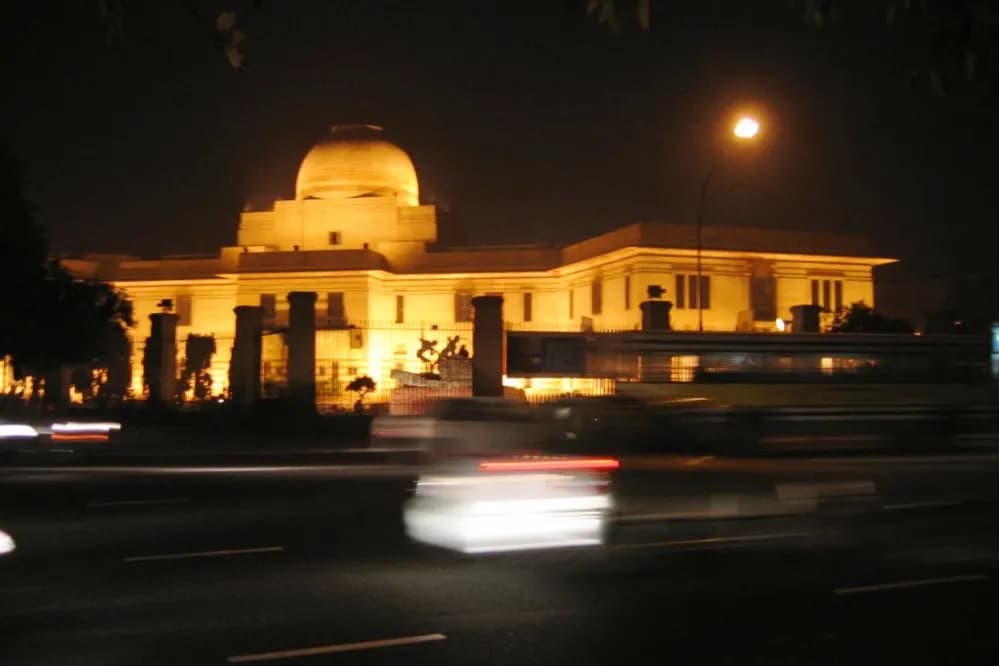
National Gallery of Modern Art (NGMA) Delhi: Timings and Guide
Visiting the National Gallery of Modern Art (NGMA) in Delhi? Timings, entry fee, the collection, Jaipur House, the sculpture garden and nearest metro.
In a Nutshell
“The National Gallery of Modern Art or NGMA, is India's premier art museum, housed in the stately Jaipur House beside India Gate in New Delhi. Opened in 1954, it holds a vast collection of over 17,000 works tracing the evolution of Indian art since 1857, including masterpieces by national treasure artists such as Raja Ravi Varma and Amrita Sher-Gil. With its heritage palace wing, a large modern wing and a sculpture garden, it is a calm cultural sanctuary. It charges a modest ticket, is closed on Mondays and is reached easily from Khan Market metro. It features on our Delhi tours, run by a unit of Experience My India.”
The National Gallery of Modern Art is one of Delhi's cultural treasures, a serene and beautiful museum where a royal palace and a sweeping modern gallery together hold the finest collection of modern Indian art in the country. For anyone who loves art or simply wants a quiet, aesthetic escape from the city's rush, it is a delight. Our team at Delhi Agra Tour Packages often suggests it for a calm afternoon near India Gate and it fits well on a cultural Golden Triangle tour through the capital.
I am Abhay Sharma, Delhi born and a Golden Triangle guide since 2015 and I send art lovers here knowing they will not be disappointed, for the collection and the setting are both exceptional. This guide gathers everything I would tell a visitor beforehand, checked against current information, including the timings, the ticket prices, the photography rule and how to reach it.
Details
National Gallery of Modern Art at a glance
| Detail | Information |
|---|---|
| Location | Jaipur House, Shershah Road, near India Gate, New Delhi |
| Opened | 1954 |
| Housed in | Jaipur House, the former winter palace of the Maharaja of Jaipur |
| Collection | Over 17,000 works of Indian art since 1857 |
| Known for | Masters such as Raja Ravi Varma and Amrita Sher-Gil |
| Entry | A modest ticket; closed Mondays |
| Nearest metro | Khan Market (Violet Line), about a 10 minute walk |
| Time needed | About 2 to 3 hours for the wings and garden |
NGMA timings
| Detail | Information |
|---|---|
| Open | 11:00 AM to 6:00 PM |
| Closed | Mondays and national public holidays |
| Time needed | Around 2 to 3 hours |
The gallery is open from 11:00 AM to 6:00 PM and is strictly closed on Mondays and national public holidays, so plan around that Monday closure. Timings can change, so reconfirm and allow two to three hours to do justice to the wings and the sculpture garden.
NGMA entry fee
| Visitor | Fee (at the time of writing, reconfirm) |
|---|---|
| Indian citizens | Around ₹20 per adult |
| Indian students | Around ₹10 per person |
| Foreign nationals | Around ₹500 per person |
| Children and school groups up to 18 | Free with valid institutional photo ID |
How to reach NGMA
| From | Route |
|---|---|
| Khan Market metro (Violet Line) | About a 10 minute walk or a short auto |
| Central Secretariat metro | A nearby alternative, then a short auto |
| India Gate | A few minutes away on the same circle |
| By cab or auto | Drops at the Shershah Road gates, with free parking |
What is the National Gallery of Modern Art?
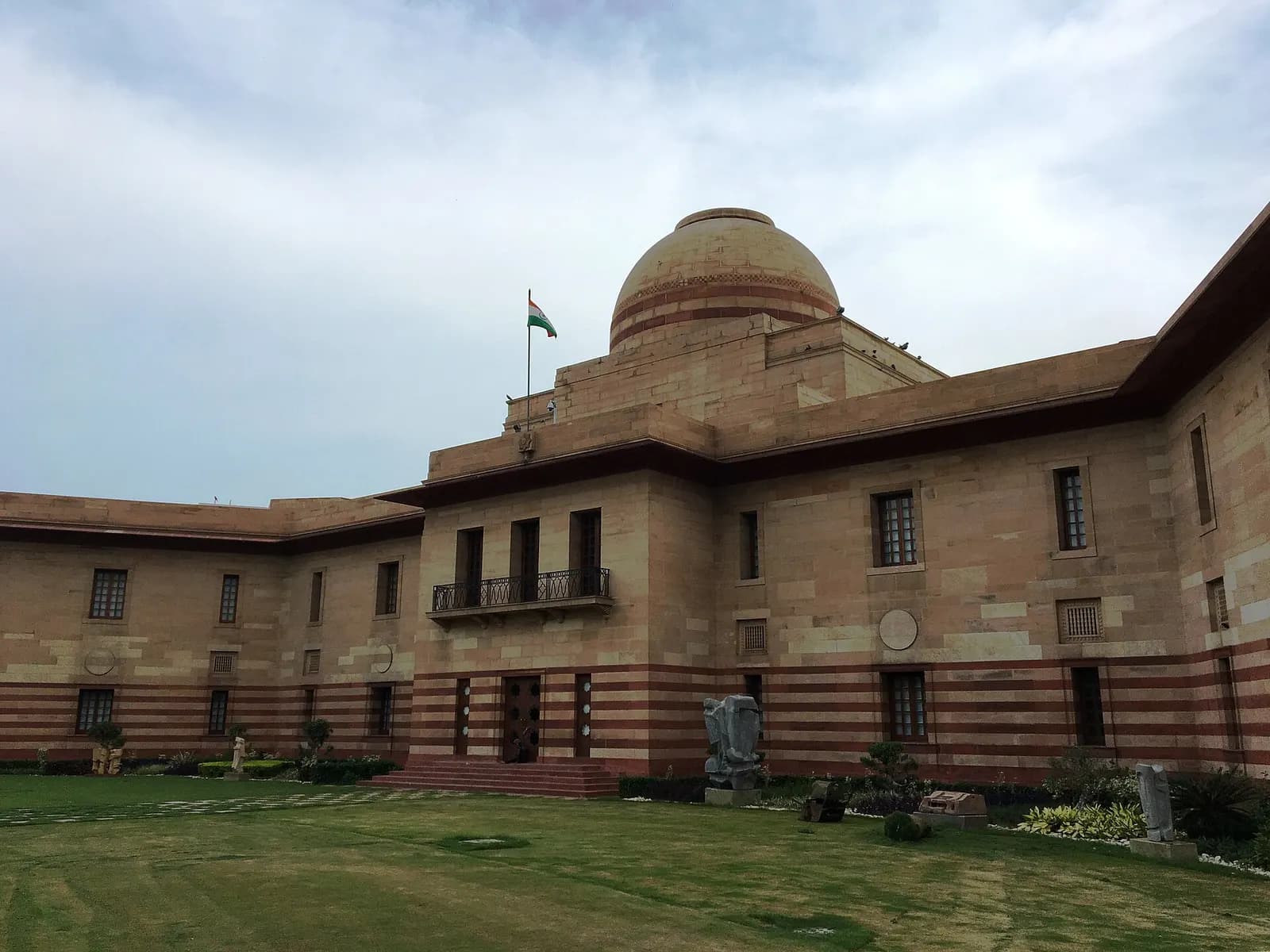
The National Gallery of Modern Art, universally known as NGMA, is India's foremost museum of modern art, the apex cultural institution of its kind, run by the Ministry of Culture. It is housed in Jaipur House, a grand former royal residence beside India Gate in the ceremonial heart of New Delhi and it holds a vast permanent collection of over 17,000 individual works that together trace the evolution of Indian art from around 1857 to the present day. Combining a heritage palace wing with an expansive modern wing and a sculpture garden, it offers a sweeping journey through more than a century and a half of Indian painting, sculpture and visual art, in a setting that is itself beautiful and calm.
Several things make it special and they are worth drawing out:
- India's premier modern art collection. Over 17,000 works charting Indian art since 1857, the most important collection of its kind in the country.
- The masters of Indian art. Landmark works by the celebrated national treasure artists, including Raja Ravi Varma, Amrita Sher-Gil, Rabindranath Tagore, Nandalal Bose and Jamini Roy.
- A royal palace setting. Housed in Jaipur House, the former winter palace of the Maharaja of Jaipur, a fine building in its own right.
- A sculpture garden. A peaceful green lawn around the palace exhibiting striking outdoor sculptures and installations.
- A calm cultural sanctuary. A quiet, aesthetic escape from the rush of central Delhi, loved by art lovers and casual visitors alike.
It is one of the most rewarding of the things to do in Delhi for anyone with a cultural bent and a significant stop among the important monuments of Delhi.
History of the National Gallery of Modern Art
The National Gallery of Modern Art was formally opened to the public in 1954, inaugurated by the then Vice President, Dr S. Radhakrishnan, as part of the young nation's effort to preserve and celebrate its artistic heritage. It was established to collect, conserve and display the modern art of India and over the decades it has grown into the apex institution of its kind, governed by the Ministry of Culture, with sister galleries later opened in other cities. Its collection, now numbering over 17,000 works, was built up to document the development of Indian art from the mid nineteenth century onward, roughly from 1857, through the colonial period, the national movement and the decades since independence.
The choice of Jaipur House as the home for the gallery was fitting. The building was originally the grand winter palace residence of the Maharaja of Jaipur, one of several princely mansions built around India Gate in the imperial capital planned under the British. After independence, the palace was repurposed to house the national art collection, giving the gallery both a dignified setting and a place among the ceremonial buildings of New Delhi. In later years a large new wing was added to vastly expand the exhibition space and bring the facilities up to international museum standards. Knowing this history, that a maharaja's palace became the nation's gallery of modern art, adds to the pleasure of a visit, for you are walking through a building that is itself a piece of Delhi's layered story.
The art collection at NGMA Delhi
The heart of NGMA is of course its collection, which is the finest survey of modern Indian art anywhere. Spanning from around 1857 to the present, it charts the evolution of Indian painting and sculpture through the colonial encounter, the Bengal School, the rise of modernism and the art of independent India, so that a thoughtful visit is a journey through the visual history of the nation. The gallery permanently showcases landmark works by the artists often grouped as the great masters or national treasures of Indian art, whose most important works are protected as national treasures.
Among the celebrated names represented here are:
- Raja Ravi Varma, the pioneering painter who fused European technique with Indian subjects and mythology.
- Amrita Sher-Gil, one of the most important modern Indian painters, known for her evocative depictions of Indian life.
- Rabindranath Tagore, the Nobel laureate whose paintings reveal another side of his genius.
- Nandalal Bose, a leading figure of the Bengal School and a major influence on modern Indian art.
- Jamini Roy, celebrated for his bold, folk inspired style.
Beyond these, the collection holds thousands of works across painting, sculpture, graphic art and photography, representing the sweep of modern Indian creativity. Because only a portion can be displayed at any one time, the galleries are rotated and complemented by special exhibitions, so there is usually something new to see. For anyone with even a passing interest in art, standing before original works by these masters, rather than reproductions, is a genuine privilege and the reason the gallery draws visitors from around the world.
NGMA architecture and Jaipur House
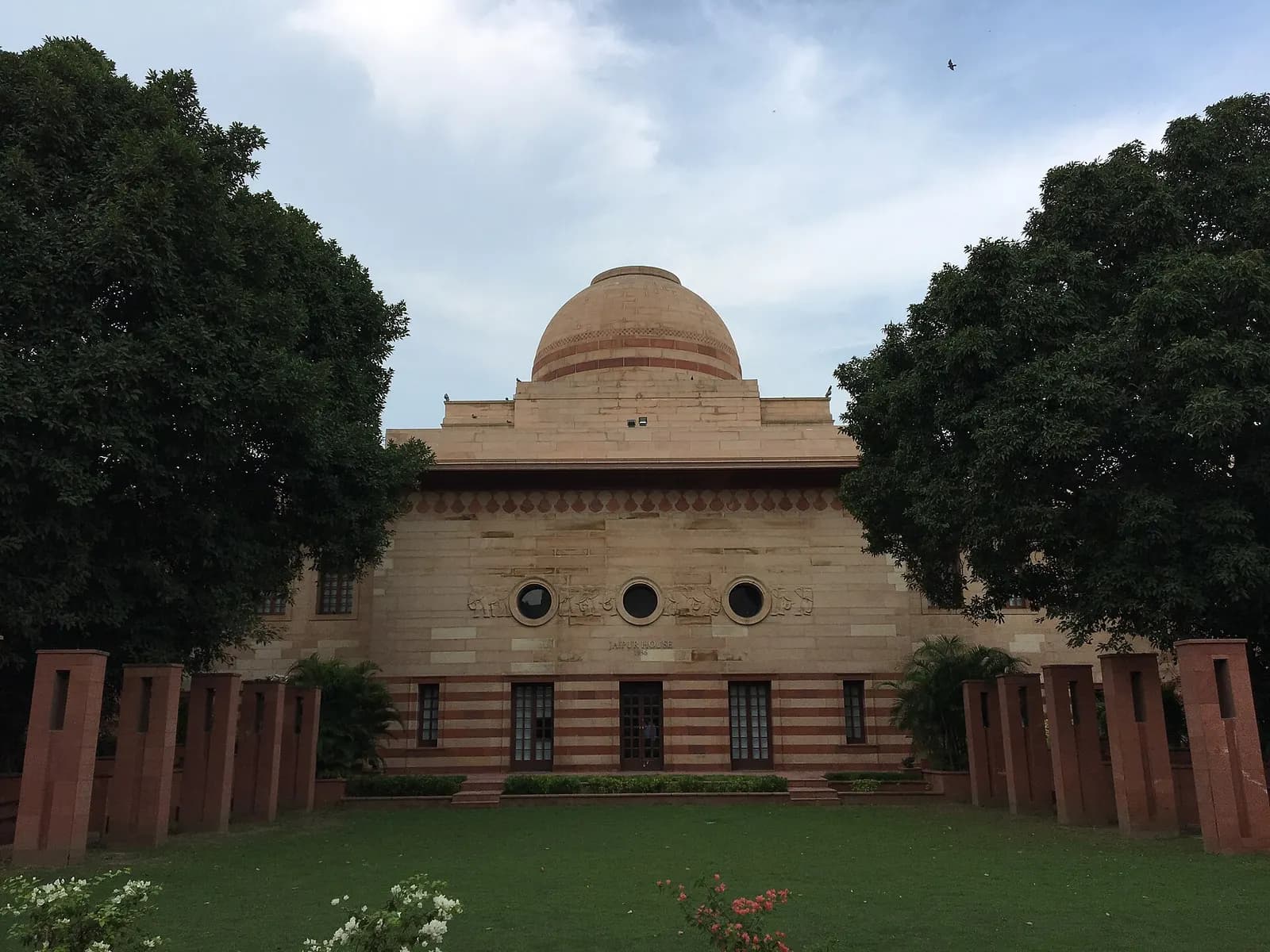
The gallery's setting is as much a part of the experience as the art, for it occupies two contrasting but complementary buildings. The original home is Jaipur House itself, designed by the British architect Arthur Blomfield in a distinctive butterfly shaped plan topped by a large central neo classical dome. The design fuses the colonial Lutyens style of imperial New Delhi with traditional Indian features such as chhatris, the small domed pavilions that crown so many Indian buildings, giving the palace a character that is both grand and rooted in place. It is one of several princely houses laid out around India Gate and its graceful form is a landmark in its own right.
The two wings offer very different atmospheres:
- The Jaipur House heritage wing. The historic palace rooms, with wood panelled royal hallways, fireplaces and classical arched windows, showcasing the early modern masters in an intimate, period setting.
- The new wing. A large modern addition rising across four floors with around 12,000 square metres of exhibition space, featuring clean white walls, open glass stairwells and climate controlled track lighting for the art.
Moving between the two, from the cosy, panelled rooms of the palace to the airy, contemporary galleries of the new block, is part of the pleasure of a visit and it reflects the gallery's own span from the historic to the modern. The architecture, old and new together, makes NGMA one of the more beautiful museum experiences in the country.
The sculpture garden at NGMA
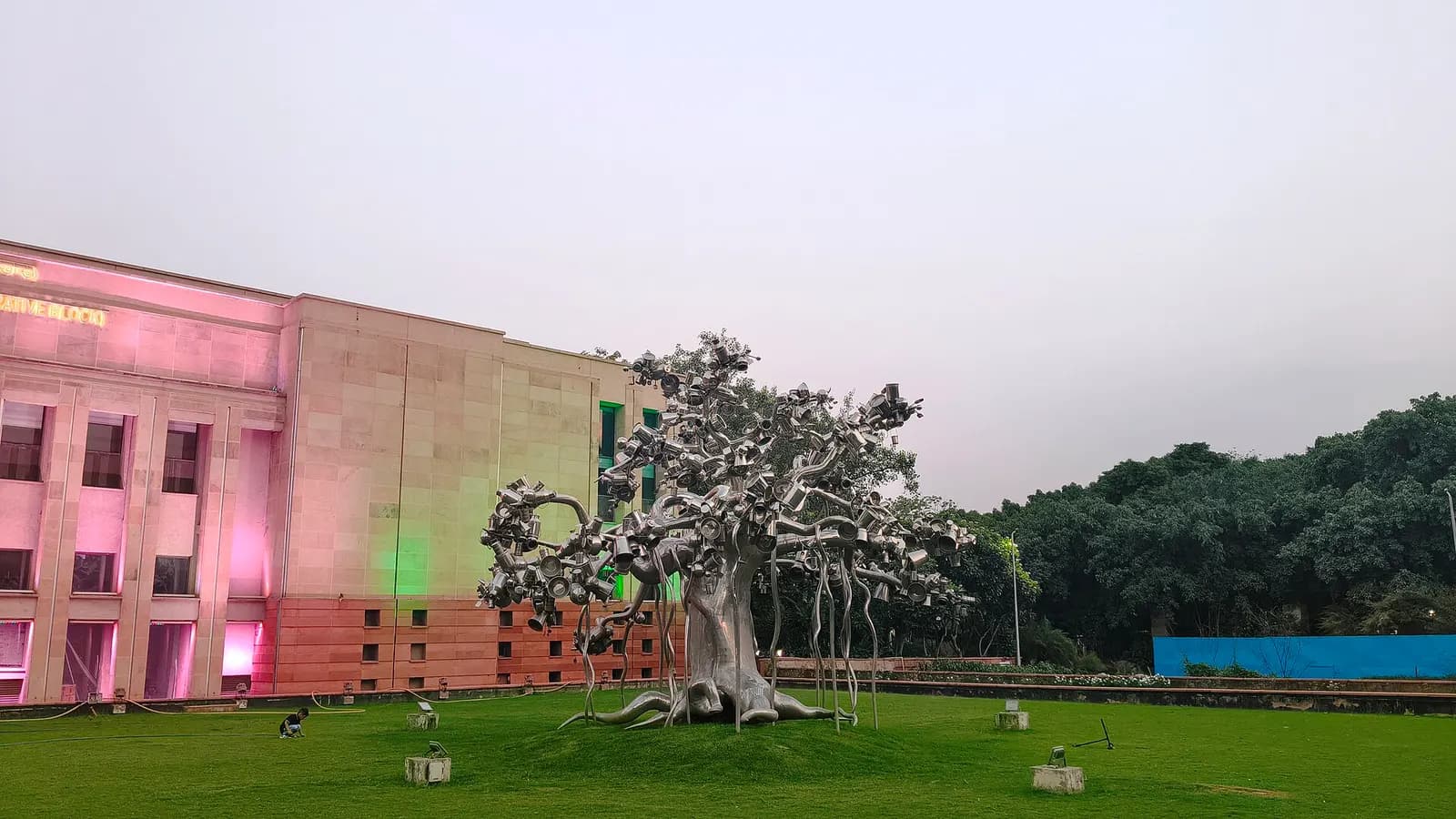
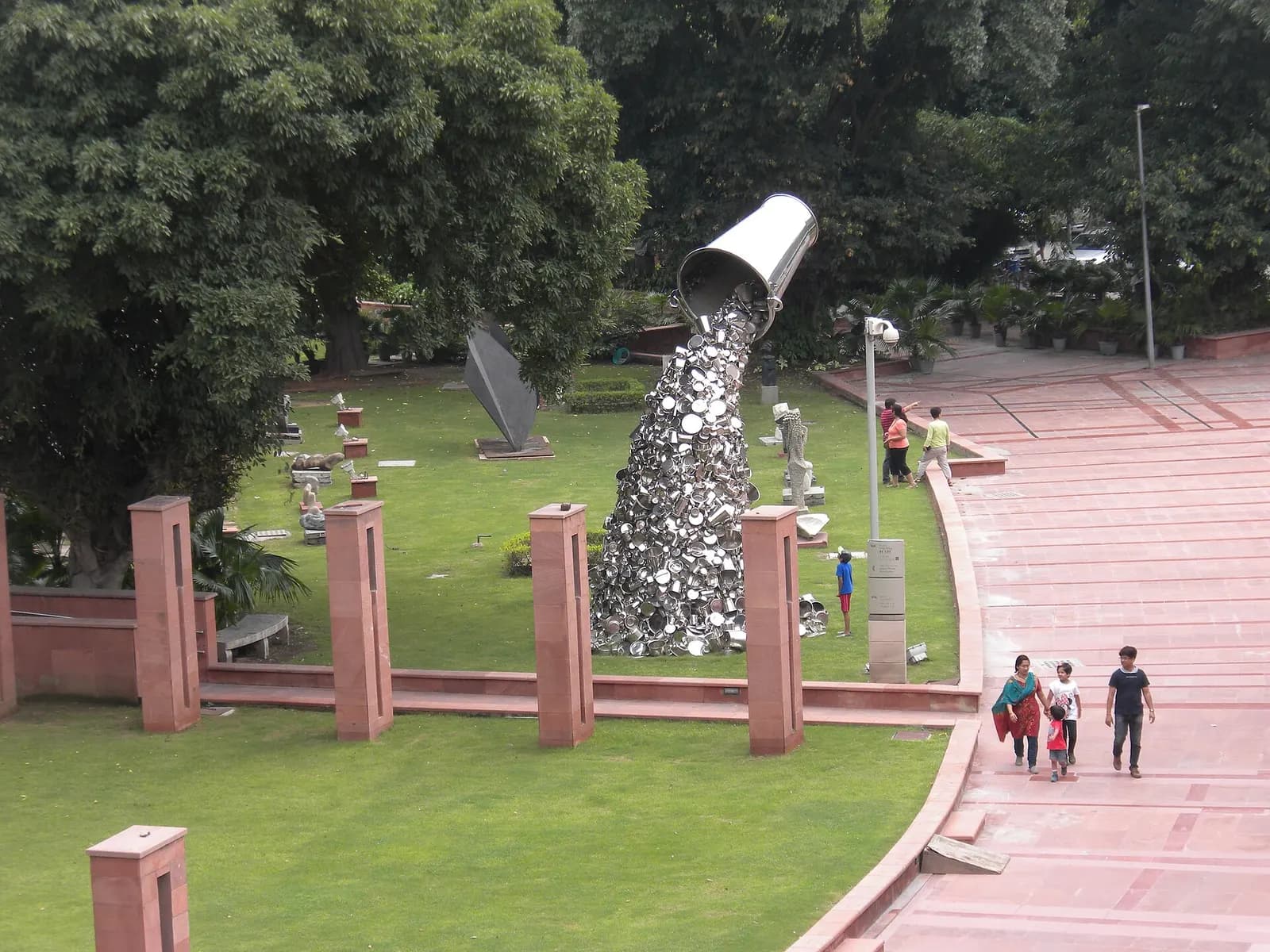
Surrounding the palace compound is a peaceful, sprawling green lawn that serves as an outdoor sculpture garden and it is a highlight in its own right. Here, among the greenery, stand towering outdoor metal installations, stone works and contemporary sculptures, so that art spills out of the galleries and into the open air. A major focal point is a famous large stainless steel sculpture in the form of a banyan tree, created entirely from kitchen utensils by the renowned contemporary artist Subodh Gupta, a striking and much photographed work that captures the inventive spirit of modern Indian art. The sculpture garden is a lovely place to wander and rest and, unlike the indoor galleries, photography is freely allowed here, so it is where most visitors take their pictures. On a pleasant day, strolling the lawns among the sculptures, with the dome of Jaipur House rising behind, is one of the calmest and most enjoyable experiences the gallery offers and it rounds out a visit beautifully.
Things to see at the National Gallery of Modern Art
A visit divides naturally among the two wings and the garden and each deserves time:
- The heritage wing masters. The early modern masters displayed in the period rooms of Jaipur House, including works by the great names of Indian art.
- The new wing galleries. The four floors of the modern block, with their rotating displays and special exhibitions across the sweep of modern Indian art.
- The sculpture garden. The outdoor lawns with their installations, including the famous utensil banyan tree, where photography is allowed.
- The architecture itself. The butterfly plan, central dome and chhatris of Jaipur House, worth appreciating as you move between the wings.
- The facilities. The art reference library, the auditorium and the cafe, for those who wish to linger.
Allow two to three hours to take in the wings and the garden at a thoughtful pace, more if there is a major special exhibition on or if you wish to use the library or cafe. Because photography is not allowed in the indoor galleries, this is a visit to experience with your eyes, which many art lovers find a welcome focus.
What to expect at NGMA
A visit to NGMA feels worlds away from the bustle of central Delhi and knowing what to expect helps you settle into it. You enter through the gates off Shershah Road into the calm compound, pass a security check, buy your modest ticket and step into a hush that is rare in the city. The galleries are cool, quiet and softly lit, the floors polished, the walls hung with works that span more than a century of Indian art and attendants keep the spaces orderly and serene. In the heritage wing of Jaipur House the atmosphere is intimate, the art set among panelled rooms and arched windows, while the new wing opens out into airy, white walled contemporary galleries across several floors. Moving between the two is like moving through time and the whole experience is contemplative rather than crowded.
Most visitors take the galleries slowly, pausing before the famous works, then step out into the sculpture garden to see the outdoor installations and take their photographs, perhaps finishing with a coffee at the cafe. The pace is unhurried and because the indoor photography ban keeps phones in pockets, people actually look at the art rather than rushing to capture it, which gives the place a focused, respectful feel. It is the kind of museum where art students sketch in corners, where couples and families drift quietly from room to room and where an hour can easily stretch to three. Many visitors arrive with only a passing interest and leave genuinely impressed by the depth and beauty of the collection. It is a place to slow down and absorb and for anyone with an eye for art it is one of the most satisfying stops in the capital.
Why NGMA matters for Indian art
Part of what makes a visit meaningful is understanding the gallery's place in the story of Indian art. The period the collection covers, from around 1857 onward, was one of profound change, as Indian artists absorbed European techniques, revived indigenous traditions, responded to the freedom movement and finally forged the confident modern art of an independent nation. NGMA holds the works that chart that journey, so walking its galleries is a way of seeing how India saw itself across more than a century and a half, from the mythological canvases of the early masters to the experiments of the modernists. The fact that the most important works of the great masters are protected as national art treasures underlines their significance and NGMA is where many of them can be seen together. For students, researchers and art lovers it is an essential institution and for the general visitor it offers a rare chance to understand modern India through its art rather than only its monuments. This deeper significance is why the gallery, though quieter than the city's famous forts and temples, deserves its place among Delhi's cultural treasures.
NGMA timings and entry fee
The National Gallery of Modern Art is open from 11:00 AM to 6:00 PM and is closed on Mondays and national public holidays, so be sure not to plan your visit for a Monday. The entry fee is modest: at the time of writing, around ₹20 for Indian adults and ₹10 for Indian students, around ₹500 for foreign nationals and free for children and school groups up to the age of eighteen with a valid institutional photo ID. These figures are current at the time of writing and can be revised, so reconfirm at the ticket counter. There is free parking on site within the main gates, a welcome convenience in central Delhi. Allow two to three hours for a proper visit across the two wings and the sculpture garden. As with all timings and prices, treat these as a current guide and reconfirm before a special trip.
Rules and photography policy at NGMA
The most important rule to know is the photography policy, which catches some visitors by surprise:
- No photography indoors. Photography and videography are strictly prohibited inside the indoor gallery rooms and security staff actively enforce this throughout the hallways.
- Photography allowed in the garden. Out in the open sculpture garden lawns, visitors are free to take photos, so that is where to use your camera.
- Do not touch the art. As in any gallery, keep a respectful distance from the works.
- Keep it quiet. The gallery is a calm, contemplative space, so keep voices low.
- Bags and large items. Expect a security check and cloak arrangements for large bags at the entrance.
Knowing the indoor photography ban in advance saves disappointment and many visitors find that putting the camera away lets them engage more fully with the art. Save your photography for the sculpture garden, where the famous outdoor works make fine subjects.
Facilities and accessibility at NGMA
NGMA is a well equipped, modern institution and its facilities add to the experience for those who wish to linger. The campus includes a large art reference library, valuable for students and researchers, a preview theatre and a sizable auditorium that hosts cultural talks and panel discussions, a souvenir gift shop selling canvas prints and art books and a stylish cafe for a break between the wings. On accessibility, the entire new block is well provided for, with ramps, accessible restrooms and elevators giving smooth wheelchair access across all the floors, making the modern galleries easy to navigate for visitors with limited mobility. Combined with the free on site parking, these facilities make NGMA a comfortable and visitor friendly museum, suitable for a relaxed half day. Whether you come purely for the art or to attend a talk, use the library or simply enjoy the cafe and garden, the gallery is set up to make the visit easy and pleasant.
Best time to visit the National Gallery of Modern Art
The best time to visit is a weekday late morning or early afternoon, soon after the 11:00 AM opening, when the galleries are quietest and you have the clearest run of the collection before the day fills up. Weekends are busier, especially if a popular special exhibition is on. Above all, avoid Mondays and national holidays, when the gallery is closed. In terms of season, because the galleries are air conditioned, NGMA is a comfortable indoor refuge year round, which makes it an excellent choice on a hot or rainy day when the open air monuments are less appealing; the sculpture garden, though, is most pleasant in the cooler months from October to March. A weekday visit in the cooler season, allowing time for both the indoor wings and the garden, is close to ideal. Our guide to the best time to visit Delhi sets out the seasons across the city in more detail.
How to reach NGMA Delhi (nearest metro)
NGMA stands in Jaipur House on Shershah Road, right on the India Gate circle in central New Delhi and it is easy to reach. The nearest metro station is Khan Market on the Violet Line, from which it is about a ten minute walk or a brief auto-rickshaw hop to the Shershah Road gates and Central Secretariat is another convenient station nearby. The gallery is just off the India Gate circle, so if you are already at India Gate it is only a few minutes away. App cabs and autos can drop you at the gates and there is free parking on site if you drive. Being so central, it slots neatly into a plan of the imperial quarter and a guided New Delhi tour can fold it in alongside the surrounding landmarks, while a broader Delhi day tour ties it into the full span of the capital.
Places to visit near the National Gallery of Modern Art
NGMA sits in the ceremonial heart of New Delhi, so it is easy to build a half day around it. Right beside it is the iconic India Gate, the great war arch and lawns, the natural companion to the gallery and the central ring holds a cluster of further sights within easy reach: the great circle of Connaught Place, the ancient stepwell of Agrasen ki Baoli, the astronomical Jantar Mantar, the much loved Pracheen Hanuman Mandir and the serene Bangla Sahib Gurudwara.
A little further out, the capital's great monuments are an easy ride away: the mighty Red Fort, the towering Qutub Minar, the serene Humayun's Tomb, the old fort of Purana Qila and the modern Lotus Temple and Akshardham. Together these make NGMA a cultured anchor for exploring the whole city.
NGMA in your Delhi itinerary
For most visitors, NGMA works best as a calm, cultural stop of a couple of hours within a central New Delhi circuit, easily paired with India Gate, which is right beside it. A pleasant plan is to see India Gate and the ceremonial avenues, then step into the cool galleries for the art, finishing with a wander in the sculpture garden and a coffee at the cafe. Because it is indoors and air conditioned, it also makes an ideal refuge in the heat of the day or in bad weather, when the open monuments are less appealing, so it pairs well with early morning and evening outdoor sightseeing. Those on a fuller itinerary often combine a central New Delhi day like this with an Old Delhi morning of the Red Fort and the bazaars, giving a balanced span of the city.
If Delhi is your gateway to the wider Golden Triangle, NGMA adds a cultural and artistic dimension to a trip otherwise focused on architecture and history, a chance to see how Indian creativity evolved into the modern age. Many of my guests with an interest in art rate it among their favourite Delhi stops and it offers a thoughtful, quiet counterpoint before the journey on to the monuments of Agra and Jaipur.
Travel tips for visiting NGMA
A few pointers make the visit smoother and more rewarding:
- Never come on a Monday, when the gallery is closed and allow 2 to 3 hours.
- Visit on a weekday late morning, soon after the 11:00 AM opening, for the quietest galleries.
- Save your camera for the garden, as photography is banned in the indoor galleries but allowed outdoors.
- Use it as a hot or rainy day refuge, since the galleries are air conditioned.
- Enjoy the sculpture garden, including the famous utensil banyan tree, in the cooler months.
- Make use of the facilities, the library, auditorium, gift shop and cafe, if you wish to linger.
- Carry a valid ID for students and school groups to claim the concession or free entry.
- Combine it with India Gate, which is right beside it, for a full central Delhi half day.
If you would like a local guide to build NGMA into a wider Delhi plan, message our team on WhatsApp at +91 7302265809 with your travel dates and group size and we will shape the day for you.
Is the National Gallery of Modern Art worth visiting?
For the right visitor, very much so. If you have any interest in art, it is close to essential, holding the finest collection of modern Indian art in the country, with original works by the great masters in a beautiful palace and modern setting. Even for the general sightseer, it offers a calm, cultured and air conditioned break from the city's monuments, with a lovely sculpture garden and a stylish cafe and the modest ticket makes it easy to include. The honest note is that it is a museum, best approached with time and attention rather than as a quick photo stop and those with no interest in art may prefer to spend their limited Delhi hours elsewhere. But for art lovers, culturally curious travellers and anyone wanting a peaceful, aesthetic hour or two near India Gate, it is one of the city's real pleasures and I recommend it warmly to guests with that bent.
Plan your trip with us
At Experience My India, through our Delhi and Golden Triangle travel desk, we design unhurried, well paced trips that make room for cultural gems like NGMA, not just the headline monuments and we time indoor stops like this for the heat of the day so your schedule flows. Whether you want a relaxed set of Delhi Agra tours or a full Golden Triangle route through Delhi, Agra and Jaipur, we plan around your pace, your interests and the right season, with local guides who know the city's art and history. Share your dates and the kind of trip you have in mind through our enquiry page, tell us your group size and we will put together an honest, tailored plan rather than a rushed checklist.
Related guides
- Places to visit in Delhi, for the wider picture
- Hidden places to visit in Delhi, the city's quieter corners
- Nearby places to visit in Delhi, to extend your trip
Enquire Now
Ready to Explore
The Heart of Delhi?
Explore the Red Fort, Qutub Minar, Humayun's Tomb, and the vibrant streets of Old Delhi with our expert-guided premium tours of India's capital city.

Delhi
Premium Tour Package
Questions
Frequently asked questions
What are the timings of the National Gallery of Modern Art?
It is open from 11:00 AM to 6:00 PM and is closed on Mondays and national public holidays. Reconfirm, as timings can change.
What is the entry fee for NGMA Delhi?
Which is the nearest metro station to NGMA?
When was the National Gallery of Modern Art opened?
What is in the NGMA collection?
Can I take photos inside NGMA?
Is NGMA closed on Mondays?
What is the sculpture garden at NGMA?
How much time do I need at NGMA?
Is the National Gallery of Modern Art worth visiting?
Explore more
Plan your National Gallery of Modern Art (NGMA) trip with us

Interested in National Gallery of Modern Art (NGMA) Delhi: Timings and Guide?
Chat with our travel team for a custom quote, or browse every package.
Related Attractions
9Ready to explore National Gallery of Modern Art (NGMA) Delhi: Timings and Guide?
Book your private tour today and experience the magic of India's rich heritage.