
National War Memorial Delhi: Timings and Visitor Guide
Visiting the National War Memorial near India Gate? Timings, free entry, the four chakras, the eternal flame, the Retreat ceremony and nearest metro.
In a Nutshell
“The National War Memorial in New Delhi is a solemn 40 acre complex beside India Gate, dedicated to the nation in 2019 to honour the soldiers of the Indian Armed Forces who died in service since independence. Its four concentric circles carry an eternal flame and the names of more than 26,000 fallen personnel etched in gold on granite tablets. It is free to enter, open daily, hosts a moving sunset ceremony and is now the site of the nation's ceremonial wreath laying. It features on our Delhi tours, run by a unit of Experience My India.”
The National War Memorial is one of Delhi's most dignified and moving places, a thoughtfully designed tribute set among the lawns behind India Gate, where the eternal flame burns for the country's fallen soldiers. Visiting it, especially around the daily Retreat ceremony at sunset, is a quietly powerful experience. Our team at Delhi Agra Tour Packages often pairs it with India Gate and the central avenues and it sits naturally on a Golden Triangle tour through the capital.
I am Abhay Sharma, Delhi born and a Golden Triangle guide since 2015 and I always bring guests here with a word about its meaning, because it is a place to feel rather than just to see. This guide gathers everything I would tell a visitor beforehand, checked against current information, including the timings, the free entry, the ceremonies and how to reach it.
Details
National War Memorial at a glance
| Detail | Information |
|---|---|
| Location | C Hexagon, beside India Gate, central New Delhi |
| Dedicated | 2019, to the nation |
| Honours | Armed forces personnel fallen since independence |
| Known for | The eternal flame, four chakras, over 26,000 names |
| Size | Spread across about 40 acres |
| Entry | Free for everyone, no booking needed |
| Nearest metro | Central Secretariat or Khan Market |
| Time needed | About 1 to 1.5 hours, longer for the ceremony |
National War Memorial timings
| Season | Timings |
|---|---|
| Winter | 9:00 AM to 7:30 PM, last admission 7:00 PM |
| Summer | 9:00 AM to 8:30 PM, last admission 8:00 PM |
| Retreat ceremony | A solemn drill at sunset daily |
| Change of Guard | Sunday evenings |
The memorial is open daily, from 9:00 AM to 7:30 PM in winter with last admission at 7:00 PM and from 9:00 AM to 8:30 PM in summer with last admission at 8:00 PM. Timings can change, so reconfirm and try to be there for the moving Retreat ceremony at sunset.
National War Memorial entry fee and rules
| Item | Information |
|---|---|
| Entry fee | Free for everyone, no advance ticket needed |
| Phones and cameras | Smartphones and compact cameras allowed, on silent |
| Not allowed | Professional rigs, large lenses, tripods and drones |
| Conduct | A solemn site; no picnicking, food or lounging on grass |
How to reach National War Memorial
| From | Route |
|---|---|
| Central Secretariat metro (Yellow and Violet) | A short walk or auto to the C Hexagon |
| Khan Market metro (Violet Line) | A short walk or auto-rickshaw |
| India Gate | Adjacent, a few minutes on foot |
| By cab or auto | Drops near the C Hexagon circle |
What is the National War Memorial?
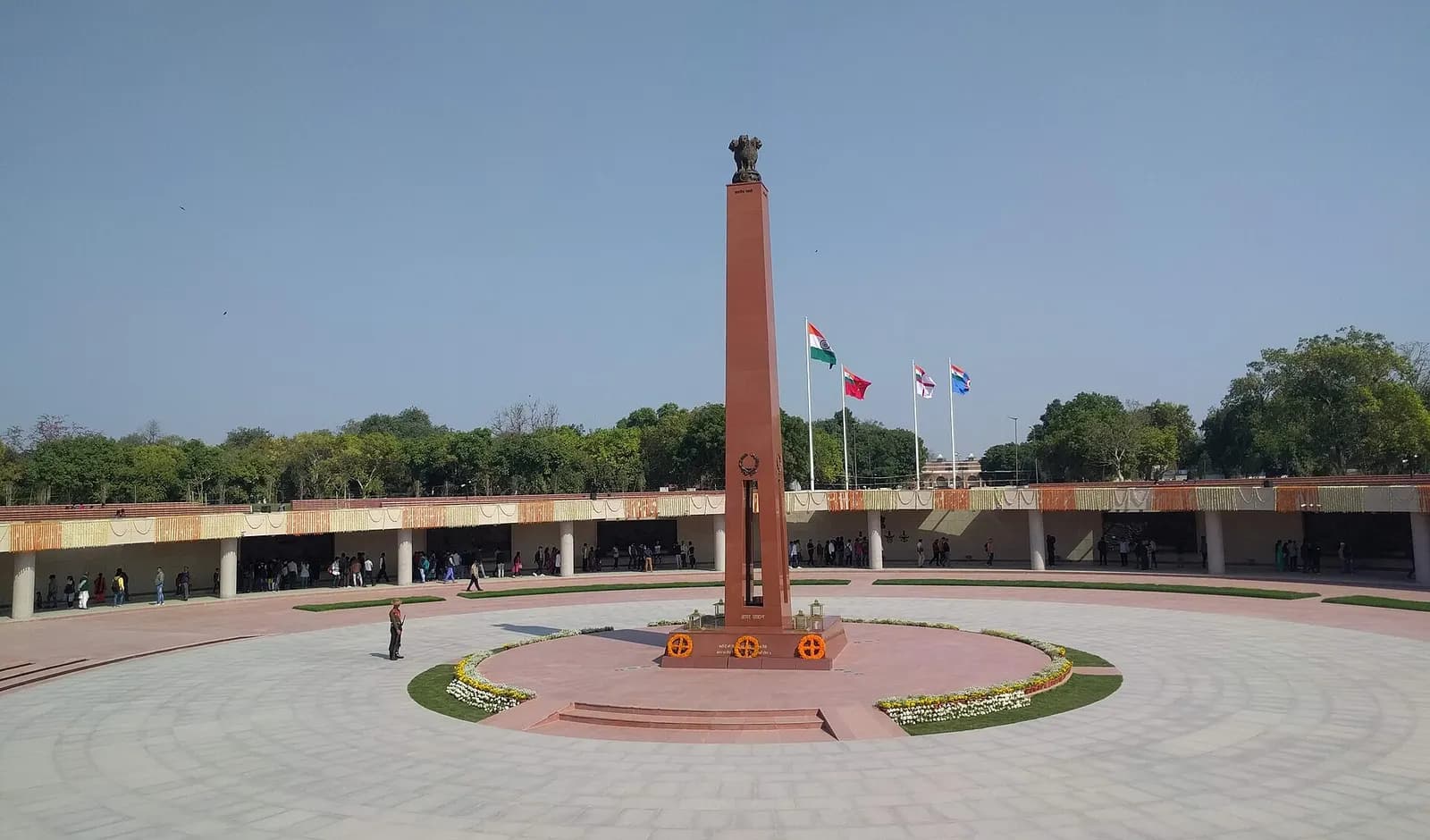
The National War Memorial is India's official monument to the soldiers, sailors and airmen of the Indian Armed Forces who have laid down their lives in the service of the nation since independence in 1947. Spread across about 40 acres on the C Hexagon beside India Gate, in the ceremonial heart of New Delhi, it was built to give the country a dedicated place to remember and honour its war dead, a role that until recently was filled informally by the India Gate arch itself. The memorial is designed as a series of four concentric circles around a central obelisk, at whose base an eternal flame burns in tribute to the fallen and its walls carry the names of more than 26,000 individual personnel.
Several things make it special and they are worth drawing out:
- A long overdue national tribute. The country's first dedicated memorial to all armed forces personnel fallen since independence, honouring them by name.
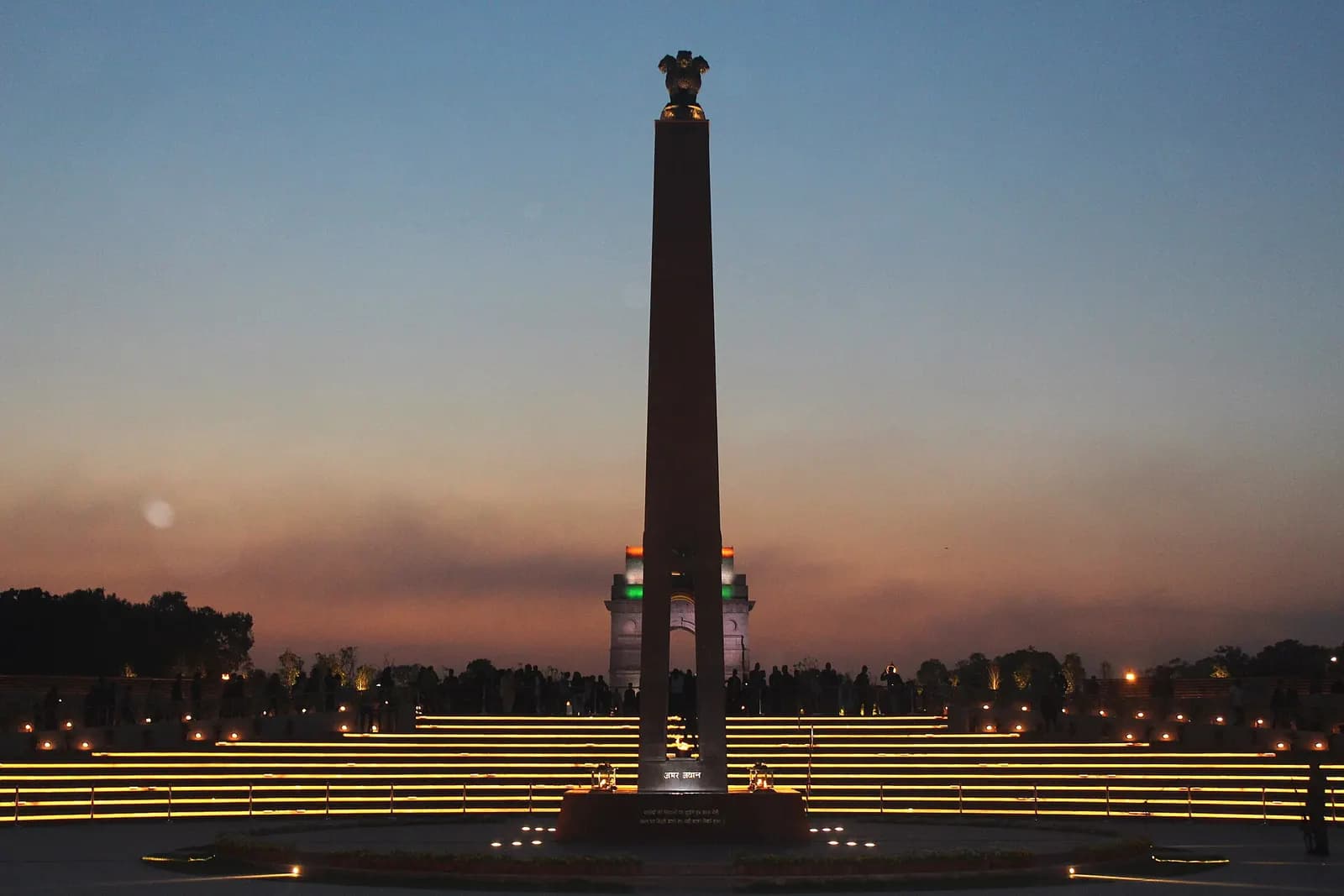
- The eternal flame. A perpetual flame at the base of the central obelisk, now carrying the historic Amar Jawan Jyoti, honouring the immortal spirit of the soldiers.
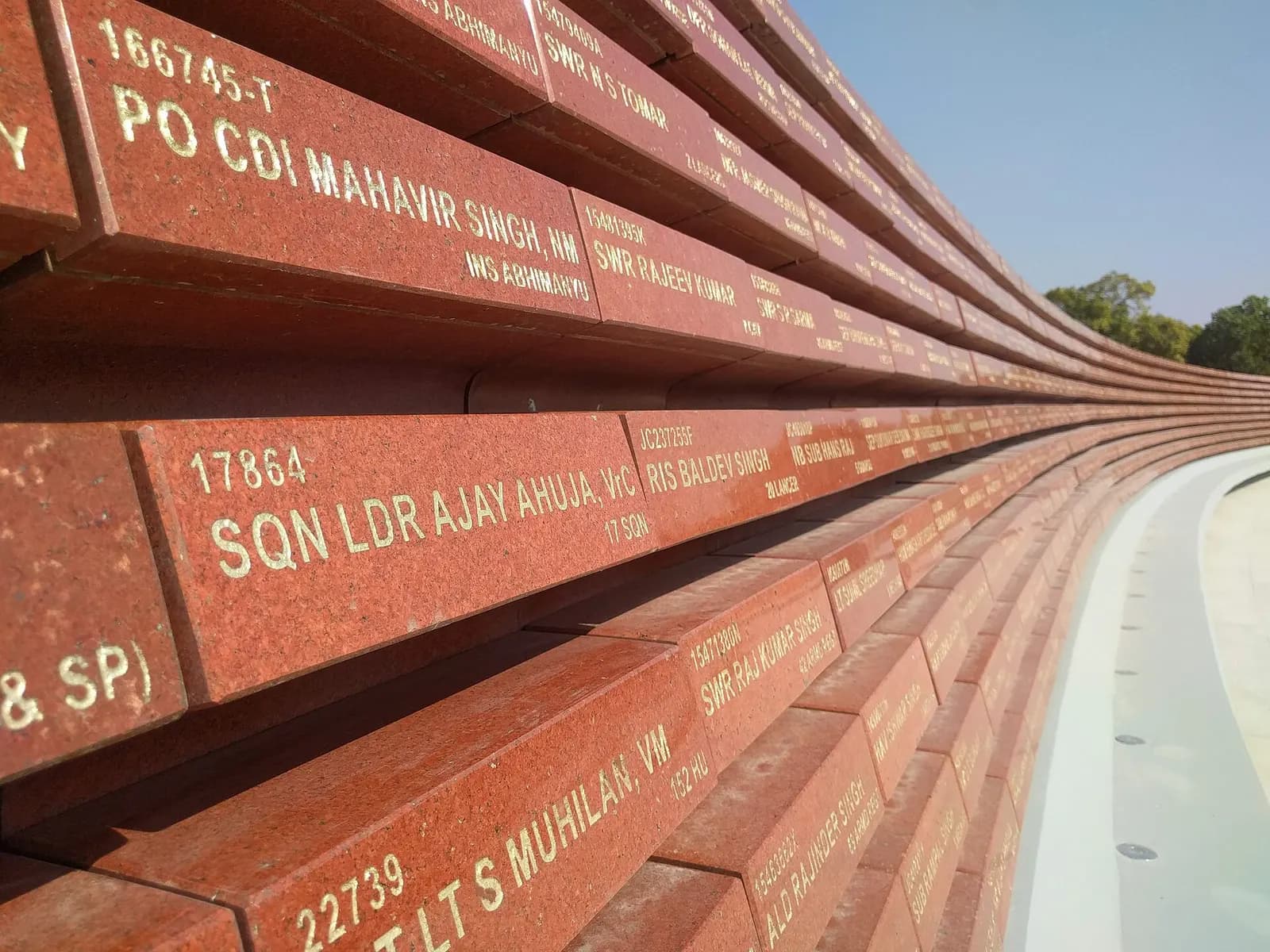
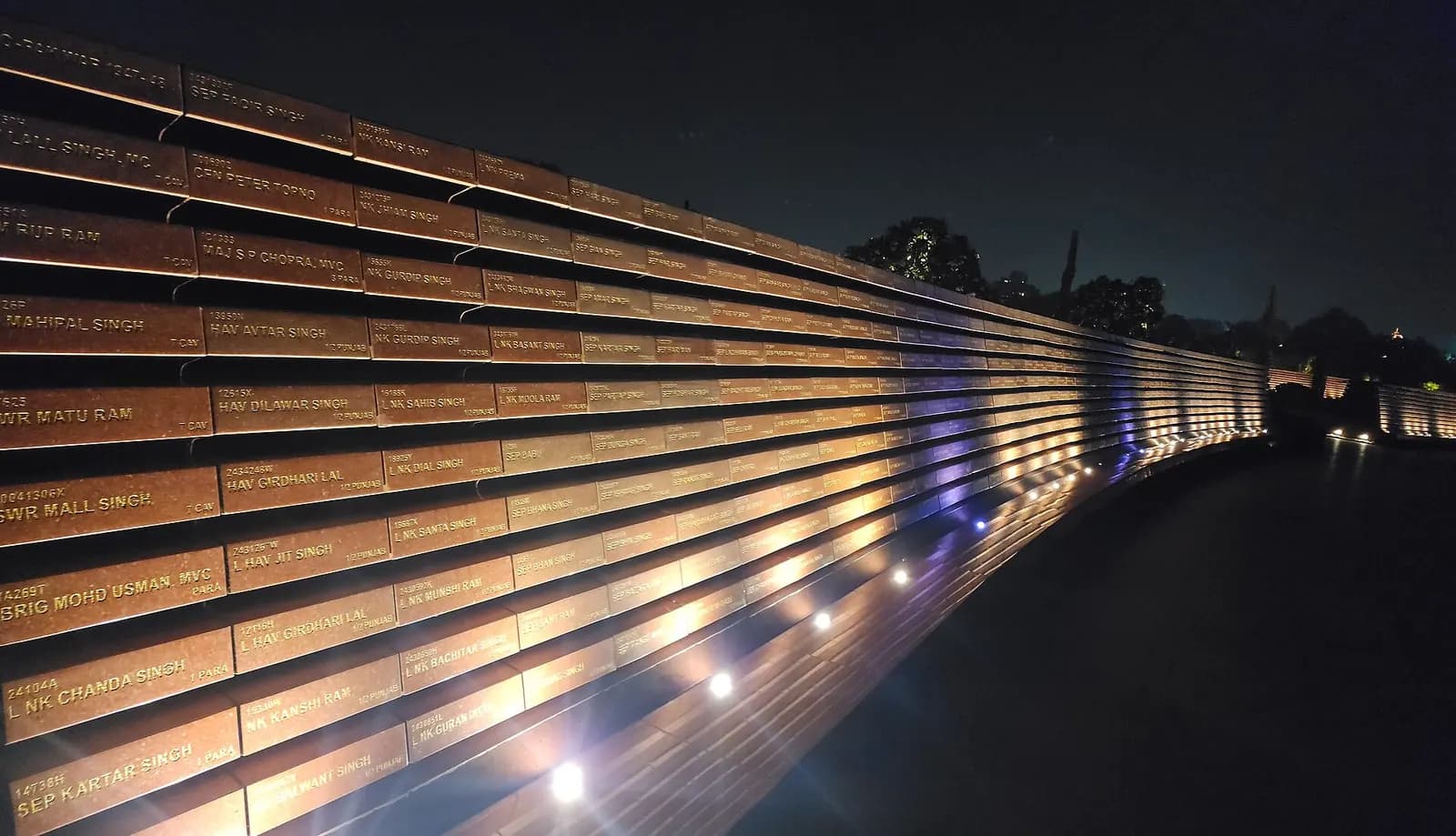
- Over 26,000 names in gold. The names of the fallen etched in golden letters on granite tablets, arranged by the conflicts in which they died.
- A meaningful design. Four concentric circles inspired by a traditional military formation, each with its own symbolism of immortality, bravery, sacrifice and protection.
- A living ceremonial site. The place where the nation now holds its formal wreath laying and where a moving Retreat drill takes place every evening.
It is among the most dignified of the things to do in Delhi and a significant modern addition to the important monuments of Delhi.
History of the National War Memorial
For decades after independence, India had no single national memorial dedicated to the armed forces personnel who died in its post independence wars and operations. The India Gate arch, built by the British to commemorate the Indian soldiers of the First World War and other earlier campaigns, served informally for the purpose and the Amar Jawan Jyoti, a flame of the immortal soldier, was lit beneath its arch in 1972 after the 1971 war. Yet the demand for a proper, dedicated national war memorial grew over many years and the project was finally realised in the 2010s. The memorial was dedicated to the nation on 25 February 2019 by the Prime Minister, giving the country at last a fitting place to honour its modern fallen.
A significant moment came in January 2022, when the Amar Jawan Jyoti flame that had burned under the India Gate arch since 1972 was formally merged with the eternal flame at the National War Memorial, bringing the nation's tribute together at one dedicated site. From that point, the formal ceremonial wreath laying by national, military and visiting international dignitaries, which had traditionally taken place at the India Gate arch, shifted here to the National War Memorial. Today, therefore, this is the focal point of the country's official remembrance of its armed forces, the place where the state honours those who died in service. Knowing this history, that the memorial gathers into one place a tribute that had been informal and scattered before, helps a visitor understand why it carries such weight and why it is treated with such solemnity.
The Amar Jawan Jyoti and the eternal flame
At the heart of the memorial, at the base of the central obelisk, burns an eternal flame honouring the immortal spirit of the fallen soldiers and it is the focal point of any visit. This flame now carries the legacy of the Amar Jawan Jyoti, the flame of the immortal soldier that was first lit beneath the India Gate arch in 1972 to commemorate the soldiers of the 1971 war and which in January 2022 was merged with the flame here, uniting the nation's tribute at this dedicated memorial. The eternal flame is never allowed to go out, symbolising that the sacrifice of the fallen will never be forgotten and standing before it, with the names of thousands of soldiers inscribed around, is a genuinely moving experience. It is the point at which the abstract idea of national sacrifice becomes something present and personal and most visitors find themselves pausing here in quiet reflection. Whatever one's views on history or politics, the flame speaks simply of lives given in service and it is the still centre around which the whole memorial turns.
National War Memorial architecture and the four chakras
The design of the National War Memorial is thoughtful and symbolic, drawing architectural inspiration from the Chakravyuh, a concentric military formation from ancient Indian tradition. The memorial is laid out as four concentric circles, each called a chakra and each carrying its own meaning, radiating out from the central flame. The effect is both grand and contemplative, a design that invites you to move inward through layers of symbolism towards the eternal flame at the core.
The four chakras, from the centre outward, are worth understanding:
- Amar Chakra, the circle of immortality. The innermost ring, housing the central obelisk, around 15.5 metres tall, at whose base the eternal flame burns for the immortal spirits of the fallen.
- Veerta Chakra, the circle of bravery. A covered gallery featuring six large bronze murals by noted sculptors, depicting famous battles fought by the Army, Navy and Air Force.
- Tyag Chakra, the circle of sacrifice. Concentric circular walls of granite tablets, each tablet representing a fallen soldier, with the names and details arranged chronologically by conflict.
- Rakshak Chakra, the circle of protection. The outermost ring, formed of more than 600 dense rows of trees, symbolises the protective wall of soldiers who guard the nation's borders.
This layered design means a visit is not just a look at a monument but a walk through an idea, from the living wall of trees that stands for the guarding soldiers, inward past the names and the battle murals, to the flame of immortality at the centre. It is one of the most meaningful contemporary monument designs in the country.
Things to see at the National War Memorial
A visit divides naturally among the four chakras, the flame and the adjoining Param Yodha Sthal and each deserves time:
- The eternal flame and central obelisk. The focal point at the heart of the Amar Chakra, the still centre of the whole memorial.
- The bronze battle murals. The six large murals of the Veerta Chakra, depicting celebrated battles across the three services.
- The granite name tablets. The walls of the Tyag Chakra, where the names of more than 26,000 fallen personnel are etched in gold, arranged by conflict.
- The ring of trees. The Rakshak Chakra, the outermost circle of more than 600 rows of trees, a living symbol of protection.
- Param Yodha Sthal. The adjoining park of bronze busts honouring the recipients of the Param Vir Chakra, India's highest wartime gallantry award.
Allow around an hour to an hour and a half to walk the circles thoughtfully and visit the busts and longer if you stay for the evening Retreat ceremony. Because this is a place of remembrance, it is best approached slowly and quietly rather than rushed.
Param Yodha Sthal at the National War Memorial
Right beside the main concentric circles lies the Param Yodha Sthal, a dedicated green park that is one of the most affecting parts of the complex. It showcases individual bronze busts of all the recipients of the Param Vir Chakra, India's highest decoration for valour in wartime, each bust accompanied by the story of the act of courage for which the award was given. Among those honoured here are legendary figures such as Captain Vikram Batra, celebrated for his heroism in the Kargil conflict and Flying Officer Nirmal Jit Singh Sekhon, the only member of the Air Force to receive the award. Walking among the busts and reading the citations is a powerful reminder that behind the statistics of war are individual acts of extraordinary bravery and it personalises the sacrifice that the wider memorial commemorates. For many visitors, especially families with children, the Param Yodha Sthal is where the meaning of the memorial truly comes home and it is well worth the short extra time to walk through it. The citations beside each bust are brief but vivid, telling in a few lines how a young officer or soldier held a position against impossible odds, saved his comrades or pressed on despite fatal wounds and reading them one after another leaves a deep impression of the human cost behind the nation's security. It is a quiet, understated space rather than a triumphant one, which suits its subject and it rewards an unhurried walk. Pausing here, after the sweep of names on the granite walls, brings the memorial's message from the scale of thousands down to the courage of single individuals, which is perhaps the most powerful way to understand what the whole site stands for.
The Retreat and Change of Guard ceremonies
One of the best reasons to time your visit for the evening is to witness the ceremonies held at the memorial, which add a living, solemn dimension to the site:
- The Retreat ceremony. A moving military drill takes place at sunset every day, concluding with a formal bugle call, a daily act of remembrance that is genuinely stirring to watch.
- The Change of Guard ceremony. Held on Sunday evenings, featuring ceremonial military band displays and coordinated drills by the inter services guard.
Arriving in good time before sunset lets you find a respectful spot and take in the drill as the light fades and the flame glows brighter, which is the memorial at its most atmospheric. These ceremonies are performed with precision and dignity and they leave a lasting impression. If your schedule allows, planning your visit around the evening Retreat or the Sunday Change of Guard, turns a visit into something you will remember, so it is worth checking the current timing of the ceremony when you plan your trip.
What to expect at the National War Memorial
A visit to the National War Memorial feels different from the city's forts and palaces and knowing what to expect helps you meet it in the right spirit. The complex is open, clean and beautifully kept, with wide paved pathways leading through the circles of lawn and tree and the mood is calm and reverent rather than busy or commercial. There are no hawkers, no clutter and no noise, which in central Delhi is itself striking. You enter through the outer ring of trees, move inward past the walls of inscribed names and the bronze battle murals and arrive at the central flame, so that the walk itself carries you from the idea of protection to the fact of sacrifice. Along the way the gold lettering of thousands of names, each one a person who died in service, has a quiet cumulative power that most visitors feel without needing it explained.
Most people walk the circles slowly, pause at the eternal flame, read a few of the citations at the Param Yodha Sthal and, if they have timed it well, settle to watch the Retreat ceremony as the sun goes down. Serving and retired military families often visit, which adds to the sense of a living place of remembrance rather than a museum. Because photography is allowed only in a limited, respectful way and the rules keep the grounds orderly, there is none of the picnic and selfie atmosphere of an ordinary park; people come to pay respect and the place holds that tone. Many visitors arrive expecting a brief look and find themselves staying longer, moved by the scale of the tribute and the dignity of the ceremony. It is an experience to absorb quietly and it tends to stay with people.
National War Memorial timings and entry fee
The National War Memorial is open daily, with hours that vary by season: in winter it is open from 9:00 AM to 7:30 PM with last admission at 7:00 PM and in summer from 9:00 AM to 8:30 PM with last admission at 8:00 PM, the longer summer hours allowing for the later sunset. Entry is completely free for everyone and no advance booking or ticket is required, so you can simply walk in during opening hours. The sunset Retreat ceremony is the highlight of the day, so aim to arrive an hour or so before closing to see it. Allow around an hour to an hour and a half to walk the four chakras and the Param Yodha Sthal thoughtfully. As with all timings, treat these as a current guide and reconfirm before a special trip, as seasonal hours and ceremony timings can change.
Rules and code of conduct at the National War Memorial
The National War Memorial is a highly solemn site of national remembrance, not a park or an amusement ground and visitors are expected to behave with appropriate respect. The key rules:
- Treat it as solemn ground. Lounging on the grass, picnicking and carrying outside food, snacks or oversized bags are not allowed.
- Stay on the paths. Walk only on the designated paved pathways through the complex.
- Do not touch. Visitors must not touch the murals, the busts or the gold lettering of the names.
- Phones on silent. Smartphones and personal compact digital cameras are allowed, but mobile devices must be kept strictly on silent mode.
- No professional or aerial gear. Professional video rigs, large lenses, commercial tripods and drones are prohibited without formal prior defence clearance.
Observing these simple courtesies keeps the memorial the dignified place it is meant to be and it is part of paying respect to those it honours. Dress and behave as you would at any place of remembrance and the visit will be all the more meaningful.
Best time to visit the National War Memorial
The best time of day to visit is the late afternoon into the evening, timed so that you can walk the memorial in the softening light and then witness the Retreat ceremony at sunset, which is the memorial at its most moving. Sunday evening has the added draw of the Change of Guard ceremony. In terms of season, the cooler months from October to March are far more comfortable for walking the open 40 acre complex, since the central Delhi summer can be harsh on the exposed lawns and pathways; if you do visit in the warmer months, the slightly later summer hours give you a pleasant cooler evening. Early in the day is quieter but lacks the ceremony, so most visitors find the late afternoon and evening the most rewarding window. Avoid the harsh midday sun. Our guide to the best time to visit Delhi sets out the seasons across the city in more detail.
How to reach the National War Memorial (nearest metro)
The National War Memorial stands on the C Hexagon around India Gate, in the ceremonial centre of New Delhi and it is easy to reach. The nearest metro stations are Central Secretariat, an interchange on the Yellow and Violet Lines and Khan Market on the Violet Line, from either of which a short walk or an auto-rickshaw ride brings you to the C Hexagon. The memorial is right beside India Gate, so if you are already at the India Gate lawns it is only a few minutes away on foot. App cabs and autos can drop you near the C Hexagon circle, from where you walk in. Because it sits in the heart of the imperial avenues, it slots neatly into a central Delhi plan and a guided New Delhi tour can fold it in alongside the surrounding landmarks, while a broader Delhi day tour ties it into the full span of the capital.
Places to visit near the National War Memorial
The National War Memorial sits in the richest ceremonial quarter of New Delhi, so it is easy to build a half day around it. Right beside it is the iconic India Gate, the great war arch and lawns that are the natural companion to the memorial and the grand avenue leading up to the presidential palace stretches away from the complex. The central ring holds a cluster of further sights within easy reach: the great circle of Connaught Place, the ancient stepwell of Agrasen ki Baoli, the astronomical Jantar Mantar, the much loved Pracheen Hanuman Mandir and the serene Bangla Sahib Gurudwara.
A little further out, the capital's great monuments are an easy ride away: the mighty Red Fort, the towering Qutub Minar, the serene Humayun's Tomb, the old fort of Purana Qila and the modern Lotus Temple and Akshardham. Together these make the memorial a fine central anchor for exploring the whole city.
National War Memorial in your Delhi itinerary
For most visitors, the National War Memorial works best as a reflective stop of an hour or so within a central New Delhi circuit, ideally timed for the late afternoon so you can pair it with India Gate and the ceremonial avenues and stay for the sunset Retreat. A pleasant plan is to see the central monuments through the afternoon, arrive at the memorial as the day cools, walk the four chakras and the Param Yodha Sthal and then watch the Retreat ceremony as the flame glows in the dusk. This central New Delhi half day pairs beautifully with an Old Delhi morning of the Red Fort and the bazaars, giving a full and balanced day across the imperial and the old city.
If Delhi is your gateway to the wider Golden Triangle, the National War Memorial adds a note of modern national feeling to a trip otherwise rich in Mughal and colonial history, a reminder of the India of today alongside the India of the past. Many of my guests find it one of the more unexpectedly moving stops of their time in the capital, particularly those travelling with older children and it sets a thoughtful tone before the journey on to Agra and Jaipur.
Travel tips for visiting the National War Memorial
A few pointers make the visit smoother and more respectful:
- Come for the sunset Retreat ceremony, the most moving part of the day or the Sunday Change of Guard.
- Visit in the cooler months, October to March, as the 40 acre complex is open and exposed.
- Keep your phone on silent and use only a phone or compact camera, not professional or aerial gear.
- Treat it as solemn ground, staying on the paved paths and not touching the murals, busts or lettering.
- Leave food and large bags behind, as picnicking and oversized bags are not allowed.
- Allow time for Param Yodha Sthal, the adjoining park of gallantry award busts.
- Combine it with India Gate, which is right beside it, for a full central Delhi evening.
- Arrive by metro, from Central Secretariat or Khan Market, then a short walk or auto.
If you would like a local guide to build the National War Memorial into a wider Delhi plan, message our team on WhatsApp at +91 7302265809 with your travel dates and group size and we will shape the day for you.
Is the National War Memorial worth visiting?
Yes and for more visitors than might expect it. If you have any interest in India's modern history, its armed forces or simply in thoughtful monument design, it is a genuinely rewarding and moving stop and the sunset Retreat ceremony is one of the quietly memorable experiences of a Delhi trip. Because it sits right beside India Gate and is free to enter, it is also extremely easy to include. The honest note is that it is a place of solemn remembrance rather than a lively attraction, so it rewards a reflective, unhurried visit rather than a quick photo stop; approached in that spirit, it rarely fails to move. For families with older children it offers a meaningful lesson in sacrifice and service and for most adults it is a dignified and worthwhile hour. I include it often on central Delhi itineraries, especially timed for the evening ceremony.
Plan your trip with us
At Experience My India, through our Delhi and Golden Triangle travel desk, we design unhurried, well paced trips that give a place like the National War Memorial the time and context it deserves, timed for the evening ceremony rather than rushed past in the heat of the day. Whether you want a relaxed set of Delhi Agra tours or a full Golden Triangle route through Delhi, Agra and Jaipur, we plan around your pace, your interests and the right season, with local guides who know the ceremony times and the story behind the site. Share your dates and the kind of trip you have in mind through our enquiry page, tell us your group size and we will put together an honest, tailored plan rather than a rushed checklist.
Related guides
- Places to visit in Delhi, for the wider picture
- Hidden places to visit in Delhi, the city's quieter corners
- Nearby places to visit in Delhi, to extend your trip
Enquire Now
Ready to Explore
The Heart of Delhi?
Explore the Red Fort, Qutub Minar, Humayun's Tomb, and the vibrant streets of Old Delhi with our expert-guided premium tours of India's capital city.

Delhi
Premium Tour Package
Questions
Frequently asked questions
What are the timings of the National War Memorial?
It is open daily, from 9:00 AM to 7:30 PM in winter with last admission at 7:00 PM and from 9:00 AM to 8:30 PM in summer with last admission at 8:00 PM. Reconfirm, as seasonal hours can change.
What is the entry fee for the National War Memorial?
Which is the nearest metro station to the National War Memorial?
When was the National War Memorial built?
What is the eternal flame at the National War Memorial?
What are the four chakras at the National War Memorial?
What is Param Yodha Sthal?
Can I take photos at the National War Memorial?
What is the Retreat ceremony at the National War Memorial?
Is the National War Memorial worth visiting?
Explore more
Plan your National War Memorial trip with us

Photo credits
Photos from Wikimedia Commons, used under their licences:
- Photo 1 by DiplomatTesterMan, CC BY-SA 4.0
- Photo 2 by KCVelaga, CC BY-SA 4.0
- Photo 3 by DiplomatTesterMan, CC BY-SA 4.0
- Photo 4 by Radhika41, CC BY-SA 4.0
- Photo 5 by KCVelaga, CC BY-SA 4.0
Interested in National War Memorial Delhi: Timings and Visitor Guide?
Chat with our travel team for a custom quote, or browse every package.
Related Attractions
9Ready to explore National War Memorial Delhi: Timings and Visitor Guide?
Book your private tour today and experience the magic of India's rich heritage.