


Nehru Planetarium Delhi: Show Timings, Tickets and Guide
Visiting Nehru Planetarium in Delhi? Show timings, ticket price, the 2D and 3D sky shows, the Rakesh Sharma space relics, nearest metro and visitor tips.
In a Nutshell
“Nehru Planetarium in New Delhi is the capital's main planetarium, set on the historic grounds of Teen Murti Bhavan, once the home of Jawaharlal Nehru. It runs immersive 2D and 3D sky shows under a 15 metre dome with advanced 4K projection and its galleries hold prized space relics including the Soyuz capsule and spacesuit from India's first human spaceflight. It is open Tuesday to Sunday, closed Mondays, charges per-show tickets and is reached from the Udyog Bhawan or Lok Kalyan Marg metro. It features on our Delhi tours, run by a unit of Experience My India.”
Nehru Planetarium is one of Delhi's most engaging stops for anyone curious about space and astronomy, a place where immersive dome shows, real space artefacts and India's astronomical story come together. For families with children, science lovers and the simply curious, it is both fun and genuinely educational. Our team at Delhi Agra Tour Packages often suggests it as part of a central Delhi plan and it fits easily into a wider Golden Triangle tour through the capital.
I am Abhay Sharma, Delhi born and a Golden Triangle guide since 2015 and I love sending families here, especially children fascinated by space, since few places bring the universe so vividly to life. This guide gathers everything I would tell a visitor beforehand, checked against current information, including the show timings, the ticket prices, the galleries and how to reach it.
Details
Nehru Planetarium at a glance
| Detail | Information |
|---|---|
| Location | Teen Murti Bhavan, central New Delhi |
| Inaugurated | 1984 |
| Set within | The grounds of Teen Murti Bhavan, Nehru's former home |
| Known for | Immersive dome sky shows and real space relics |
| The dome | A 15 metre sky theatre seating around 250 to 270 |
| Entry | Per-show tickets; closed Mondays |
| Nearest metro | Udyog Bhawan or Lok Kalyan Marg (Yellow Line) |
| Time needed | About 1.5 to 2 hours with a show and the galleries |
Nehru Planetarium timings
| Detail | Information |
|---|---|
| Open | Tuesday to Sunday, 11:00 AM to 6:00 PM |
| Closed | Mondays and gazetted national holidays |
| Shows | Multiple 40 minute shows daily, English and Hindi |
The planetarium is open Tuesday to Sunday from 11:00 AM to 6:00 PM and is closed on Mondays and gazetted national public holidays. It runs multiple sky shows through the day, alternating between English and Hindi. Timings and the show schedule can change, so reconfirm and plan your arrival around the show you want to see.
Nehru Planetarium ticket price
| Visitor | 2D show | 3D show (at the time of writing, reconfirm) |
|---|---|---|
| Adults | Around ₹100 | Around ₹200 |
| Children 4 to 12 years | Around ₹70 | Around ₹150 |
| School groups | Around ₹50 per student, with a prior request letter | Around ₹50 per student, with a prior request letter |
How to reach Nehru Planetarium
| From | Route |
|---|---|
| Udyog Bhawan metro (Yellow Line) | A short auto ride to Teen Murti |
| Lok Kalyan Marg metro (Yellow Line) | Also close, a short auto ride |
| Central Secretariat metro | E-rickshaw shuttle to the Teen Murti roundabout |
| By cab or auto | Drops at the PMML gates, with free parking |
What is Nehru Planetarium Delhi?
Nehru Planetarium is the principal planetarium of Delhi, a centre for astronomy and space science set on the lush, historic grounds of Teen Murti Bhavan in the heart of New Delhi. The complex was once the official residence of India's first Prime Minister, Jawaharlal Nehru and the planetarium operates alongside the Prime Ministers Museum and Library on the same estate. At its heart is a large dome theatre that hosts immersive 2D and 3D sky shows, taking visitors on journeys through the cosmos and around it are galleries holding real space relics, India's astronomical history and interactive outdoor exhibits. It was established to foster a scientific temper, promote space research and popularise astronomy among students and the general public and it remains one of the capital's most popular educational attractions.
Several things make it special and they are worth drawing out:
- Immersive dome sky shows. A 15 metre dome with advanced 4K projection running 2D and 3D astronomy shows that bring the universe to life.
- Real space relics. The actual Soyuz capsule and spacesuit from India's first human spaceflight, a rare and prized display.
- India's astronomical story. A gallery tracing Indian astronomy from ancient Vedic mathematics to modern ISRO missions.
- A historic setting. The grounds of Teen Murti Bhavan, Nehru's former home, alongside the Prime Minister's Museum and Library.
- Outreach and stargazing. Outdoor telescopes and sundials, with public stargazing camps during eclipses and meteor showers.
It is one of the most engaging and educational of the things to do in Delhi for families and the curious and a lively complement to the historic important monuments of Delhi.
History of Nehru Planetarium
The Nehru Planetarium was inaugurated in 1984 by the then Prime Minister, Indira Gandhi and was established by the Jawaharlal Nehru Memorial Fund with a clear mission: to foster a scientific temper among citizens, to promote interest in space research and to popularise astronomy among students and the general public. It was built on the grounds of Teen Murti Bhavan, which had been the official residence of Jawaharlal Nehru, India's first Prime Minister and a passionate believer in science and scientific thinking, so the location itself carries a fitting symbolism. The planetarium has operated ever since as part of this historic estate, which today also houses the Prime Ministers Museum and Library.
Over the decades, the facility has kept pace with advancing technology through major revamps, moving from its original star projector to introduce hybrid projection capabilities and advanced 4K digital systems, transforming the classic dome into a highly immersive, stereoscopic simulation of the universe. This means that a show today is a far richer, more vivid experience than the planetarium shows of earlier generations, with sharp digital visuals wrapping around the whole dome. Knowing this history, that the planetarium grew from Nehru's own belief in science on the grounds of his former home and has continually modernised, adds a layer of meaning to a visit, connecting the wonder of the cosmos overhead with the nation's commitment to scientific progress.
Nehru Planetarium show timings and schedule
The planetarium runs multiple sky shows daily, each about 40 minutes long, alternating precisely between English and Hindi, so there is usually a show to suit whatever time you arrive and whichever language you prefer. A representative daily schedule, which should be reconfirmed as it can change, runs as follows:
| Time | Show | Language | Format |
|---|---|---|---|
| 11:00 AM | Cosmic Life | English | 2D |
| 12:00 PM | From Earth to the Universe | Hindi | 3D or 2D |
| 2:00 PM | Biography of the Universe | English | 3D or 2D |
| 3:00 PM | Cosmic Life | Hindi | 2D |
| 4:00 PM | Biography of the Universe | Hindi | 3D or 2D |
| 5:00 PM | From Earth to the Universe | English | 2D |
| 6:00 PM | From Earth to the Universe | Hindi | 3D or 2D |
Because the shows are the main draw, it is wise to decide which show and language you want and arrive in good time, as the ticket window closes fifteen minutes before each show begins. The schedule above is a guide only, so always reconfirm the current timings, titles and languages before your visit, since they are periodically updated. Booking ahead for a popular show, especially a 3D one at a weekend, is sensible.
The Sky Theatre dome and shows
The heart of the planetarium is its Sky Theatre, a massive 15 metre dome fitted with a reclining seating layout of around 250 to 270 seats, where the audience leans back to watch the show projected across the whole curved ceiling overhead. Equipped with advanced 4K digital and hybrid projection, the dome creates a highly immersive, stereoscopic simulation of the universe, so that you feel surrounded by stars, planets and galaxies rather than simply watching a screen. The high-definition 2D and 3D astronomy programmes trace the story of the cosmos and the universe, from the life of stars to the vast scales of space, in a way that is both spectacular and easy to follow. For children especially, lying back as the dome fills with the night sky and then soars out across the galaxy is a genuinely magical experience and even adults come out impressed. The 3D shows, viewed with glasses, add an extra layer of depth and immersion. The dome show is the signature experience of the planetarium and the main reason to visit, so it is worth building your trip around a show that suits your timing and language.
The Rakesh Sharma exhibition and space relics
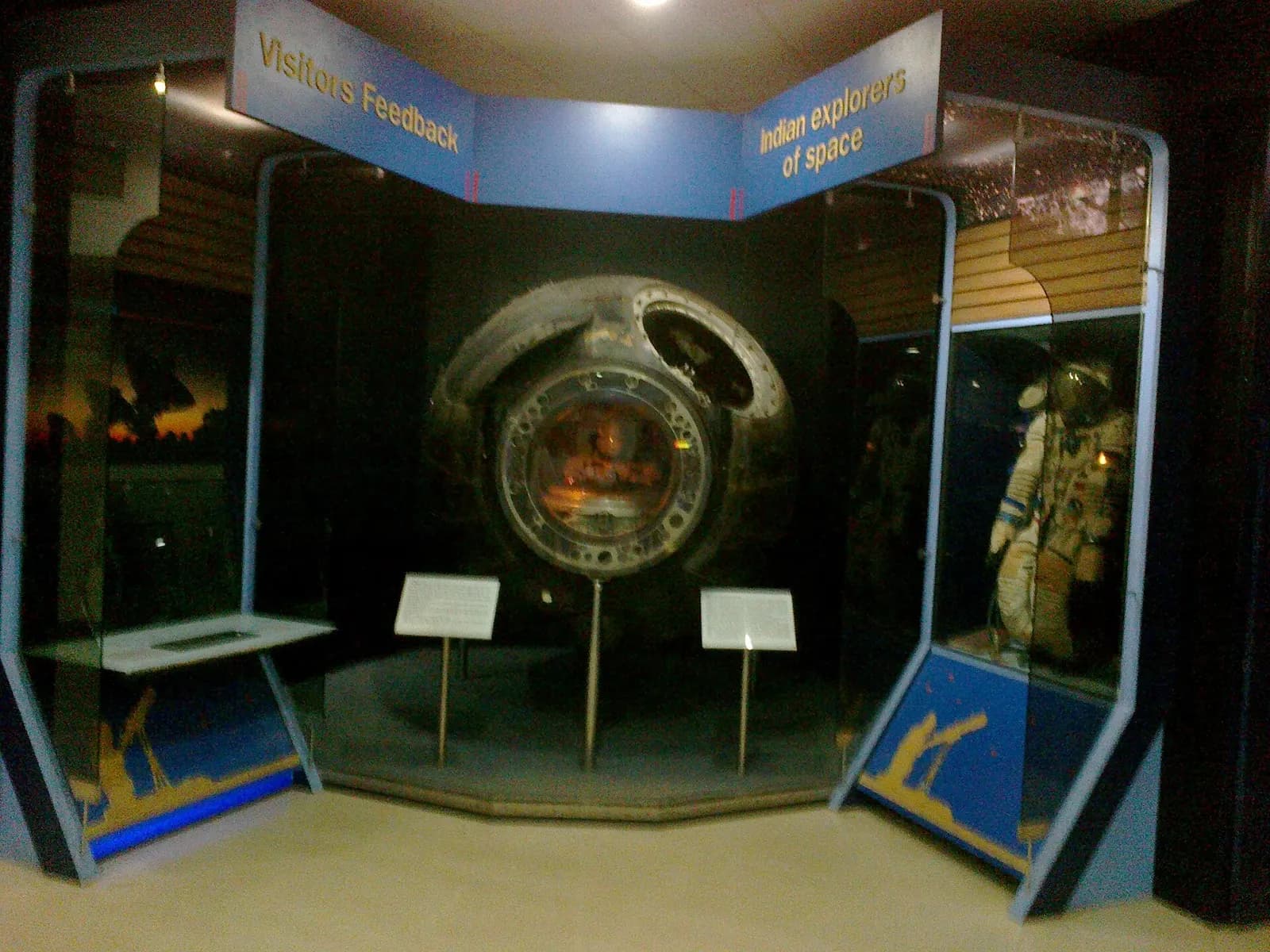
One of the most prized parts of the planetarium is its exhibition of genuine relics from India's first human spaceflight, which are a rare treat for any space enthusiast. In 1984, Rakesh Sharma became the first Indian to travel into space and the gallery here holds historical artefacts connected with that landmark mission, including:
- The Soyuz descent capsule. The actual Soyuz T-10 spacecraft capsule associated with the mission that took India's first cosmonaut into space, a genuine piece of spaceflight history.
- The mission spacesuit. Rakesh Sharma's official spacesuit from the mission, displayed alongside the capsule.
- Cosmic tools and journal. His cosmic tools and his personal handwritten spaceflight journal from the mission.
Standing before the actual capsule that returned India's first astronaut from orbit and seeing his suit and handwritten notes, is a surprisingly moving experience, bringing a proud chapter of the nation's history vividly close. It is the kind of genuine, historic artefact that lifts the planetarium from an entertaining show venue to a place of real significance and it is a highlight not to miss while you are there.
The Aryabhata Gallery and astronomy outreach
Beyond the dome and the space relics, the planetarium has further galleries and outdoor exhibits that round out a visit:
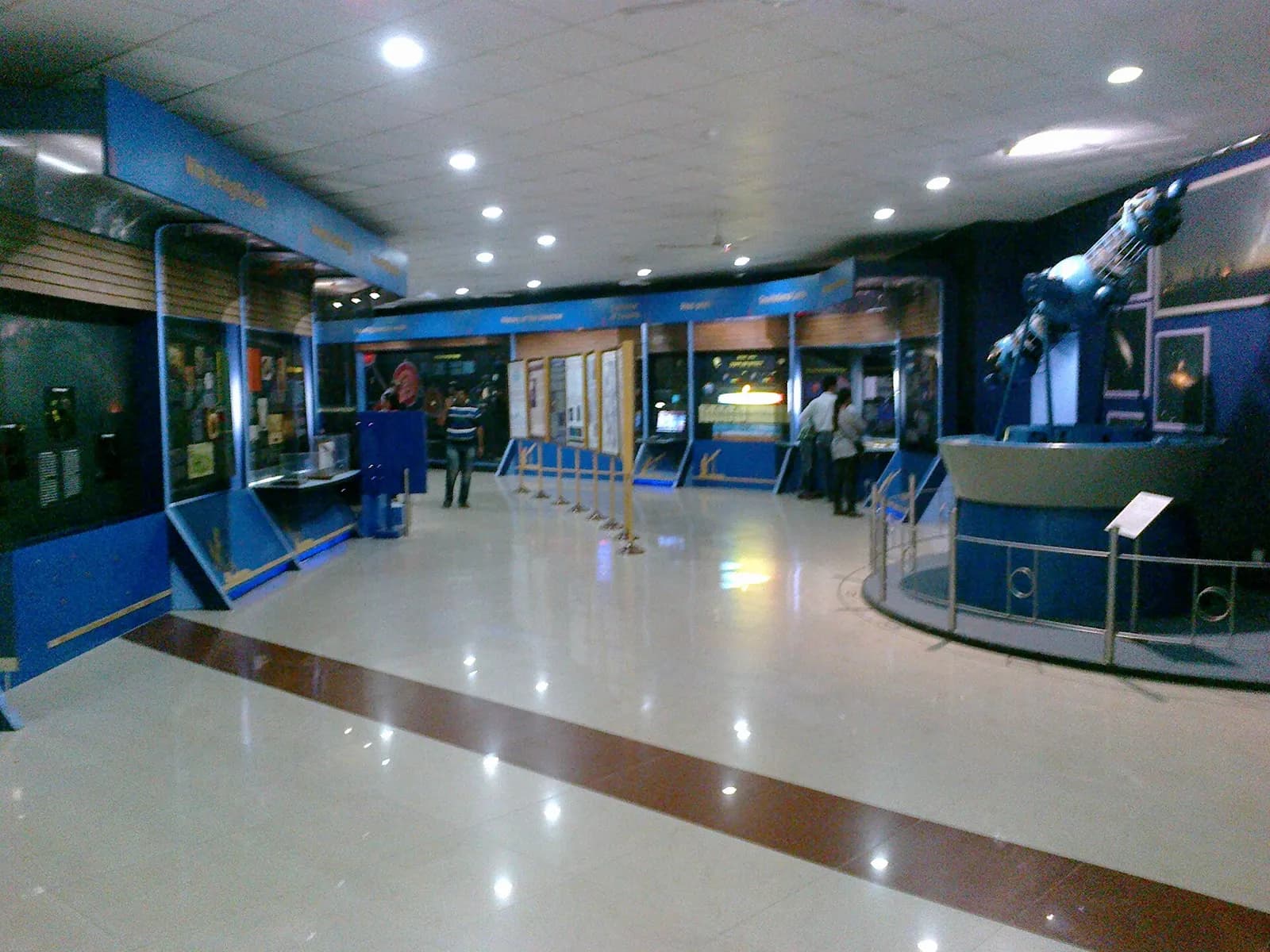
- The Aryabhata Gallery. A dedicated indoor exhibition detailing India's rich astronomical history, from ancient Vedic computational mathematics through to modern ISRO achievements such as the Chandrayaan and Mangalyaan deep space missions.
- The astronomy outreach yard. An outdoor area with interactive models, telescopes and sundials, where you can engage hands-on with astronomy.
- Public stargazing camps. The facility hosts well attended public stargazing sessions using high-powered telescopes during rare celestial events such as solar eclipses, meteor showers and planetary alignments.
The Aryabhata Gallery in particular is worth time, tracing a continuous thread from India's ancient astronomers and mathematicians to the country's modern missions to the Moon and Mars, a story of which many visitors leave proud. The outreach yard and the stargazing camps, meanwhile, make the planetarium a living centre of astronomy rather than just a show venue and if your visit happens to coincide with a special celestial event, the public telescope sessions are a wonderful bonus. Together these exhibits make the planetarium a well rounded space and astronomy experience.
Things to see at Nehru Planetarium
A visit combines a dome show with the galleries and the outdoor yard and the highlights are worth seeking out:
- A dome sky show. The signature 2D or 3D show under the 15 metre dome, the main reason to visit.
- The Rakesh Sharma relics. The Soyuz capsule, spacesuit, tools and journal from India's first human spaceflight.
- The Aryabhata Gallery. The story of Indian astronomy from Vedic times to ISRO's Moon and Mars missions.
- The outreach yard. Outdoor telescopes, sundials and interactive models.
- The Teen Murti grounds. The historic, leafy estate around the planetarium, home also to the Prime Ministers Museum and Library.
Allow around an hour and a half to two hours to take in a show and the galleries and plan your arrival around your chosen show time. Because the dome show is the centrepiece, it is worth making sure you catch one rather than only seeing the galleries.
What to expect at Nehru Planetarium
A visit to Nehru Planetarium combines a show with a wander through the galleries and knowing what to expect helps you time it well. You arrive at the leafy Teen Murti estate, buy your ticket for a specific show and spend any waiting time in the space galleries before heading into the dome. The Sky Theatre itself is a large, dark, air-conditioned space with reclining seats and once the show begins the whole dome fills with stars and imagery overhead, so you lean back and let the universe unfold above you. The atmosphere is calm and absorbing, hushed as the show plays, with children in particular gazing up wide-eyed. Shows run about forty minutes, long enough to be immersive without tiring young visitors and they are narrated clearly in English or Hindi depending on the sitting.
Around the show, most visitors spend time at the Rakesh Sharma exhibition, lingering over the real Soyuz capsule and spacesuit and in the Aryabhata Gallery tracing India's astronomical story, with children often drawn to the outdoor models and telescopes in the yard. The pace is relaxed, the complex is not so large as to tire anyone and the historic, green setting of Teen Murti adds to the pleasure. Because photography is allowed in the galleries but not in the dome, people put their phones away for the show and simply watch, which suits the experience. Many visitors arrive mainly for the show and are pleasantly surprised by the quality of the exhibits around it. It is an easy, enriching couple of hours and for space-struck children it can be the highlight of their whole trip.
Why Nehru Planetarium is special for children and space lovers
Among Delhi's attractions, the Nehru Planetarium stands out as one of the most rewarding for children and anyone fascinated by space and it is worth understanding why it works so well. Astronomy is a subject that naturally captures the imagination and here it is presented at its most vivid: rather than reading about the cosmos, visitors are surrounded by it under the dome, soaring past planets and galaxies in a way that no textbook or screen can match. The real space relics make the wonder concrete, letting children stand before the actual capsule and suit that carried India's first astronaut, which turns an abstract achievement into something they can almost touch. The Aryabhata Gallery then connects that wonder to a proud national story, from ancient Indian astronomers to modern missions to the Moon and Mars, planting the idea that space is not only distant history but a field India leads in today. For parents, it is a stop where children are absorbed, excited and quietly learning and for adult space enthusiasts it offers genuine substance. It is exactly the kind of place that broadens a Delhi itinerary beyond forts and tombs and it is why I so often suggest it to guests travelling with curious children.
Nehru Planetarium timings and ticket price
The planetarium is open Tuesday to Sunday from 11:00 AM to 6:00 PM and is closed on Mondays and gazetted national public holidays, so plan around that Monday closure. Tickets are charged per show and prices differ for 2D and 3D shows: at the time of writing, 2D shows cost around ₹100 for adults and ₹70 for children aged four to twelve, while 3D shows cost around ₹200 for adults and ₹150 for children. School groups can get a concessional rate of around ₹50 per student with a prior institutional request letter. These figures are current at the time of writing and can be revised, so reconfirm at the counter. Tickets can be booked online through dynamic ticketing platforms or at the on-site counter and the booking window closes fifteen minutes before each show, so do not arrive at the last minute. Allow around an hour and a half to two hours for a show and the galleries. As with all timings and prices, treat these as a current guide and reconfirm before a special trip.
Booking and photography rules at Nehru Planetarium
A few practical rules help a visit go smoothly:
- Book ahead or arrive early. Tickets can be booked online or at the counter, but the window closes 15 minutes before each show, so arrive in good time, especially for popular 3D shows.
- Choose your show and language. Shows alternate between English and Hindi and between 2D and 3D, so check the schedule and pick the one that suits you.
- Photography in the galleries. Photography is permitted in the general history galleries and the Rakesh Sharma exhibition room.
- No photography in the dome. Photography is strictly banned inside the dark Sky Theatre during active projections, to protect the experience for all.
- Mind the children. The reclining dome and the dark can excite young children, so settle them before the show begins.
Knowing the booking window and the photography rules in advance saves disappointment, so plan to arrive well before your chosen show and save your photography for the galleries and the space relics rather than the dome.
Best time to visit Nehru Planetarium
The best time to visit is a weekday, arriving in time for a show that suits you, when the planetarium is quieter and the ticket queues shorter than at the weekend. Weekends and school holidays are busier, with more families and school groups, so if you come then, book ahead and arrive early. Because the shows and galleries are indoors and air conditioned, the planetarium is a comfortable choice year round and an excellent option on a hot or rainy day when the open air monuments are less appealing. In terms of season, the cooler months from October to March are the most pleasant for getting around central Delhi generally. If a special celestial event such as an eclipse or meteor shower is on, the public stargazing camps are a wonderful reason to time a visit. A weekday show, arriving in good time, is close to ideal. Our guide to the best time to visit Delhi sets out the seasons across the city in more detail.
How to reach Nehru Planetarium Delhi (nearest metro)
Nehru Planetarium stands on the grounds of Teen Murti Bhavan in central New Delhi, near the Teen Murti roundabout and it is easy to reach. The nearest metro stations are Udyog Bhawan and Lok Kalyan Marg, both on the Yellow Line, from either of which a short auto-rickshaw ride brings you to Teen Murti. Alternatively, Central Secretariat station offers e-rickshaw shuttle services to the Teen Murti roundabout. App cabs and autos can drop you at the Prime Ministers Museum and Library gates, within which there is ample free parking for planetarium ticket holders if you drive. Being so central, it slots neatly into a plan of the imperial quarter and a guided New Delhi tour can fold it in alongside the surrounding landmarks, while a broader Delhi day tour ties it into the full span of the capital.
Places to visit near Nehru Planetarium
Nehru Planetarium sits in the ceremonial heart of New Delhi, so it is easy to build a half day around it. On the same estate is the Prime Ministers Museum and Library and the ceremonial India Gate and the imperial avenues are a short ride away. The central ring holds a cluster of further sights within easy reach: the great circle of Connaught Place, the ancient stepwell of Agrasen ki Baoli, the astronomical Jantar Mantar, the much loved Pracheen Hanuman Mandir and the serene Bangla Sahib Gurudwara.
A little further out, the capital's great monuments are an easy ride away: the serene Humayun's Tomb, the mighty Red Fort, the towering Qutub Minar, the old fort of Purana Qila and the modern Lotus Temple and Akshardham. Together these make the planetarium a fine central anchor for exploring Delhi.
Nehru Planetarium in your Delhi itinerary
For most visitors, Nehru Planetarium works best as an engaging stop of an hour and a half to two hours within a central Delhi circuit, ideally built around a show time that suits you and it is an especially smart choice for anyone travelling with children interested in space. It pairs naturally with the surrounding central sights and, being indoors, makes an ideal refuge from the heat or the rain between outdoor monuments. A sensible plan is to see some of the central monuments, then catch a dome show and explore the space galleries, timing your arrival for a show in your preferred language. Those on a fuller itinerary often slot it in as an educational change of pace from the historic sites.
If Delhi is your gateway to the wider Golden Triangle, the planetarium adds a modern, scientific dimension to a trip otherwise rich in history and its space relics connect the ancient astronomy of places like the Jantar Mantar to India's journeys to the Moon and Mars. Many of my guests travelling with children say the dome show was a highlight and it offers a wonder-filled contrast before the journey on to the monuments of Agra and Jaipur.
Travel tips for visiting Nehru Planetarium
A few pointers make the visit smoother and more rewarding:
- Plan around a show time, choosing your preferred language and 2D or 3D and arrive before the window closes 15 minutes prior.
- Book ahead for weekends, especially for popular 3D shows.
- Never come on a Monday, when the planetarium is closed.
- Come on a weekday for shorter queues and a calmer visit.
- See the Rakesh Sharma relics and the Aryabhata Gallery as well as the show.
- Save photography for the galleries, as it is banned inside the dome during shows.
- Come by metro, from Udyog Bhawan or Lok Kalyan Marg or use the free on-site parking.
- Watch for stargazing camps during eclipses or meteor showers, a special bonus.
If you would like a local guide to build Nehru Planetarium into a wider Delhi plan, message our team on WhatsApp at +91 7302265809 with your travel dates and group size and we will shape the day for you.
Is the Nehru Planetarium worth visiting?
For families with children and anyone curious about space, very much so. If you are travelling with young ones fascinated by stars and planets, the immersive dome show is a genuine highlight and the real space relics from India's first human spaceflight add a sense of occasion that few attractions can match. It is inexpensive, central and indoors, which makes it easy to include and the Aryabhata Gallery offers a proud, engaging account of India's journey from ancient astronomy to Moon and Mars missions. The honest note is that it is a show and exhibition venue rather than a grand historic monument, so travellers with very limited time focused on Delhi's heritage might prioritise those sights first; but for anyone with children or an interest in space and science, it is a genuinely rewarding stop. For families especially, I recommend it warmly and the dome show is often the part of a Delhi trip that children remember most.
Plan your trip with us
At Experience My India, through our Delhi and Golden Triangle travel desk, we design unhurried, well paced trips that make room for engaging, family friendly stops like Nehru Planetarium, not just the headline monuments and we time show-based stops like this around the schedule so you catch the right show. Whether you want a relaxed set of Delhi Agra tours or a full Golden Triangle route through Delhi, Agra and Jaipur, we plan around your pace, your interests and the right season, with local guides who know the show times and how to keep every age happy. Share your dates and the kind of trip you have in mind through our enquiry page, tell us your group size and we will put together an honest, tailored plan rather than a rushed checklist.
Related guides
- Places to visit in Delhi, for the wider picture
- Hidden places to visit in Delhi, the city's quieter corners
- Nearby places to visit in Delhi, to extend your trip
Enquire Now
Ready to Explore
The Heart of Delhi?
Explore the Red Fort, Qutub Minar, Humayun's Tomb, and the vibrant streets of Old Delhi with our expert-guided premium tours of India's capital city.

Delhi
Premium Tour Package
Questions
Frequently asked questions
What are the show timings at Nehru Planetarium Delhi?
The planetarium runs multiple 40 minute shows daily, alternating between English and Hindi and between 2D and 3D, roughly hourly from late morning to early evening. The schedule changes periodically, so reconfirm and note the ticket window closes 15 minutes before each show.
What are the timings of Nehru Planetarium?
What is the ticket price at Nehru Planetarium?
Which is the nearest metro station to Nehru Planetarium?
Which day is Nehru Planetarium closed?
What can I see at Nehru Planetarium besides the show?
Can I book Nehru Planetarium tickets online?
Is photography allowed at Nehru Planetarium?
Is Nehru Planetarium good for children?
Is Nehru Planetarium worth visiting?
Explore more
Plan your Nehru Planetarium trip with us

Photo credits
Photos from Wikimedia Commons, used under their licences:
- Photo 1 by Wiki-uk, Public domain
- Photo 2 by Analizer, CC BY-SA 3.0
- Photo 3 by Analizer, CC BY-SA 3.0
- Photo 4 by Analizer, CC BY-SA 3.0
- Photo 5 by Analizer, CC BY-SA 3.0
Interested in Nehru Planetarium Delhi: Show Timings, Tickets and Guide?
Chat with our travel team for a custom quote, or browse every package.
Related Attractions
9Ready to explore Nehru Planetarium Delhi: Show Timings, Tickets and Guide?
Book your private tour today and experience the magic of India's rich heritage.