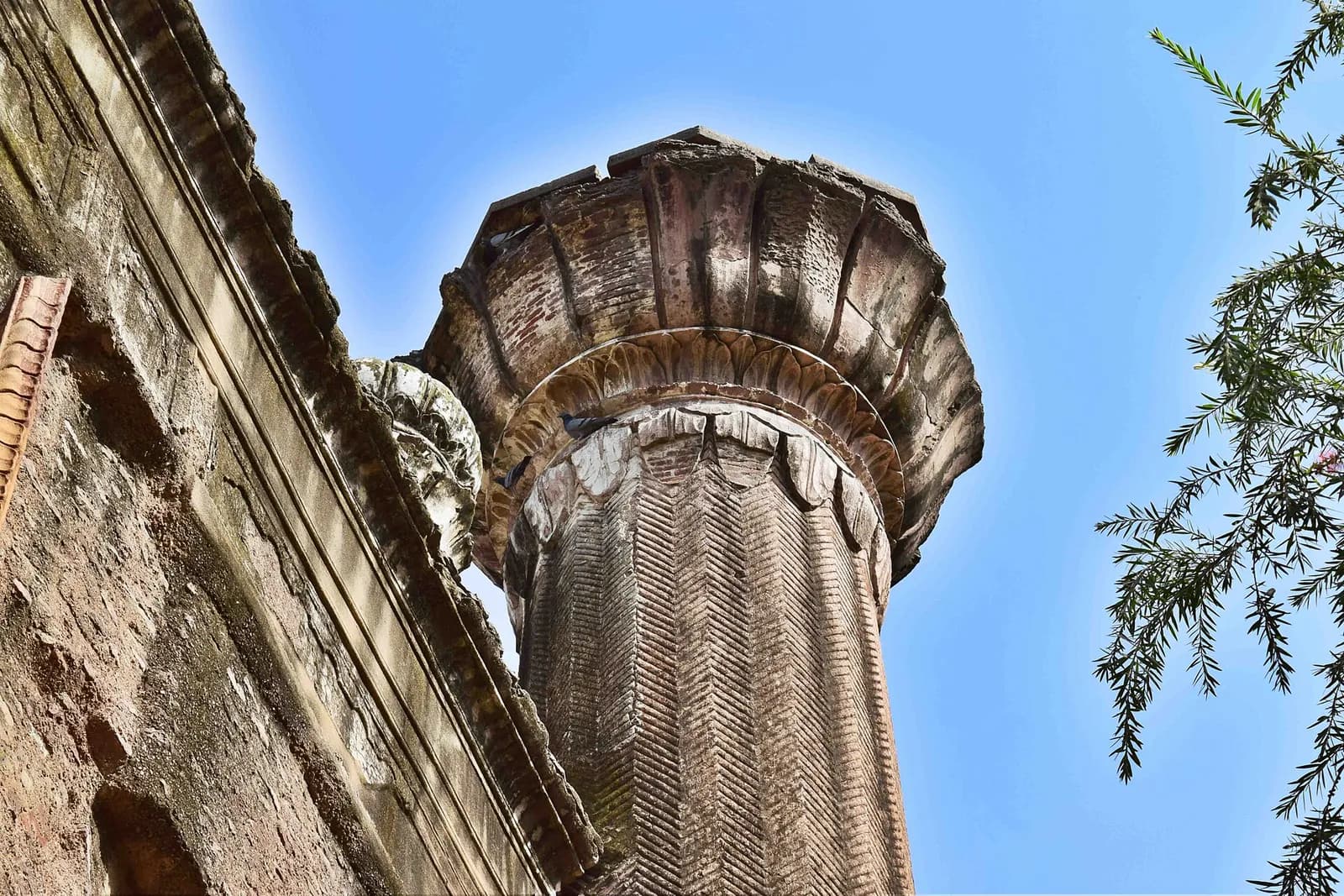
Qudsia Bagh Delhi: History, Timings and Visitor Guide
Visiting Qudsia Bagh near Kashmere Gate? The story of Qudsia Begum, the surviving gateway and mosque, the rebellion's history, timings, free entry and metro.
In a Nutshell
“Qudsia Bagh is a historic 18th-century Mughal garden in Civil Lines, North Delhi, built in 1748 by Qudsia Begum, the powerful queen mother of Emperor Ahmad Shah Bahadur. Once a vast riverside palace-garden of around 100 acres, it was devastated in the 1857 uprising, when the British set up artillery here to bombard Kashmere Gate and only about 20 acres and a few structures survive today, including a grand gateway, a scarred mosque and a pavilion. It is now a quiet public park. Entry is free, it is open through the day and it sits beside Kashmere Gate metro. It features on our heritage Delhi tours, run by a unit of Experience My India.”
Qudsia Bagh is one of Delhi's most atmospheric and overlooked historical gardens, a melancholy green oasis behind the bustle of the Kashmere Gate bus terminus that carries the memory of an 18th-century queen, the destruction of 1857 and even the plans of the freedom struggle. For history lovers and those seeking the city's quieter corners, it is a rewarding stop. Our team at Delhi Agra Tour Packages sometimes includes it on a Kashmere Gate heritage walk and it adds a tranquil, story-rich dimension to a wider Golden Triangle tour through the capital.
I am Abhay Sharma, Delhi born and a Golden Triangle guide since 2015 and I enjoy bringing history-minded guests here, because few places pack so much of the city's history, Mughal, colonial and revolutionary, into such quiet and green space. This guide gathers everything I would tell a visitor beforehand, checked against current information, including the history, the surviving monuments, the timings and how to reach it.
Details
Qudsia Bagh at a glance
| Detail | Information |
|---|---|
| Location | Civil Lines, near Kashmere Gate, North Delhi |
| Built | 1748, by Qudsia Begum |
| Original size | Around 100 acres; about 20 acres survive |
| Known for | Its Mughal garden, the surviving gateway and mosque, 1857 history |
| Setting | A quiet public park behind the Kashmere Gate ISBT |
| Entry | Free; an open public garden |
| Nearest metro | Kashmere Gate, Gate No. 5, about a 5 to 7 minute walk |
| Time needed | About 45 minutes to an hour |
Qudsia Bagh timings
| Detail | Information |
|---|---|
| Access | Open through the day as a public park |
| Recommended hours | 6:00 AM to 6:00 PM, sunrise to sunset |
| Time needed | About 45 minutes to an hour |
Qudsia Bagh functions as an open public municipal park and is nominally accessible around the clock, but a visit is best made during daylight, roughly 6:00 AM to 6:00 PM, for safety and the best experience. Walking the garden and seeing the surviving monuments takes about forty five minutes to an hour. These timings are current at the time of writing and can vary, so a daytime visit is best.
Entry fee
| Item | Information |
|---|---|
| Entry fee | Free for all visitors |
| Tickets | None; no counters or digital passes |
| Setting | An open public park with historic monuments |
How to reach Qudsia Bagh
| From | Route |
|---|---|
| Kashmere Gate metro | Gate No. 5, a 5 to 7 minute walk, about 500 metres |
| Metro lines | Red, Yellow and Violet Lines interchange at Kashmere Gate |
| Civil Lines and the ISBT | Directly behind the Kashmere Gate bus terminus |
| By car | Limited; the Kashmere Gate area is very busy |
What is Qudsia Bagh?
Qudsia Bagh is a historic Mughal garden of the mid-18th century in Civil Lines, North Delhi, built in 1748 by the formidable Qudsia Begum and now surviving as a quiet public park dotted with the ruins of its grand past. In its day it was an enormous and luxurious riverside pleasure garden and palace complex of around 100 acres, laid out along the Yamuna just north of the walled city of Shahjahanabad as a summer retreat for the royal family, complete with waterfalls, stone channels orchards and mansions. The complex was all but destroyed in the fighting of 1857, when the British used it as an artillery position to bombard the Kashmere Gate and today only about 20 acres and a handful of structures remain, chief among them a monumental gateway, a bullet-scarred mosque and a surviving pavilion, set in an overgrown, melancholy green space behind the Kashmere Gate bus terminus. It is a place where the splendour of the late Mughal court, the violence of the uprising and the quiet of a modern neighbourhood park all meet.
Several things make it special and they are worth drawing out:
- A queen's garden. Built in 1748 by Qudsia Begum, a former courtesan who rose to become a powerful Mughal queen mother and regent.
- A once-vast estate. Originally a 100-acre riverside palace-garden, of which about 20 acres survive today.
- The scars of 1857. Used by the British as an artillery base to bombard Kashmere Gate, which devastated the complex.
- Surviving monuments. A grand gateway, a scarred imperial mosque and a garden pavilion still stand under ASI protection.
- A revolutionary footnote. A reputed secret meeting place of freedom fighters Bhagat Singh and Batukeshwar Dutt in 1929.
It is one of the most atmospheric and historically layered of the offbeat things to do in Delhi and a fascinating lesser-known entry among the important monuments of Delhi.
Who was Qudsia Begum?
The garden is inseparable from the remarkable woman who built it and her story is one of the most striking in late Mughal Delhi. Qudsia Begum originally born Udham Bai, rose from humble beginnings as a royal courtesan and dancer to become the third wife of the Mughal emperor Muhammad Shah, the ruler known by the nickname Rangeela. More remarkably still, after Muhammad Shah's death she became an exceptionally powerful figure as the queen mother and effective regent during the reign of her son, the emperor Ahmad Shah Bahadur, wielding real political influence at a time when the Mughal court, though declining, was still the centre of power in Delhi.
It was at the height of her influence, in 1748, that Qudsia Begum commissioned this grand garden and palace complex, a statement of her wealth and status as one of the most powerful women of her age. Her rise, from courtesan to queen mother and patron of one of the great gardens of the city, is a vivid illustration of the fluid and dramatic world of the late Mughal court and it gives the garden a human story as compelling as its monuments. For the visitor, knowing that this quiet park was the creation of such a figure, a woman who climbed from the margins to the summit of imperial power, transforms a walk among its ruins into an encounter with one of the most intriguing personalities of 18th-century Delhi and it is a large part of what makes Qudsia Bagh worth seeking out.
History of Qudsia Bagh
The history of Qudsia Bagh runs from the splendour of the late Mughal court through the devastation of 1857 to the quiet of a modern park and it is this layered story that gives the garden its depth. Its key chapters are worth setting out:
- The imperial garden, 1748. Qudsia Begum built the complex as a vast, luxurious riverside palace-garden of around 100 acres, a secure summer retreat just north of the walled city, with waterfalls, stone water channels orchards and grand residential mansions.
- The 1857 devastation. Positioned immediately north of the city walls, the high-walled garden became a key battleground in the uprising, as the British seized it and set up heavy artillery batteries among the orchards to bombard the rebel stronghold at nearby Kashmere Gate, pulverising most of the palace buildings and pavilions in the crossfire.
- The revolutionary meeting, 1929. Decades later, the quiet, damaged garden served as a discreet hideout where the freedom fighters Bhagat Singh and Batukeshwar Dutt are said to have met to plan their famous protest at the Central Legislative Assembly.
- The shrinking estate. Over the following century, railway construction and urban expansion carved up the original 100-acre grounds, until only about 20 acres survive today as a public park.
Taken together, this is a history that spans the full arc of modern Delhi: the opulence of the late Mughal twilight, the violence of the 1857 uprising, the stirrings of the freedom struggle and the slow erosion of the city's green heritage under modern growth. Each layer is present in the surviving garden, in its ruined grandeur, its bullet-scarred mosque and its quiet lanes. For the visitor, knowing this story turns a modest neighbourhood park into one of the most historically resonant spaces in the city, where the splendour and the suffering of Delhi's past are both palpable.
Qudsia Bagh and the 1857 uprising
Of all the chapters in the garden's history, it was the uprising of 1857 that most dramatically shaped the Qudsia Bagh we see today and the story is worth telling in full. Because the garden lay immediately north of the walls of Shahjahanabad, just outside the Kashmere Gate, it occupied a position of great strategic importance when the British forces gathered on the Ridge and in the north of the city to retake Delhi from the rebels who held it. The high-walled garden, with its orchards and open ground, made an ideal artillery position and the British seized it and set up heavy mortar and gun batteries among its trees.
From these batteries, the British launched a relentless and devastating bombardment against the rebel-held stronghold at the nearby Kashmere Gate, one of the principal targets in the assault on the walled city. The garden thus became both a base and a battleground and in the intense crossfire of the fighting its grand palace buildings and stone pavilions were almost completely pulverised, reducing the once-splendid imperial retreat to the fragmentary ruins that survive today. The scars of that bombardment are still visible, most strikingly on the surviving mosque, whose walls bear the marks of bullets and shell splinters. For the history-minded visitor, this makes Qudsia Bagh a tangible monument to the violence of 1857, best understood alongside the nearby Kashmere Gate, Nicholson Cemetery and the Ridge sites and knowing what happened here deepens a visit immeasurably. There is a poignant irony in it, too, that a garden built for pleasure and retreat by a Mughal queen should have become, a century later, the very platform from which the guns were turned on the imperial capital she had known and that the mosque within it should still carry the marks of that bombardment for every later visitor to see.
Surviving architecture and monuments
Despite the heavy destruction of 1857, three major structures survive within the garden under the protection of the Archaeological Survey of India and seeking them out is the heart of a visit. Each tells part of the garden's story:
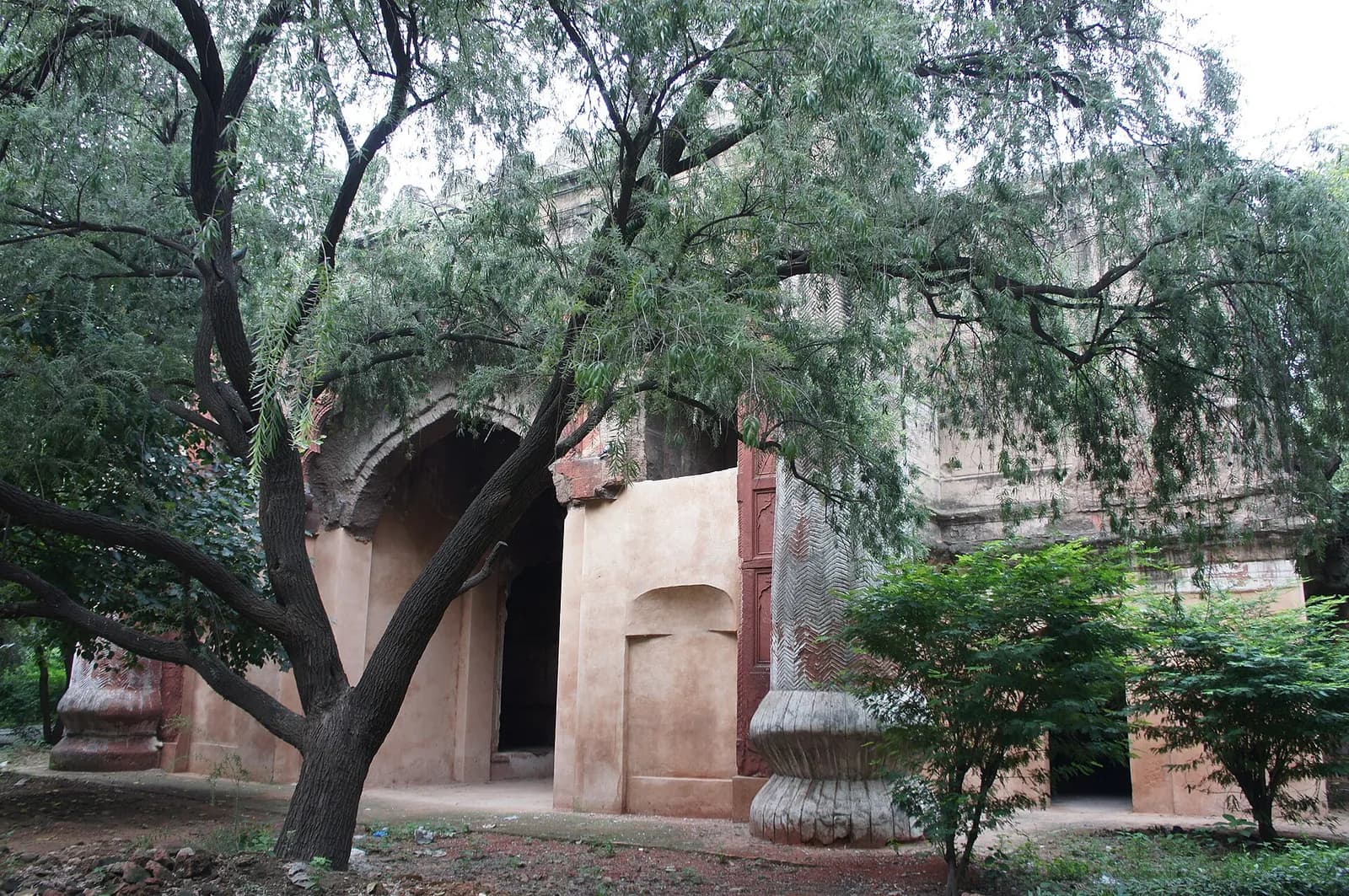
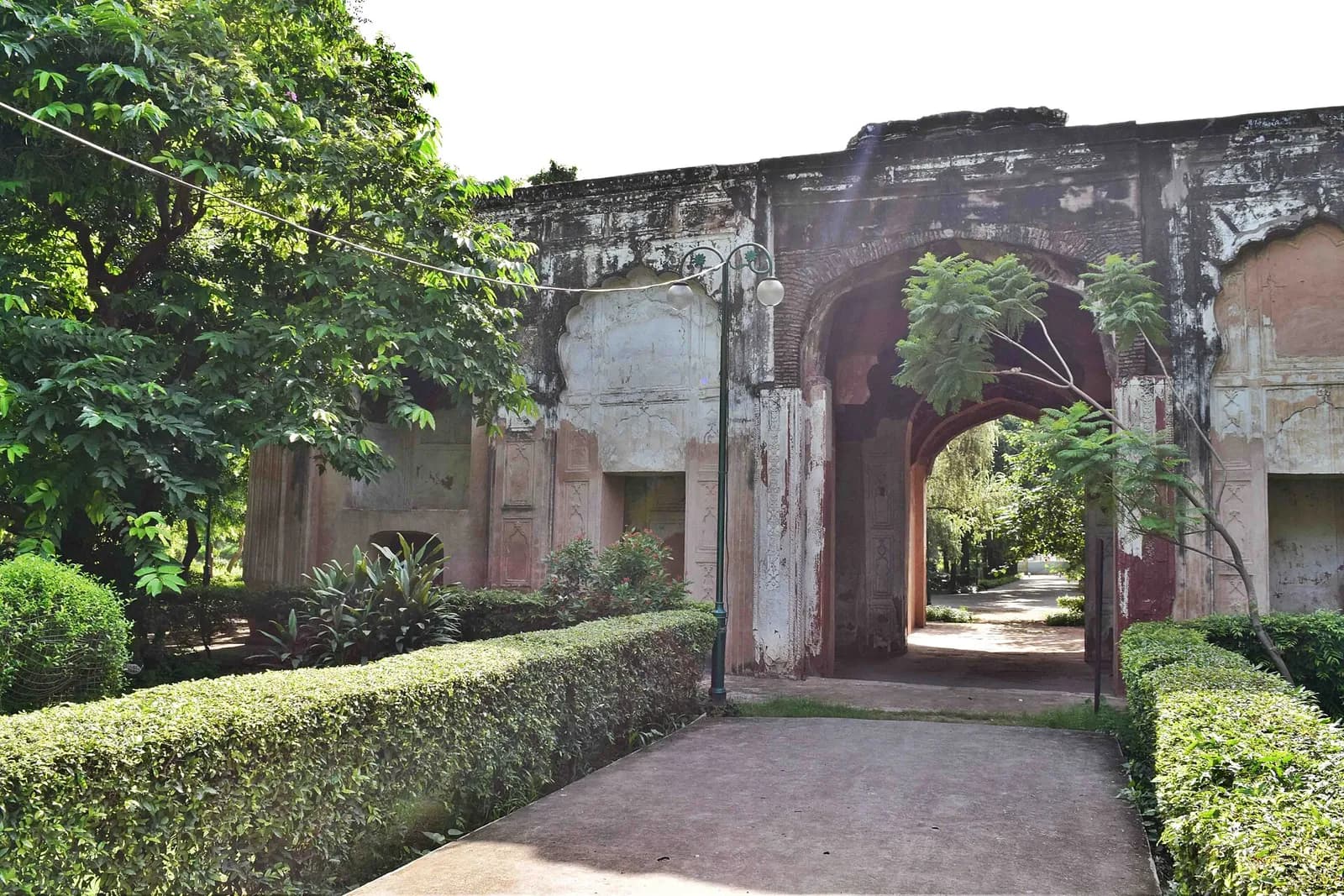
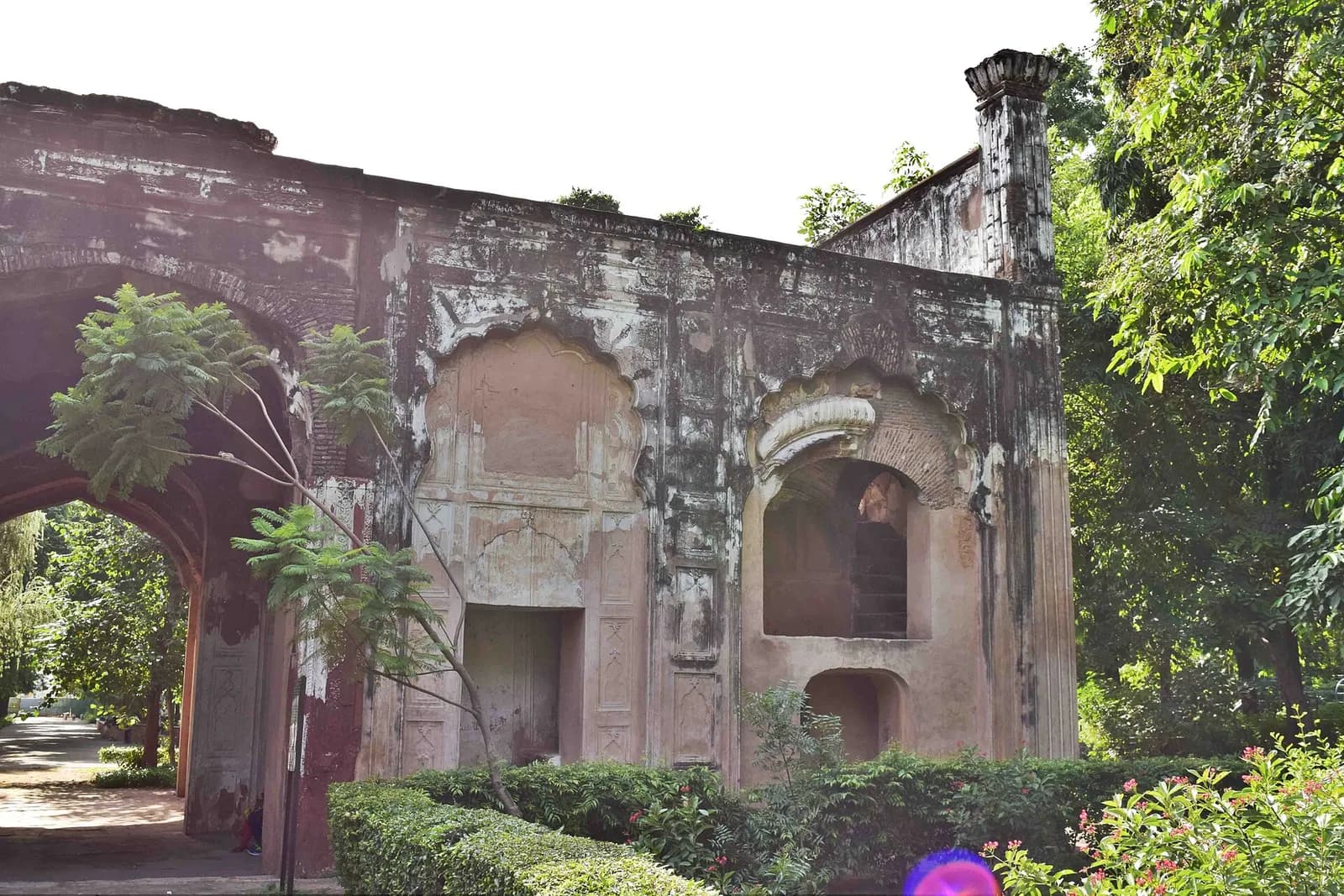
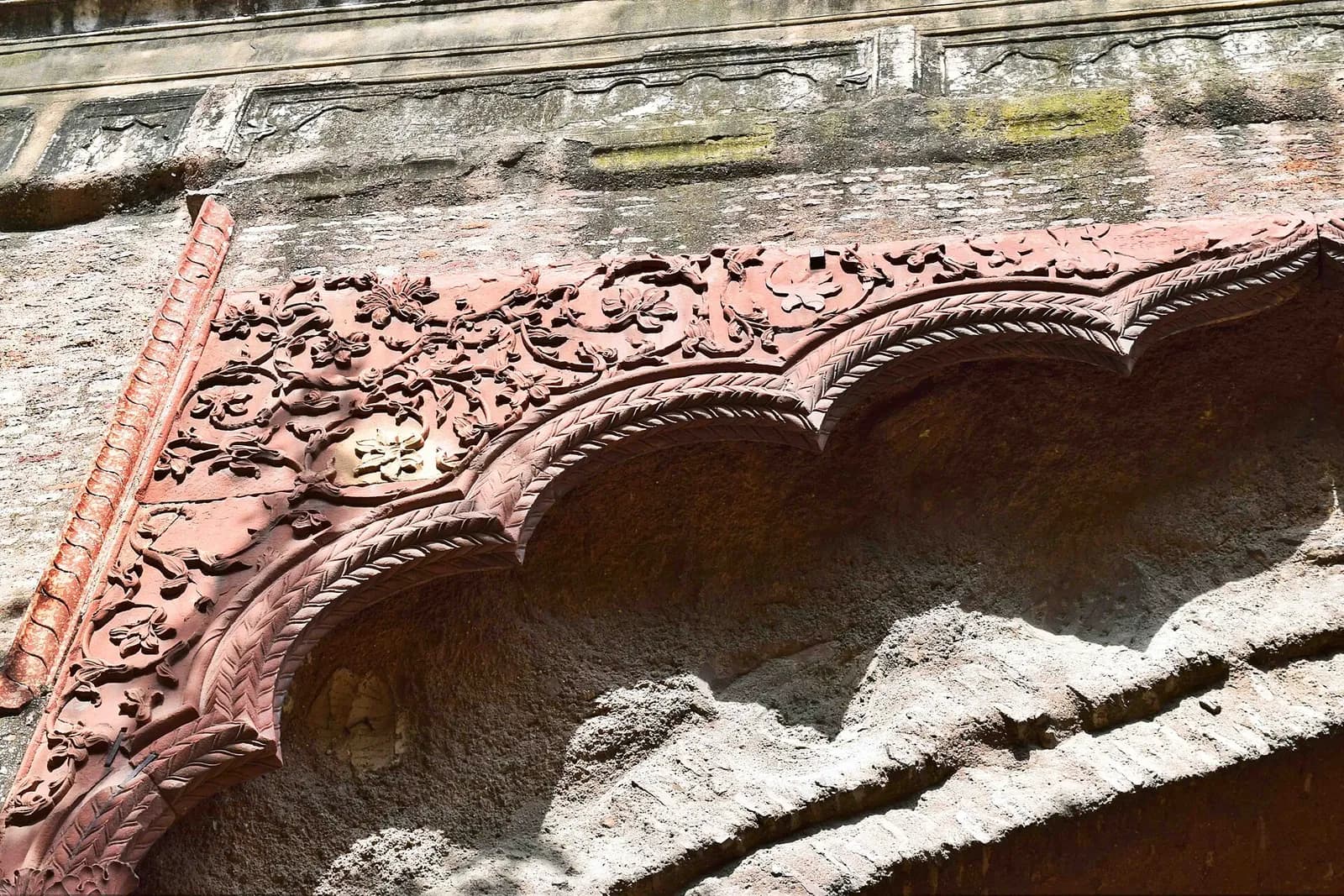
- The Western Gateway, the Hathi Darwaza. A monumental, towering entrance archway built of traditional thin lakhori bricks with red sandstone accents, featuring late-Mughal pointed arches ornamental wall niches and old stone staircases winding up to broken upper levels, the grandest surviving relic of the complex.
- The Shahi Masjid, the imperial mosque. A beautiful functioning historical mosque set deep within the lawns, with a heavy stone prayer hall topped by three prominent domes and adorned with intricate internal plasterwork, still bearing the dramatic, visible scars and cracks left by the bullets and shell splinters of 1857.
- The surviving baradari, the pavilion. A stone garden pavilion built on the classic twelve-door grid, which subtly shows early hybrid renovations combining Persian geometry with later British colonial modifications.
Together these three structures, the gateway, the mosque and the pavilion, are the surviving fragments of what was once a vast and luxurious palace-garden and each rewards a close look. The Hathi Darwaza gives a sense of the grand scale on which the complex was conceived, the Shahi Masjid is both a serene survival and a direct witness to the violence of 1857 in its scarred walls and the baradari shows the layering of Mughal and colonial hands over time. Set among the overgrown lawns and mature trees of the modern park, they form an evocative scattering of ruins and knowing what each one is and what it has survived, turns a wander through the garden into a reading of the city's history in stone.
What to expect at Qudsia Bagh
A visit to Qudsia Bagh is quiet, green and gently melancholic, a striking contrast to the chaos just outside its walls and knowing what to expect helps you appreciate it. The garden is tucked directly behind the roaring traffic loops and bus queues of the Kashmere Gate inter-state bus terminus, so stepping inside is like entering a hidden, overgrown oasis, a deeply quiet and atmospheric green space insulated from the surrounding urban noise. The experience is one of unhurried wandering: strolling the park lanes beneath mature trees, seeking out the monumental gateway, the scarred mosque and the pavilion and absorbing the layered history of the place. The whole visit takes about forty five minutes to an hour at a relaxed pace.
The garden functions today very much as a neighbourhood park, popular with local elders for morning yoga, walking and birdwatching away from the city's din, so you will likely share the quiet lanes with residents going about their routines, which adds to its lived-in, tranquil character. Because it is somewhat overgrown and tucked inside an understated sector, the deeper and far corners can feel isolated and the unlit trails become very dark after twilight, so it is wise to visit in daylight and stick to the more frequented areas. The mature tree canopy is also home to territorial troops of rhesus monkeys, so keep snacks and belongings zipped inside a bag to avoid snatching. Come in daylight, with the history in mind and an eye on the monkeys and the garden offers a rare pocket of green calm and deep history in the heart of north Delhi.
Qudsia Bagh timings and entry
Qudsia Bagh functions as an open public municipal park and is nominally accessible at any time, but a visit is strongly recommended during daylight hours, roughly 6:00 AM to 6:00 PM, for safety and the best experience. Entry is completely free for all domestic and international visitors, with no ticket counters or digital passes of any kind. Walking the garden and seeing the surviving monuments takes about forty five minutes to an hour. A few sensible precautions apply: because the park is tucked inside an understated neighbourhood sector, the deep, unlit corner trails can become very isolated and dark after twilight, so avoid them late in the day and do not visit after dark and the mature trees house territorial troops of rhesus monkeys, so keep all snacks and belongings zipped inside a bag to prevent aggressive snatching. These timings and conditions are current at the time of writing and can vary, so plan a daytime visit and reconfirm if your plans depend on exact hours.
Safety and what to carry
Because the garden is a large, green and somewhat isolated public park, a few precautions make the visit safer and smoother:
- Visit in daylight. The unlit corner trails become very dark and isolated after twilight, so come between the recommended daytime hours.
- Stick to the frequented areas. The deeper, overgrown corners can feel isolated, so stay where other visitors and local walkers are.
- Guard your belongings from monkeys. Keep snacks and items zipped inside a bag, as the resident rhesus monkeys snatch aggressively.
- Carry your own water. There are limited facilities within the park.
- Wear comfortable shoes. The garden is large and the ground around the ruins uneven.
- Allow 45 minutes to an hour and combine it with the nearby Kashmere Gate heritage.
The key point is that this is a quiet, lived-in neighbourhood park with historic ruins rather than a serviced tourist site, so visiting in daylight, staying alert in the quieter corners and guarding against the monkeys is what makes it comfortable. Treated sensibly, the garden rewards you with a rare combination of deep history and green calm in the heart of the busy north of the city.
Best time to visit Qudsia Bagh
The best time to visit is the cooler months, from October to March and during the day in the morning, when the garden is at its most pleasant and liveliest with local walkers and the light is soft through the trees. A winter morning is ideal, with comfortable temperatures for strolling the lanes and seeing the ruins and the garden is at its greenest and most atmospheric. The summer is hot, though the mature tree canopy gives welcome shade and the monsoon leaves the garden lush but can make the lanes muddy. Because the quieter corners are best avoided late in the day, a morning or early afternoon visit is both the most pleasant and the safest. Allow around an hour and combine it with the surrounding Kashmere Gate heritage. Our guide to the best time to visit Delhi sets out the seasons across the city in more detail.
How to reach Qudsia Bagh (nearest metro)
Qudsia Bagh is in Civil Lines, tucked directly behind the Kashmere Gate inter-state bus terminus and bordered to the west by the Nicholson Cemetery and it is very easy to reach by metro. The nearest station is Kashmere Gate, one of the city's largest interchange nodes connecting the Red, Yellow and Violet Lines, which makes it accessible from almost anywhere in Delhi. From the station, take the exit at Gate No. 5, from which the main entry gateway of the park is a brief and comfortable five to seven minute walk, about five hundred metres, along the Sham Nath Road extensions. App cabs and autos can also drop you nearby, though the Kashmere Gate area is extremely busy, so the metro is by far the easiest option. Set right among the historic heritage of the Kashmere Gate district, the garden pairs naturally with a heritage-focused New Delhi tour or a broader Delhi day tour that takes in the old city and the 1857 sites.
Places to visit near Qudsia Bagh
Qudsia Bagh sits in Civil Lines near Kashmere Gate, in the historic north of the city, so it combines beautifully with the surrounding heritage on a walking plan. It is bordered immediately by the Nicholson Cemetery and lies close to St James Church and the Dara Shikoh Library, with which it forms a rich Kashmere Gate heritage cluster and its 1857 story links it to the Ridge sites nearby. A short ride south brings you to the mighty Red Fort, the great Mughal citadel and the old fort of Purana Qila, while the historic citadel of Feroz Shah Kotla, with its Ashoka pillar, lies nearby.
The ceremonial heart of New Delhi, with India Gate and the great circle of Connaught Place, is a manageable ride away and the capital's other landmarks round out a full picture of the city: the serene Humayun's Tomb, the towering Qutub Minar and the modern marvels of the Lotus Temple and Akshardham. For more layered history, the ancient stepwell of Agrasen ki Baoli, the astronomical Jantar Mantar and the historic Hauz Khas Fort complete the sweep of Delhi's past.
Qudsia Bagh in your Delhi itinerary
For most visitors, Qudsia Bagh works best as a peaceful, atmospheric stop within a Kashmere Gate and Civil Lines heritage outing rather than a destination on its own, given that the visit takes under an hour and that it rewards an unhurried, reflective pace. The natural pairing is with the other Kashmere Gate heritage, the Nicholson Cemetery right beside it, St James Church and the Dara Shikoh Library close by, which together make a rich half-day of Mughal, colonial and 1857 history in the historic north of the city. It is a stop for travellers with a genuine interest in history and in the city's quieter, greener corners, rather than for those chasing only the headline sights and it rewards knowing the story of Qudsia Begum and 1857 in advance.
If Delhi is your gateway to the wider Golden Triangle, Qudsia Bagh offers a tranquil and layered perspective on the late Mughal twilight, the violence of 1857 and even the freedom struggle, all in one green and melancholy space, a quiet counterpoint to the grand living monuments elsewhere. Many of my history-minded guests find the story of the courtesan who became a queen and the sight of the bullet-scarred mosque standing among the trees unexpectedly moving and the garden's deep calm a welcome surprise so close to the roar of the bus terminus. It adds a reflective, distinctive note to a Delhi exploration before the journey on to Agra and Jaipur.
Travel tips for visiting Qudsia Bagh
A few pointers make the visit smoother and more rewarding:
- Come in the cooler months, October to March and in the morning, for the pleasantest and liveliest time in the garden.
- Know the history first, Qudsia Begum, the 1857 bombardment and the Bhagat Singh connection, as the garden's power is in its story.
- Seek out the three survivors, the Hathi Darwaza gateway, the scarred Shahi Masjid and the baradari pavilion.
- Visit in daylight and stay in frequented areas, avoiding the isolated corners late in the day.
- Guard your belongings from the monkeys, keeping snacks and items zipped in a bag.
- Pair it with Nicholson Cemetery and St James Church for a full Kashmere Gate heritage walk.
- Reach it via Kashmere Gate metro, Gate No. 5, a 5 to 7 minute walk.
- Allow 45 minutes to an hour for the garden and its monuments.
If you would like a local guide to build Qudsia Bagh and the Kashmere Gate heritage into a wider Delhi plan, message our team on WhatsApp at +91 7302265809 with your travel dates and group size and we will shape the day for you.
Is Qudsia Bagh worth visiting?
For history lovers and those drawn to Delhi's quiet, green and atmospheric heritage, yes, it is a rewarding and evocative stop. There are few places in the city that hold so much history in so tranquil a space, the memory of a courtesan who became a queen, the splendour of a vast riverside palace-garden, the devastation of the 1857 bombardment written in the scars of its mosque and even a footnote in the freedom struggle, all set in a hidden green oasis behind the roar of the Kashmere Gate terminus. It is free and genuinely peaceful. The honest note is that it is a somewhat overgrown public park with scattered ruins rather than a manicured or ticketed attraction, best visited in daylight and with an eye on the isolated corners and the monkeys and its appeal rests on an interest in history and atmosphere. But for the curious, history-minded traveller who knows its story, it is one of the most moving and restful lesser-known places in north Delhi and I enjoy showing it to guests with a taste for the city's quieter past.
Plan your trip with us
At Experience My India, through our Delhi and Golden Triangle travel desk, we design unhurried, well paced trips that make room for tranquil, history-rich stops like Qudsia Bagh and the Kashmere Gate heritage, not just the headline monuments and we know how to reach and interpret the city's hidden green corners. Whether you want a relaxed set of Delhi Agra tours or a full Golden Triangle route through Delhi, Agra and Jaipur, we plan around your pace, your interests and the right season, with local guides who know the stories behind the stones. Share your dates and the kind of trip you have in mind through our enquiry page, tell us your group size and we will put together an honest, tailored plan rather than a rushed checklist.
Related guides
- Places to visit in Delhi, for the wider picture
- Hidden places to visit in Delhi, the city's quieter corners
- Nearby places to visit in Delhi, to extend your trip
Enquire Now
Ready to Explore
The Heart of Delhi?
Explore the Red Fort, Qutub Minar, Humayun's Tomb, and the vibrant streets of Old Delhi with our expert-guided premium tours of India's capital city.

Delhi
Premium Tour Package
Questions
Frequently asked questions
What are the timings of Qudsia Bagh?
It functions as an open public park and is nominally accessible any time, but visits in daylight, roughly 6:00 AM to 6:00 PM, for safety. A visit takes about 45 minutes to an hour. Reconfirm, as conditions can vary.
What is the entry fee for Qudsia Bagh?
Who built Qudsia Bagh?
Why is Qudsia Bagh famous?
What survives at Qudsia Bagh today?
Which is the nearest metro station to Qudsia Bagh?
Is Qudsia Bagh safe to visit?
Is Qudsia Bagh worth visiting?
Is Qudsia Bagh connected to Bhagat Singh?
Explore more
Plan your Qudsia Bagh trip with us

Interested in Qudsia Bagh Delhi: History, Timings and Visitor Guide?
Chat with our travel team for a custom quote, or browse every package.
Related Attractions
9Ready to explore Qudsia Bagh Delhi: History, Timings and Visitor Guide?
Book your private tour today and experience the magic of India's rich heritage.