Shalimar Bagh, Delhi: History, the Sheesh Mahal and Guide
Visiting Shalimar Bagh and the Sheesh Mahal in North West Delhi, the Mughal garden where Aurangzeb was crowned? Its history, timings and how to reach.
In a Nutshell
“Shalimar Bagh is a 17th-century Mughal garden in North West Delhi, laid out in 1653 by a wife of Shah Jahan as an imperial summer retreat and famous as the garden where Aurangzeb held his first coronation in 1658. At its heart stands the Sheesh Mahal pavilion, set in a classic chaharbagh with fountain channels and traces of Mughal frescoes. Now a free public heritage park within the busy residential district that borrows its name, it is a genuine hidden gem. It features on our North Delhi heritage tours, run by a unit of Experience My India.”
Shalimar Bagh is one of the most historically significant yet overlooked of Delhi's Mughal gardens, a 17th-century imperial pleasure garden whose Sheesh Mahal pavilion witnessed the coronation of one of the most powerful emperors in Indian history, now hidden within a bustling modern neighbourhood that shares its name. For the traveller drawn to Mughal history, garden design and the quieter corners of the city, it is a rewarding and peaceful discovery. Our team at Delhi Agra Tour Packages is glad to include it for guests who enjoy the storied, lesser-known sites and it adds a serene, scholarly depth to a wider Golden Triangle tour through the capital.
I am Abhay Sharma, Delhi born and a Golden Triangle guide since 2015 and Shalimar Bagh is a place I enjoy bringing curious guests, because so few realise that behind the name of a busy North Delhi colony lies a real Mughal garden where Aurangzeb was crowned emperor, with its Sheesh Mahal pavilion, fountain court and faded frescoes still surviving. This guide gathers everything I would tell a visitor beforehand, checked against current information, including the history, the Sheesh Mahal, the architecture and the timings and directions.
Details
Shalimar Bagh at a glance
| Detail | Information |
|---|---|
| What it is | A 17th-century Mughal garden with the Sheesh Mahal pavilion |
| Laid out | 1653, under a wife of Shah Jahan |
| Famous for | The coronation of Aurangzeb in 1658 |
| Location | DDA District Park, Block A, Shalimar Bagh, North West Delhi |
| Managed by | ASI (Sheesh Mahal) and DDA (the park) |
| Nearest metro | Shalimar Bagh (Pink Line) |
| Entry | Free |
| Time needed | About 1 hour |
Shalimar Bagh timings
| Detail | Information |
|---|---|
| Open | Every day |
| Hours | About 11:00 AM to 9:00 PM |
| Best time | Mornings for quiet heritage exploration |
Shalimar Bagh park is open every day, generally from around 11:00 AM to 9:00 PM. Mornings are best for crowd-free exploration of the historic Sheesh Mahal, while evenings draw local families to the park. These timings are current at the time of writing and can vary, so reconfirm before a special trip.
Entry fee
| Visitor | Fee |
|---|---|
| All visitors | Free; amateur and smartphone photography permitted |
How to reach Shalimar Bagh
| From | Route |
|---|---|
| Shalimar Bagh metro (Pink Line) | Nearest station, a short auto or e-rickshaw ride via Ring Road |
| Azadpur metro (Yellow, Pink, Red interchange) | About 1.4 km away |
| Netaji Subhash Place metro (Pink, Red Lines) | About 1.4 km away |
| By car | No dedicated lot; use street parking or nearby market decks |
What is Shalimar Bagh?
Shalimar Bagh is a 15-acre Mughal-era heritage garden in North West Delhi, laid out in the mid-17th century as an imperial summer retreat and best known as the garden where the emperor Aurangzeb held his first coronation. It takes its name and its step-terraced water design from the famous Shalimar Bagh of Kashmir, which it was built to echo. At its heart stands the Sheesh Mahal or Crystal Palace, a Mughal pavilion set on a high stone plinth, surrounded by a classic Persian chaharbagh of water channels and fountains and once packed with dense orchards. Though the surrounding lands have long since been absorbed into a busy and well-known residential district that now carries the name Shalimar Bagh, the historic core survives as a protected public heritage park, preserving remnants of Mughal garden and hydraulic design within the modern city. Free to enter and quietly atmospheric, it is one of the most historically important yet least-visited green spaces in Delhi and for the visitor it offers a rare chance to stand where a Mughal emperor was crowned.
Several things make it special and they are worth drawing out:
- A Mughal imperial garden. A 17th-century summer retreat laid out in 1653 in the classic chaharbagh style, echoing the Shalimar Bagh of Kashmir.
- The coronation of Aurangzeb. The garden's Sheesh Mahal pavilion was the site of Aurangzeb's first formal coronation in 1658.
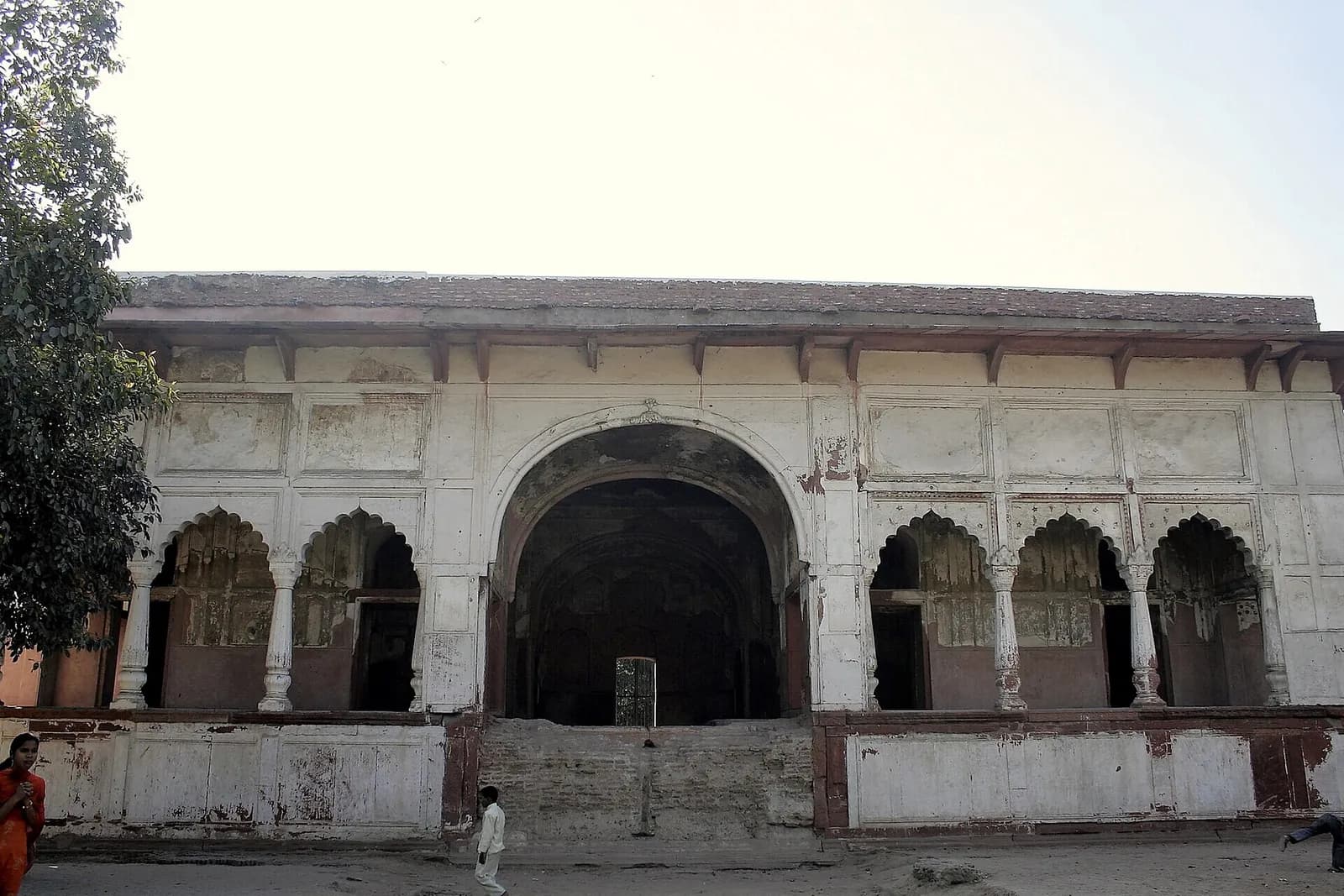
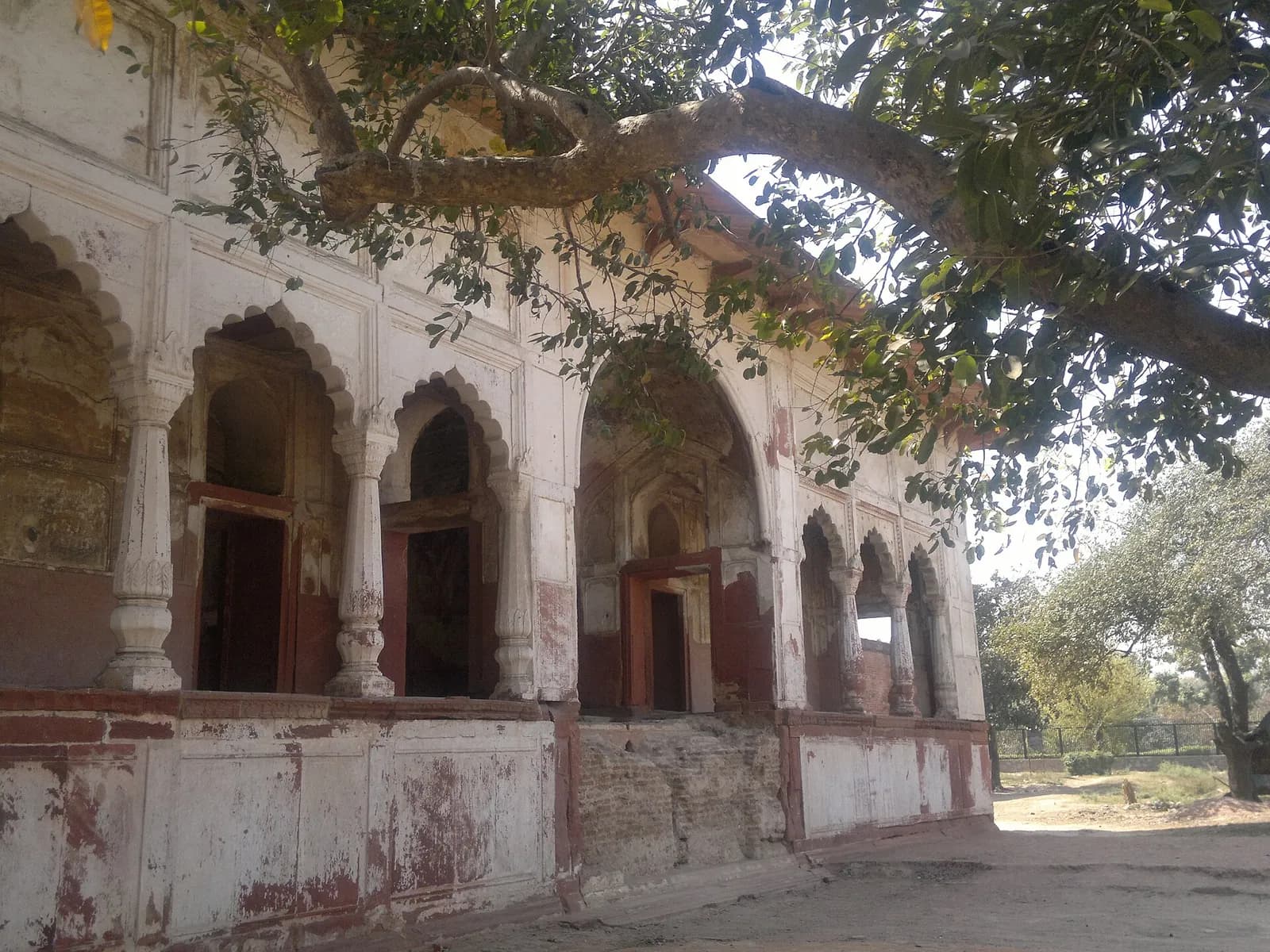
- The Sheesh Mahal. A surviving Mughal pavilion on a high plinth, with a grand central hall and traces of 17th-century frescoes.
- A fountain garden. A chaharbagh with a court of twenty-five fountains, designed to cool the royal family in the summer heat.
- A hidden core in a famous colony. The historic garden survives as a heritage park within the busy North Delhi district that borrows its name.
It is one of the most rewarding of the hidden places to visit in Delhi and a fascinating entry among the offbeat things to do in Delhi.
History of Shalimar Bagh: the coronation garden
The history of Shalimar Bagh is rich and dramatic, spanning Mughal royalty, invading armies and the colonial age and knowing it transforms a quiet park into a place of real significance. Its story centres on one of the great moments of Mughal history:
- The royal foundation. The garden was laid out in 1653 under the orders of Izz-un-Nissa Begum, titled Akbarabadi Mahal, a wife of the emperor Shah Jahan, who built it as a country palace estate named Aizzabad Bagh, modelled on the step-terraced water gardens of Kashmir's Shalimar Bagh.
- The coronation of Aurangzeb. The garden holds immense significance in Mughal history: after defeating his brother Dara Shikoh and imprisoning his father Shah Jahan in the war of succession, Prince Aurangzeb rushed to Delhi and, rather than wait to enter the Red Fort, declared himself emperor and held his first formal coronation in the Sheesh Mahal of this garden in 1658.
- A base for invaders. Because of its fort-like perimeter and abundant orchards, the garden later served as a base for military campaigns: the Persian emperor Nadir Shah is said to have camped here before his sack of Delhi in 1739 and the Afghan ruler Ahmad Shah Durrani used it as a command base around the time of the Third Battle of Panipat.
- The colonial retreat. After the British took Delhi in the early 19th century, the Resident Sir David Ochterlony and later Thomas Metcalfe used the Sheesh Mahal as a colonial summer villa, adding European-style brick gazebos and carriage paths.
- The rebellion of 1857. During the great uprising of 1857, the garden grounds became a battlefield as Company troops clashed with Indian fighters in the north west of the city.
This history makes Shalimar Bagh one of the most storied gardens in Delhi, a place that witnessed the crowning of an emperor, the camps of invading armies, the leisure of colonial officials and the violence of the 1857 rebellion, all within its walls. The coronation of Aurangzeb here, in a hastily chosen garden rather than the imperial Red Fort, is a vivid detail of one of the most consequential power struggles in Indian history. For the visitor, knowing this remarkable sequence of events transforms a modest park into a place heavy with history and it is the kind of story that makes seeking out Delhi's hidden sites so rewarding.
It is worth dwelling a moment on that coronation, for it tells you much about the man and the moment. Aurangzeb's victory in the war of succession was swift and ruthless and his decision to be proclaimed emperor in a garden on the edge of the city, rather than wait for a grand ceremony in the Red Fort, reflects both the urgency of securing the throne and the practical, austere temperament for which he became known. A second, more formal coronation followed later in the Red Fort once his position was secure, but it was here, in the Sheesh Mahal of Shalimar Bagh, that he first declared himself Padshah. That so pivotal a moment in the history of the subcontinent took place in what is now a quiet neighbourhood park, barely known even to many Delhiites, is exactly the kind of hidden significance that rewards the curious traveller and it is reason enough to seek the garden out. The later use of the garden by Nadir Shah and Ahmad Shah Durrani and the colonial officials who turned the Sheesh Mahal into a summer villa, add further layers to a site that has quietly witnessed many of the turning points of Delhi's long history.
The Sheesh Mahal and the garden's architecture
At the heart of Shalimar Bagh stands its surviving historic monument, the Sheesh Mahal, set within a classic Mughal garden layout and its features repay close attention. The design follows the refined Mughal garden tradition:
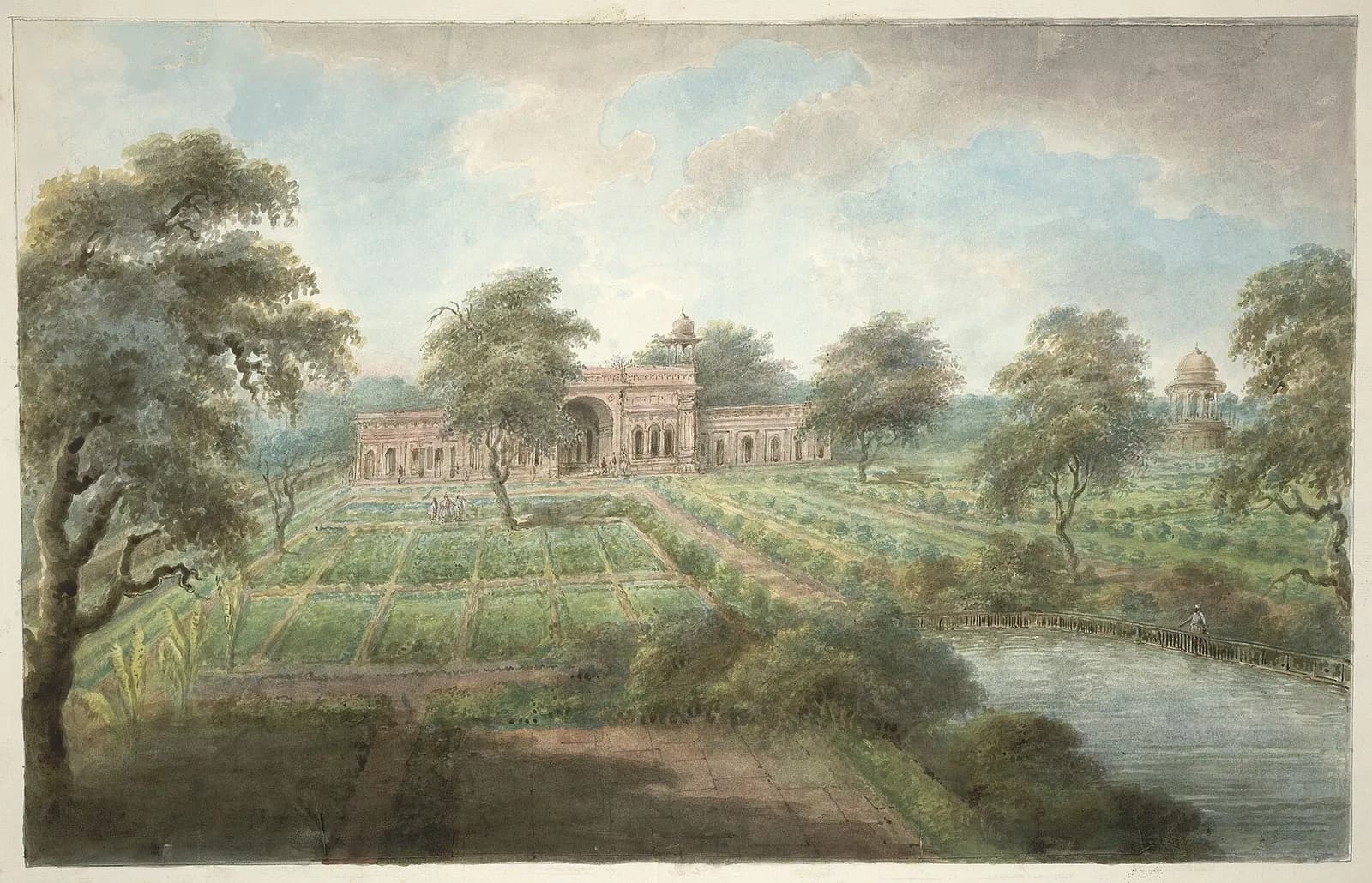
- The chaharbagh layout. The garden maps out the classic Persian chaharbagh, a four-garden grid, with symmetrical water channels fed by old masonry wells dividing the lawns into geometric squares once packed with dense orchards of guava, mango and ber.
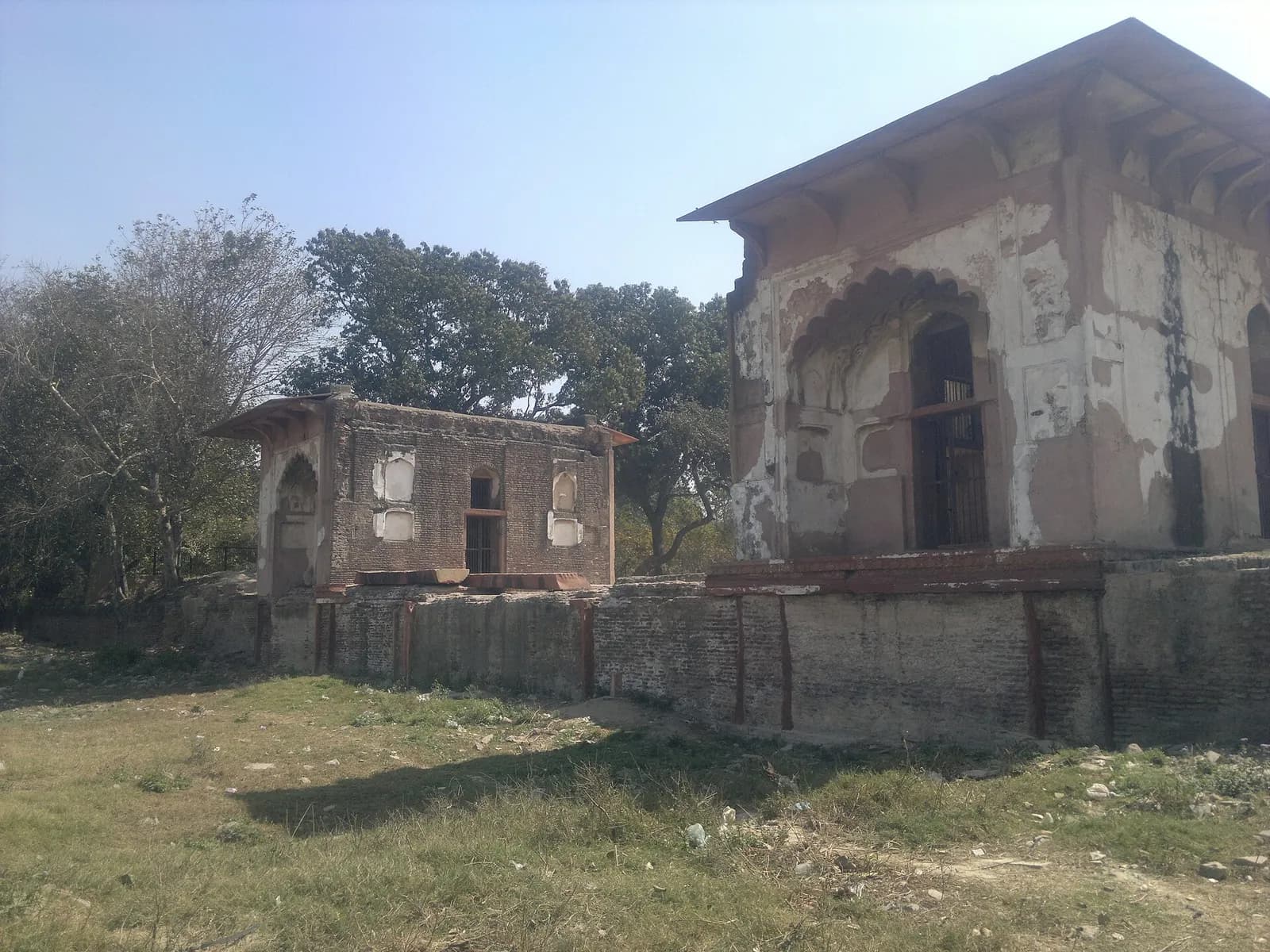
- The Sheesh Mahal pavilion. The central pavilion, the Sheesh Mahal or Crystal Palace, stands on a high, thick stone plinth built to protect it from damp, constructed of red sandstone and grey quartzite with wide semi-circular archways, a grand central hall or dalaan, flanked by smaller side rooms leading to vaulted chambers behind.
- The court of twenty-five fountains. Before the pavilion lies a flat stone parterre set with a grid of twenty-five masonry fountains linked by water channels, designed to mist the air and cool the royal family during the fierce North Indian summers.
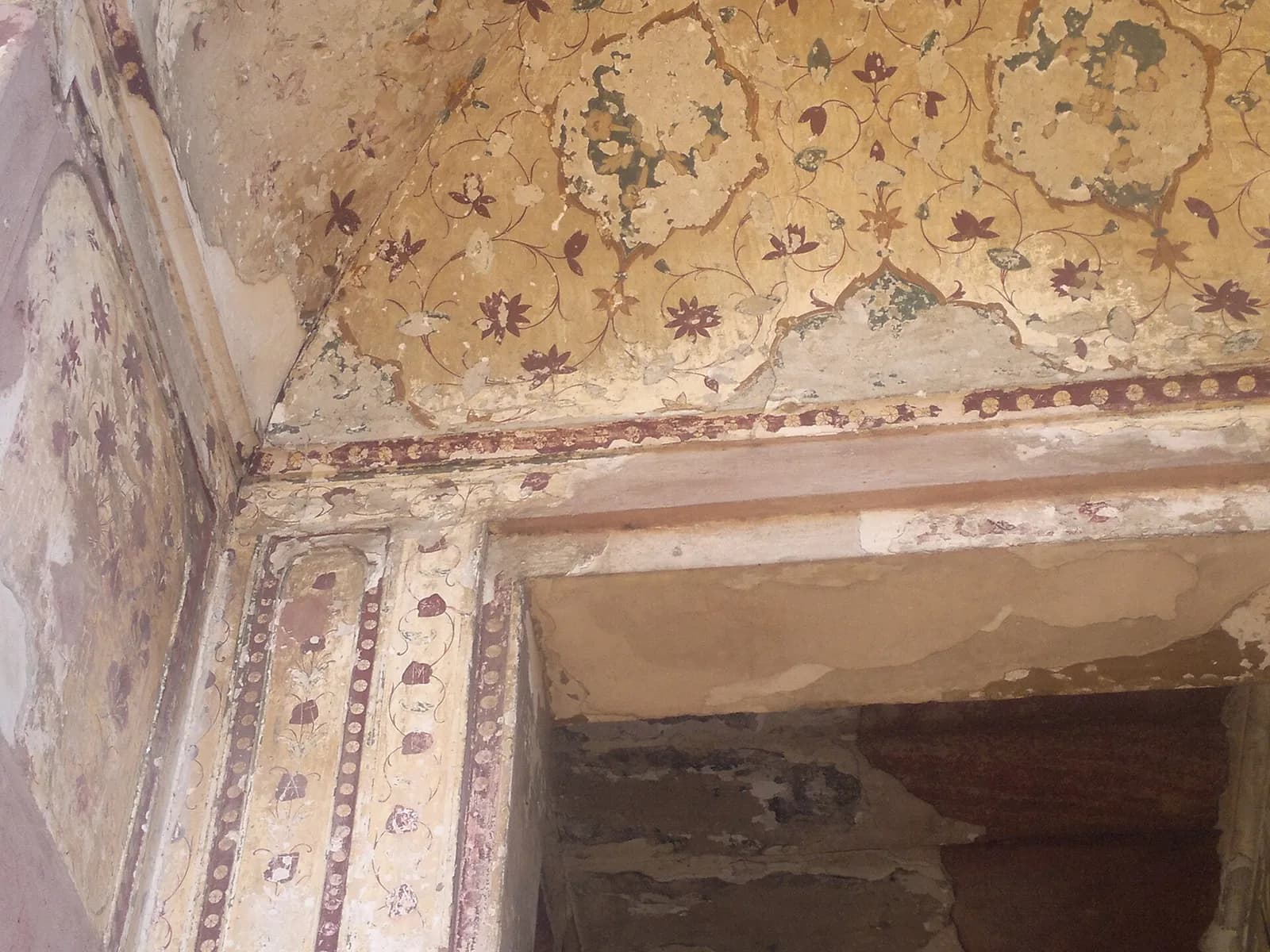
- Traces of Mughal frescoes. Though badly weathered, the high ceilings and inner alcoves of the Sheesh Mahal still hold rare surviving traces of 17th-century Mughal wall paintings, with intricate floral bouquets, leaf medallions and gold-and-crimson arabesques.
This combination makes the Sheesh Mahal and its garden a genuine, if faded, example of Mughal pleasure-garden design, where architecture, water and planting were conceived together to create a cool, beautiful retreat from the heat. The surviving fresco traces are particularly precious, offering a glimpse of how richly the pavilion was once decorated and the court of fountains and the chaharbagh layout show the sophistication of Mughal water engineering. For the visitor, the pleasure lies in reading these features, the raised pavilion, the fountain court, the geometric garden and the faint painted ceilings and in imagining the garden in its imperial prime, cool and green and alive with water.
The garden and the neighbourhood: a modern metamorphosis
One thing worth understanding before visiting is the relationship between the historic garden and the famous modern district that surrounds it, as it often confuses visitors. The name Shalimar Bagh today means two things and it helps to know the difference:
- The residential colony. After independence, the vast orchards and outer lands of the royal garden were absorbed into the city's growth and developed by the DDA into an upscale, busy residential district. Today, to most people, Shalimar Bagh is a well-known North Delhi neighbourhood of apartment blocks, markets and hospitals, rather than a Mughal garden.
- The historic core. The actual Mughal garden, with the Sheesh Mahal, survives as a protected heritage park within this district, the DDA District Park, where the pavilion and the remnants of the old garden can still be seen.
- The historic village pocket. Tucked behind the park lies the original Shalimar Village, a pocket of narrow old lanes where fragments of the original Mughal wells and outer gateways survive, embedded in the walls of local houses.
This modern metamorphosis is part of the story of Delhi itself, where imperial gardens and estates have repeatedly been absorbed into the expanding city. For the visitor, the key is simply to know that you are heading for the heritage park and its Sheesh Mahal, at the heart of the residential district, rather than the colony as a whole and that the survival of the historic garden amid the apartment blocks is itself a small triumph of preservation. The village pocket behind the park, with its embedded Mughal fragments, is a further reward for the curious explorer.
Conservation and the garden today
It is worth knowing something of the garden's modern condition, for it has passed through neglect to renewed care. Through the late 20th century the Sheesh Mahal was badly neglected, suffering from weathering and vandalism, until the ASI carried out a conservation drive to seal its leaking roofs, clean and preserve the eroded plaster and protect the surviving fresco traces with a secure barrier around the central hall. The wider park has meanwhile been rejuvenated by the DDA, which cleared the overgrown scrub, restored the walking paths and planned further improvements to the grounds. The result is that the historic Sheesh Mahal is stabilised and the surrounding park is a pleasant, usable green space, though the pavilion remains a weathered ruin rather than a restored palace and its frescoes are faint and fragile. For the visitor, this means Shalimar Bagh can be enjoyed today as both a heritage site and a neighbourhood park, with the understanding that the Sheesh Mahal is an atmospheric survival under ongoing care rather than a polished monument. It is a reminder of the constant effort needed to preserve Delhi's many layers of history amid the pressures of the modern city.
What to expect at Shalimar Bagh
A visit to Shalimar Bagh is peaceful, green and quietly historic, a complete contrast to the busy district around it and knowing what to expect helps you enjoy it. The heritage garden sits as a public park within the residential colony, frequented by local walkers and families rather than tourists, so the atmosphere is relaxed and local. Entering the park, you make your way to the Sheesh Mahal near its centre, the weathered Mughal pavilion on its high plinth, where you can see the grand central hall, the fountain court before it and, if you look closely at the ceilings and alcoves, the faint traces of old frescoes. Walking the grounds, exploring the pavilion, picturing the chaharbagh and the coronation that took place here and enjoying the greenery is the essence of the visit, which takes about an hour.
A few practical points help. As a public park it is easy and pleasant to walk, best enjoyed in the cooler morning hours for quiet exploration of the monument. Sensible shoes are useful for the grounds and the pavilion plinth. The Sheesh Mahal may be fenced or partly restricted to protect the frescoes, so some areas may only be viewable from outside. As with any urban park ordinary awareness of your surroundings is wise. For the visitor, the key is to approach Shalimar Bagh as a historic Mughal garden hidden within a modern neighbourhood, taking time at the Sheesh Mahal and appreciating the remarkable history, rather than expecting a grand, manicured monument.
Visiting tips
A few pointers make a visit to Shalimar Bagh smoother and more rewarding:
- Head for the Sheesh Mahal. The Mughal pavilion near the park's centre is the historic heart and the reason to visit.
- Come in the morning for quiet, crowd-free exploration of the monument.
- Look for the fresco traces on the ceilings and alcoves of the Sheesh Mahal.
- Picture the chaharbagh and fountains, the old garden layout around the pavilion.
- Know it is a heritage park within a colony, so head for the DDA District Park, not just the neighbourhood.
- Wear comfortable shoes for the park and the pavilion plinth.
- Seek out the old village pocket behind the park for embedded Mughal fragments.
- Allow about an hour for the garden and the Sheesh Mahal.
The key point is to treat Shalimar Bagh as a hidden Mughal heritage garden, heading for the Sheesh Mahal, appreciating its extraordinary history and faded beauty and enjoying the green space around it.
Best time to visit Shalimar Bagh
The best time to visit is during the cooler months, from October to March, when walking the park and exploring the Sheesh Mahal is comfortable and within the day during the morning, when the park is quiet and the light is soft for seeing the pavilion and its frescoes before the families arrive in the evening. A pleasant winter morning is ideal for a relaxed visit to the historic garden. The summer months are hot for the open park, though the shade of the old trees helps and the monsoon leaves the garden green but humid, so the winter window is clearly the most comfortable. Because the visit is fairly short, it combines well with other North Delhi sights on a cool-season day. Our guide to the best time to visit Delhi sets out the seasons across the city in more detail.
How to reach Shalimar Bagh (nearest metro)
Shalimar Bagh heritage park lies within the DDA District Park in the Shalimar Bagh district of North West Delhi and is easy to reach by metro. The nearest station is Shalimar Bagh on the Pink Line, from which a short five-minute auto-rickshaw or e-rickshaw ride along Ring Road brings you to the park entry, with Azadpur, an interchange for the Yellow, Pink and Red Lines and Netaji Subhash Place, on the Pink and Red Lines, both about 1.4 kilometres away as alternatives. There is no dedicated monument parking, so those arriving by car use street parking or the paid decks at nearby markets. Because the garden sits in a well-connected part of North West Delhi, the metro combined with a short ride is the easiest approach. Set in the north of the city, it makes a rewarding addition to a Delhi day tour or a heritage-focused New Delhi tour that explores beyond the usual circuit.
Places to visit near Shalimar Bagh
Shalimar Bagh lies in North West Delhi, within reach of the historic north of the city and, a little further, the great monuments of the capital, so it makes a good part of a wider North Delhi outing. The busy districts of Azadpur and Pitampura are nearby and a short way off lies the old walled city with the mighty Red Fort and the bustling lanes of Chandni Chowk. The central monuments of the capital, including the ceremonial India Gate and the astronomical Jantar Mantar, are a manageable ride to the south, as is the old citadel of Purana Qila.
Further out, the capital's other great landmarks round out a full picture of the city: the serene Humayun's Tomb, the towering Qutub Minar and the modern marvels of the Lotus Temple and Akshardham. For more of Delhi's history, the ruins of Feroz Shah Kotla, the sprawling Mehrauli Archaeological Park, the historic Hauz Khas Fort and the medieval stepwell of Agrasen ki Baoli are well worth adding and our roundup of the important monuments of Delhi ties them together. To extend your trip, see our guide to nearby places to visit in Delhi.
Shalimar Bagh in your Delhi itinerary
For most visitors, Shalimar Bagh works best as a short, offbeat heritage stop within a wider North Delhi outing rather than a mainstream destination on its own, since it is a modest and somewhat hidden site. A natural plan is to combine the garden and its Sheesh Mahal with other north Delhi sights or with the monuments of the old walled city nearby, for a day that moves from a Mughal coronation garden to the heart of imperial Delhi. The garden needs only about an hour, but its extraordinary history, as the place where Aurangzeb was crowned emperor, gives it an importance far beyond its quiet appearance and it adds a note of real historical depth to a day of sightseeing. It suits the history enthusiast, the lover of Mughal gardens and the traveller who enjoys discovering the stories hidden in Delhi's modern neighbourhoods.
If Delhi is your gateway to the wider Golden Triangle, Shalimar Bagh offers a quiet but genuinely significant piece of Mughal history away from the crowds, a garden where an emperor was crowned, surviving against the odds within a bustling modern district. Many of my guests are struck by the contrast between the ordinary neighbourhood and the momentous history of its hidden garden and it deepens their understanding of how layered and surprising Delhi is before they travel on to Agra and Jaipur.
Travel tips for visiting Shalimar Bagh
A few pointers make a visit even better:
- Reach it via Shalimar Bagh metro, then a short ride to the DDA District Park.
- Go straight to the Sheesh Mahal, the Mughal pavilion at the garden's heart.
- Visit in a quiet morning for the best experience of the monument.
- Look for the faded frescoes and picture the fountain court and chaharbagh.
- Combine it with the old city or other North Delhi sights for a fuller day.
- Wear comfortable shoes for the park grounds.
- Explore the old village pocket behind the park for Mughal fragments.
- Allow about an hour for the garden and the pavilion.
If you would like a local guide to show you Shalimar Bagh and tell the remarkable story of Aurangzeb's coronation and the Sheesh Mahal, message our team on WhatsApp at +91 7302265809 with your travel dates and group size and we will shape the day for you.
Is Shalimar Bagh worth visiting?
Yes, for the history-minded traveller Shalimar Bagh is a genuinely rewarding, if low-key, stop, one of the most historically significant hidden gardens in Delhi. There are few places where you can stand in the very garden where a Mughal emperor, Aurangzeb, was crowned, see a surviving 17th-century pavilion with its faded frescoes and fountain court and trace a classic chaharbagh, all tucked improbably within a busy modern North Delhi colony. It is free to enter, peaceful and rich in a history most visitors never suspect. The caveats are honest: it is a modest, weathered heritage site within a public park, not a grand restored monument and the Sheesh Mahal is an atmospheric ruin rather than a showpiece. For the traveller who values history over polish and enjoys the hidden, surprising side of Delhi, Shalimar Bagh is well worth seeking out and I recommend it to guests exploring the north of the city.
Plan your trip with us
At Experience My India, through our Delhi and Golden Triangle travel desk, we design unhurried, well paced trips that make room for historically rich hidden places like Shalimar Bagh and its Sheesh Mahal and not just the famous monuments, with guides who can tell the dramatic story of Aurangzeb's coronation and point out the surviving Mughal details most visitors miss. Whether you want a relaxed set of Delhi Agra tours or a full Golden Triangle route through Delhi, Agra and Jaipur, we plan around your pace, your interests and the right season. Share your dates and the kind of trip you have in mind through our enquiry page, tell us your group size and we will put together an honest, tailored plan rather than a rushed checklist.
Related guides
- Places to visit in Delhi, for the wider picture
- Pair it with Roshanara Bagh, the nearby Mughal garden and tomb of a princess of the same court
Enquire Now
Ready to Explore
The Heart of Delhi?
Explore the Red Fort, Qutub Minar, Humayun's Tomb, and the vibrant streets of Old Delhi with our expert-guided premium tours of India's capital city.

Delhi
Premium Tour Package
Questions
Frequently asked questions
What is Shalimar Bagh in Delhi?
It is a 17th-century Mughal garden in North West Delhi, laid out in 1653 as an imperial summer retreat, with the Sheesh Mahal pavilion at its heart. It is famous as the garden where Aurangzeb held his first coronation and survives today as a heritage park within the residential district that shares its name.
Who built Shalimar Bagh and when?
Why is Shalimar Bagh historically important?
What is the Sheesh Mahal at Shalimar Bagh?
What are the timings and entry fee?
Which is the nearest metro station?
Is the Shalimar Bagh garden the same as the neighbourhood?
Is the Delhi Shalimar Bagh the same as the one in Kashmir?
What is there to see at Shalimar Bagh today?
How much time do I need?
Explore more
Plan your Shalimar Bagh trip with us

Interested in Shalimar Bagh, Delhi: History, the Sheesh Mahal and Guide?
Chat with our travel team for a custom quote, or browse every package.
Related Attractions
9Ready to explore Shalimar Bagh, Delhi: History, the Sheesh Mahal and Guide?
Book your private tour today and experience the magic of India's rich heritage.