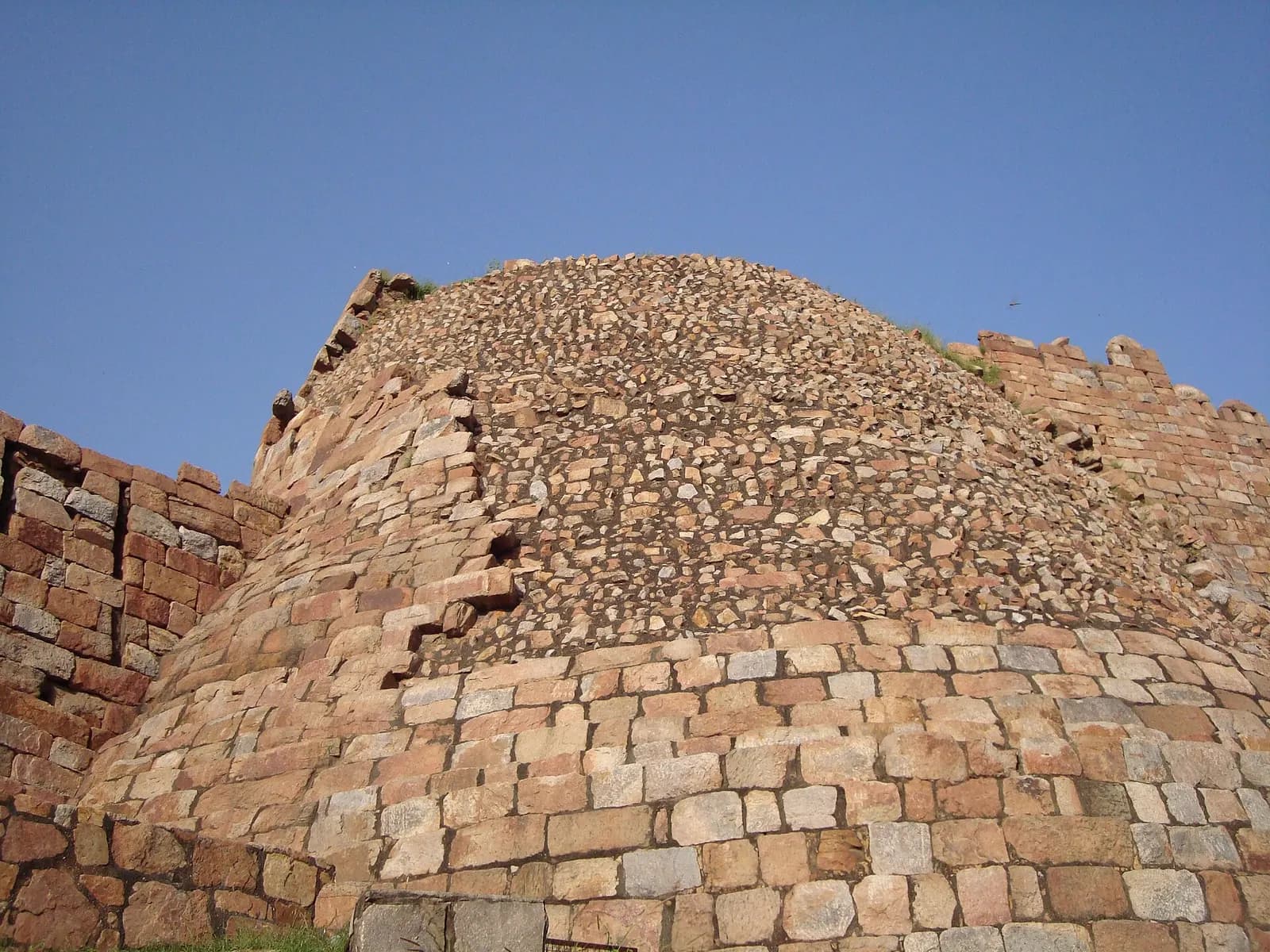
Tughlaqabad Fort Delhi: History, Timings and Visitor Guide
Visiting Tughlaqabad Fort, Delhi's third city? Its history, the saint's curse, the massive walls, Tughlaq's tomb, timings, tickets and the nearest metro.
In a Nutshell
“Tughlaqabad Fort is a vast ruined 14th-century fortress in South Delhi, the third of the historic Seven Cities of Delhi, built by Ghiyas-ud-din Tughlaq from 1321 as a stronghold against the Mongols. Famous for its massive sloping walls and its legendary abandonment within a few years, tied to the curse of the Sufi saint Nizamuddin Auliya, it also holds the handsome red sandstone and marble tomb of its founder. A rugged, atmospheric ruin on the Aravalli ridge, it is an ASI-ticketed monument, open daily and reached from Tughlakabad metro. It features on our heritage Delhi tours, run by a unit of Experience My India.”
Tughlaqabad Fort is one of Delhi's most monumental and atmospheric ruins, a colossal wilderness fortress wrapped in a famous legend, offering sweeping views and a powerful sense of the city's medieval past. For history lovers and those drawn to grand, offbeat heritage, it is a memorable stop. Our team at Delhi Agra Tour Packages often includes it on a South Delhi heritage outing and it adds an epic, story-rich dimension to a wider Golden Triangle tour through the capital.
I am Abhay Sharma, Delhi born and a Golden Triangle guide since 2015 and I love bringing history-minded guests here, because few places convey the raw power, ambition and swift downfall of a medieval dynasty as vividly as these mighty, abandoned walls. This guide gathers everything I would tell a visitor beforehand, checking against current information, including the history, the curse, the architecture, the timings and how to reach it.
Details
Tughlaqabad Fort at a glance
| Detail | Information |
|---|---|
| Location | Mehrauli-Badarpur Road, Tughlakabad, South Delhi |
| Known as | The third city of Delhi |
| Built | From 1321, by Ghiyas-ud-din Tughlaq |
| Famous for | Its massive battered walls and the saint's curse |
| Also holds | The tomb of Ghiyas-ud-din Tughlaq |
| Entry | A modest ASI entry ticket |
| Nearest metro | Tughlakabad or Govindpuri |
| Time needed | About 1.5 to 2 hours |
Tughlaqabad Fort timings
| Detail | Information |
|---|---|
| Open | Daily, 7:00 AM to 5:00 PM |
| Setting | A vast hilltop ruin on the Aravalli ridge |
| Time needed | About 1.5 to 2 hours |
Tughlaqabad Fort is open every day from 7:00 AM to 5:00 PM. Because the fort is vast, a proper visit, taking in the citadel, the walls and the tomb across the road, takes about one and a half to two hours and good walking is involved. These timings are current at the time of writing and can vary, so a daytime visit, arriving early, is best.
Entry fee
| Item | Information |
|---|---|
| Entry fee | A modest ASI entry ticket, payable at the gate |
| Tickets | Standard ASI rates, lower for Indians, higher for foreign visitors |
| Note | Reconfirm the current ticket price, as rates change |
How to reach Tughlaqabad Fort
| From | Route |
|---|---|
| Tughlakabad metro (Violet Line) | A short auto to the main ticketing gates |
| Govindpuri metro (Violet Line) | Also convenient, a short auto ride |
| Mehrauli-Badarpur Road | The fort runs along this road in South Delhi |
| By car | Parking near the main entrance gate |
What is Tughlaqabad Fort?
Tughlaqabad Fort is a vast, ruined medieval fortress in South Delhi, one of the most monumental of all the city's historic sites and famous as the third of the legendary Seven Cities of Delhi. Built from 1321 by Ghiyas-ud-din Tughlaq, the founder of the Tughlaq dynasty, as a massive military stronghold to withstand the ferocious Mongol invasions that threatened the Sultanate, it is defined by its raw, heavy, powerful architecture, enormous sloping walls of grey stone running for kilometres along the rocky Aravalli ridge, which contrasts sharply with the delicate detailing of later Mughal eras. Yet for all its might, the fort was abandoned within only a few years of its building, a swift downfall famously tied to the curse of the great Sufi saint Nizamuddin Auliya. Across the road stands the handsome tomb of its founder and the whole complex, rugged, ruined and steeped in legend, offers one of the most powerful encounters with medieval Delhi anywhere in the city.
Several things make it special and they are worth drawing out:
- The third city of Delhi. One of the Seven Cities of Delhi, a complete 14th-century city-fortress, now a vast ruin.
- A Mongol-proof stronghold. Built by Ghiyas-ud-din Tughlaq as a mighty fortress against the Mongol threat, with colossal battered walls.
- The saint's curse. Its swift abandonment is tied to the famous curse of Nizamuddin Auliya, one of Delhi's most enduring legends.
- The founder's tomb. The red sandstone and marble tomb of Ghiyas-ud-din Tughlaq stands across a causeway, a landmark of early Indo-Islamic architecture.
- Raw military grandeur. Massive walls, bastions, gateways and water systems that convey the raw power of the Tughlaq age.
It is one of the most monumental and atmospheric of the offbeat things to do in Delhi and a major entry among the important monuments of Delhi.
History of Tughlaqabad Fort
The history of Tughlaqabad Fort is a dramatic tale of ambition, speed and sudden downfall, which gives these mighty ruins their peculiar poignancy. The fort was built by Ghazi Malik, a general who seized the throne of Delhi and took the royal title Ghiyas-ud-din Tughlaq, founding the Tughlaq dynasty, the line that would rule the Sultanate at its greatest extent. He conceived Tughlaqabad as a grand new fortified capital, a city-fortress that would project his power and, above all, defend Delhi against the relentless Mongol invasions from the northwest. Its history is remarkable above all for its brevity:
- A rapid construction. Work began in 1321 and proceeded at an astonishing pace, bringing the huge city-fortress to a semi-completed, operational state in around 1325, just four years.
- A swift abandonment. Despite this feat, the entire city-fortress was abruptly abandoned by about 1327, lasting less than seven years as an active imperial capital.
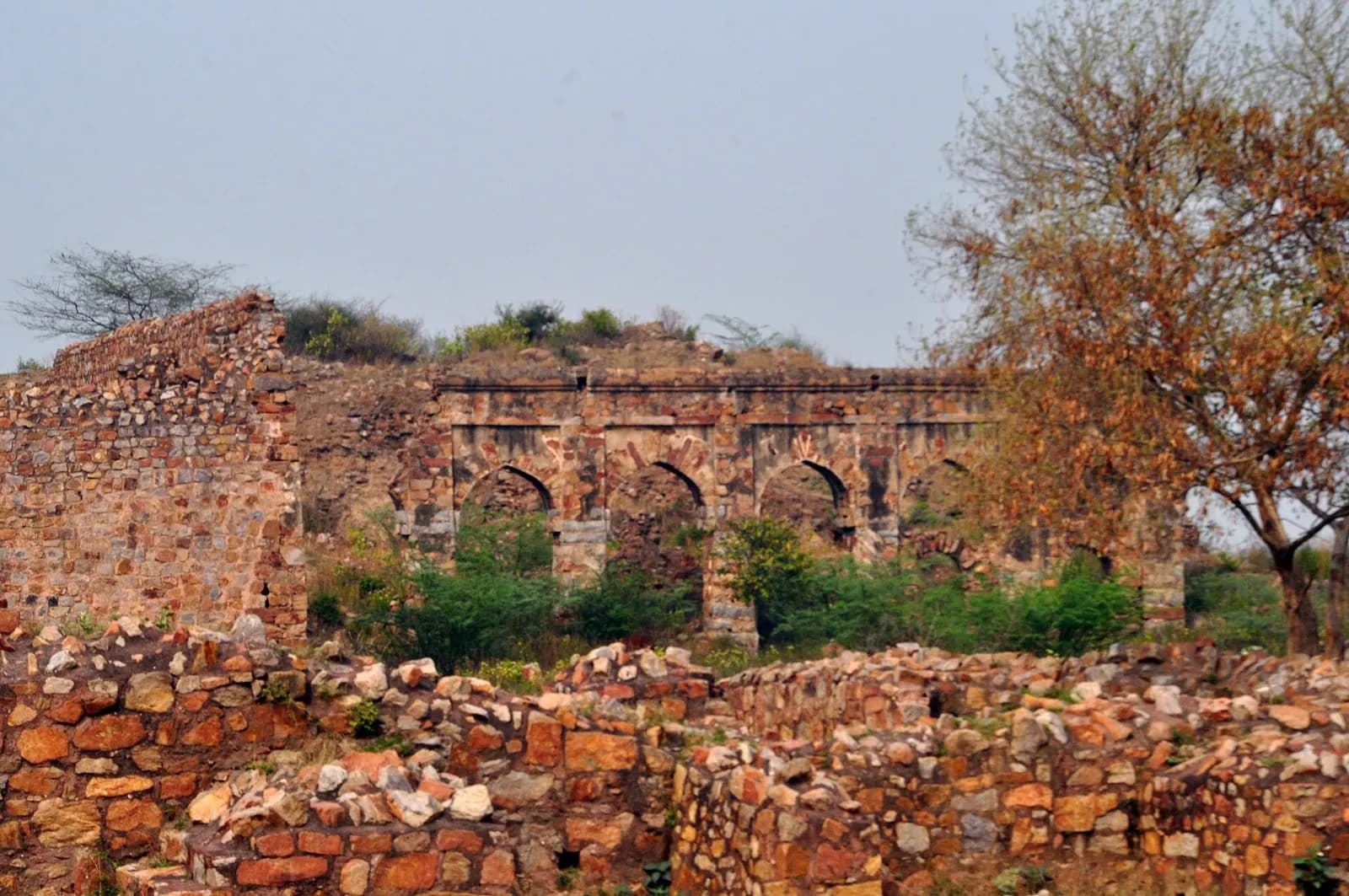
- A fall into ruin. After the dynasty moved on, the fort fell into complete ruin and was, in time, occupied only by nomadic herdsmen, exactly as legend had foretold.
The speed of both its building and its abandonment is extraordinary and it is this, combined with the famous legend that explains it, that gives Tughlaqabad its special character among Delhi's monuments. Here was a fortress built with immense effort and ambition to last for ages, yet used as a capital for only a handful of years before being left to the wild, a vivid lesson in the impermanence of even the mightiest human works. For the visitor, knowing this history of a great city raised and abandoned in less than a decade transforms the vast, empty ruins into a powerful meditation on ambition and fate, which is the heart of the fort's enduring fascination.
The curse of Nizamuddin Auliya
The swift and total abandonment of such a mighty fortress cried out for an explanation and Delhi found one in the most famous legend attached to any of its monuments, the curse of the Sufi saint Nizamuddin Auliya. This story is inseparable from Tughlaqabad and is the reason many visitors come. According to the legend, a bitter feud arose between the Sultan Ghiyas-ud-din Tughlaq and the revered saint Nizamuddin Auliya over labour and water. The Sultan, desperate to finish his fort, decreed that every single labourer in Delhi must work exclusively on its construction, which halted the digging of a sacred stepwell or baoli, that the saint was having built for his followers.
Enraged at this interference with his holy work, the saint is said to have issued a famous prophecy against the fort: "Ya rahe ujjar, ya base gujjar", meaning "May it remain desolate or be occupied only by nomadic cattle herders". And so it came to pass, for after the dynasty's fall the fort fell into complete ruin and was, for centuries, inhabited only by Gujjar herdsmen and their cattle. The legend has a second, equally famous episode. As the Sultan hurried back from a campaign in Bengal, eager to see his completed fort, the saint, warned of the king's anger toward him, calmly uttered the words "Hunuz Dilli dur ast", meaning "Delhi is still far away". True to the saint's words, the Sultan never reached his fortress to rule from it: he died just outside the city when a wooden reception pavilion, raised to welcome him, collapsed upon him. For the visitor, this legend, whether taken as history or as cherished folklore, is the soul of Tughlaqabad and knowing it makes the walk through the desolate, herder-haunted ruins profoundly resonant, a place where a saint's word is said to have doomed a king's greatest work.
Architecture and defences
Architecturally, Tughlaqabad is a masterpiece of raw military engineering, built for defence and durability rather than beauty and its features convey the power of the Tughlaq age. Classified strategically as a vana-durga or wilderness fort, it uses the natural, rugged topography of the Aravalli hills to maximise its defensive strength. Its key elements are worth understanding:
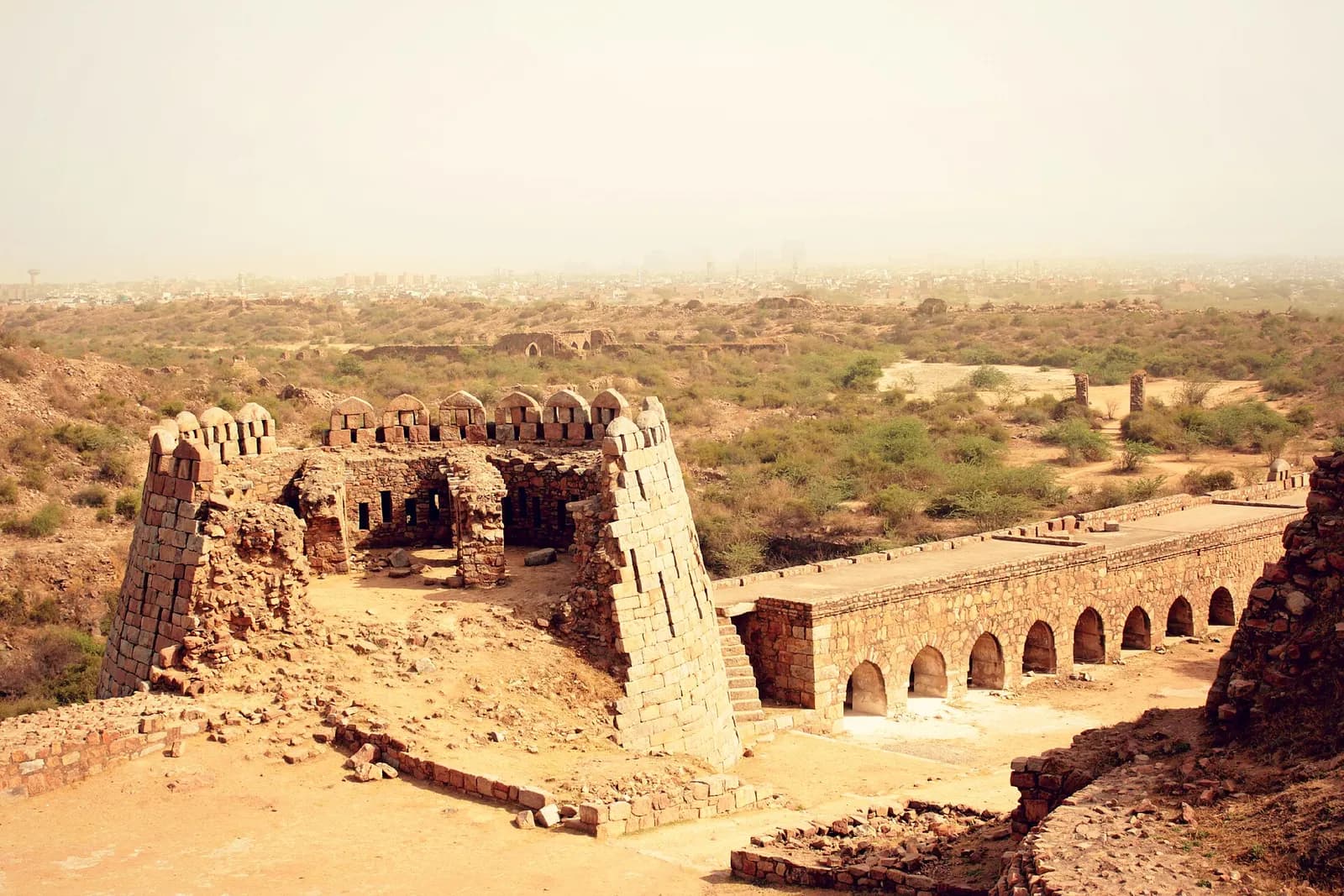
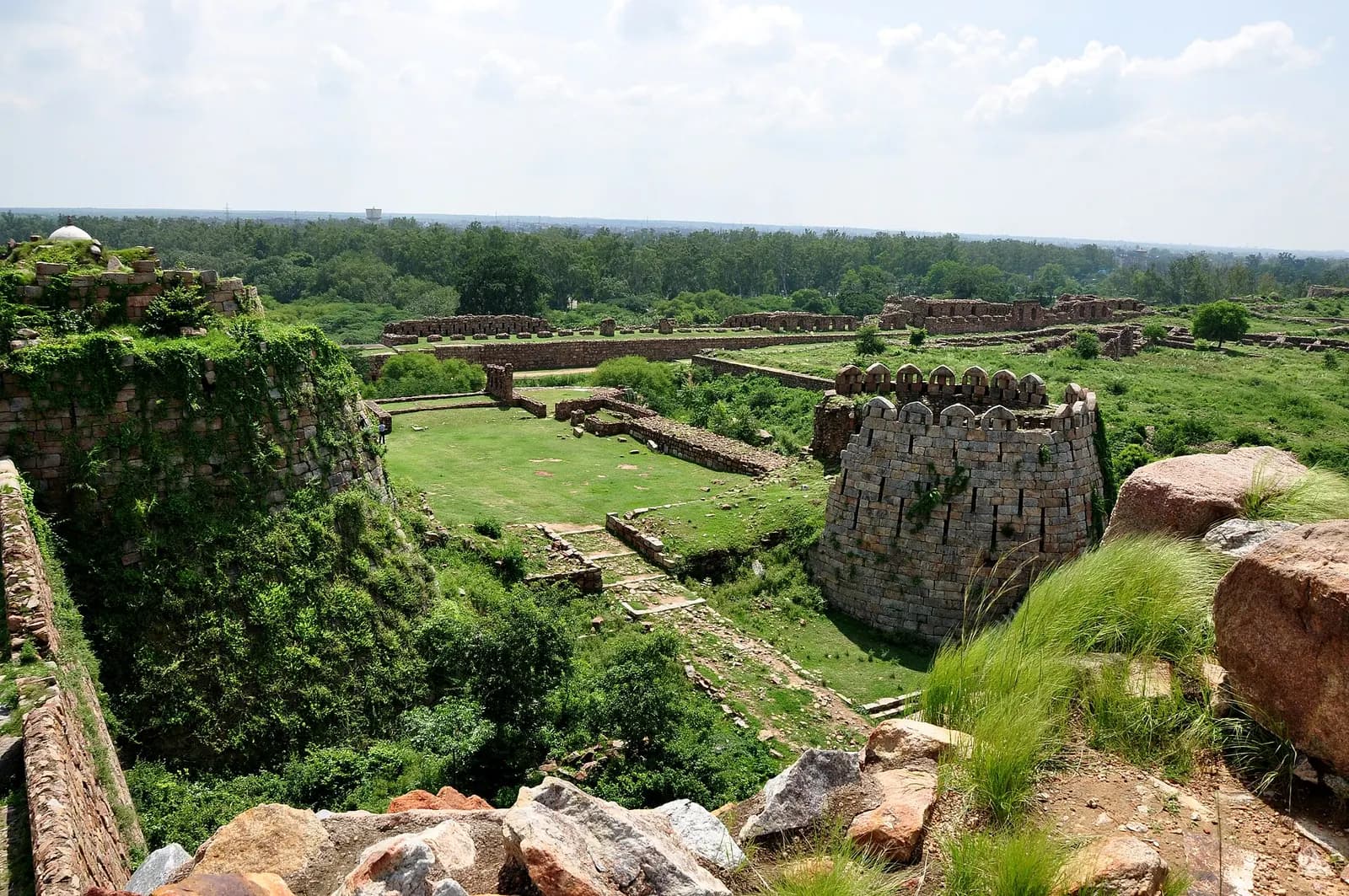
- The battered walls. The fort is defined by its massive sloping or battered, walls, which incline steeply inward, dramatically increasing stability at the base to resist battering rams and earthquakes. Built of cyclopean grey quartzite rubble bound with lime mortar, they run for a perimeter of around 6.5 kilometres and are 10 to 15 feet thick.
- The three zones. The interior is divided into three walled areas: the heavily fortified Citadel, the highest point, with the Bijai-Mandal tower as command centre and lookout; the Palace area, with underground passages, vaults and audience halls; and the Residential city, a grid of homes, garrison quarters and markets.
- The bastions and gates. The perimeter is reinforced with massive, double-storied semi-circular bastions pierced with thousands of arrow-slits and gun-ports; the fort is said to have had 52 grand gateways, of which only a handful survive.
- The water systems. As the fort sat on dry, rocky ground, the southern flank was dammed to catch seasonal runoff, creating a huge artificial lake that doubled as a defensive moat, while inside were deep stepped rain-harvesting tanks and grain silos to withstand long sieges.
The overall impression is of overwhelming strength and scale, a fortress conceived on a colossal, almost brutal scale to be impregnable, its sloping grey walls, bastions and gates radiating raw power even in ruin. The ingenuity of the battered walls, the three-part city plan and the elaborate water defences all speak to the seriousness of the Mongol threat and the ambition of its builder. Knowing what to look for, the battered walls, the citadel and Bijai-Mandal, the bastions and arrow-slits and the great dammed lake, turns a walk through the ruins into an appreciation of one of the great military works of medieval India.
The tomb of Ghiyas-ud-din Tughlaq
Directly opposite the southern ramparts of the fort stands its most beautiful and best-preserved element, the tomb of the founder, Ghiyas-ud-din Tughlaq, which offers a striking contrast to the raw grey fortress and is an important monument in its own right. The tomb is remarkable both for its setting and its design:
- The island fortress and causeway. The tomb sits inside its own small, standalone pentagonal fortress, which was originally completely surrounded by the waters of the artificial lake and it is reached by a high stone causeway some 228 metres long, carried on arches across what was once water.
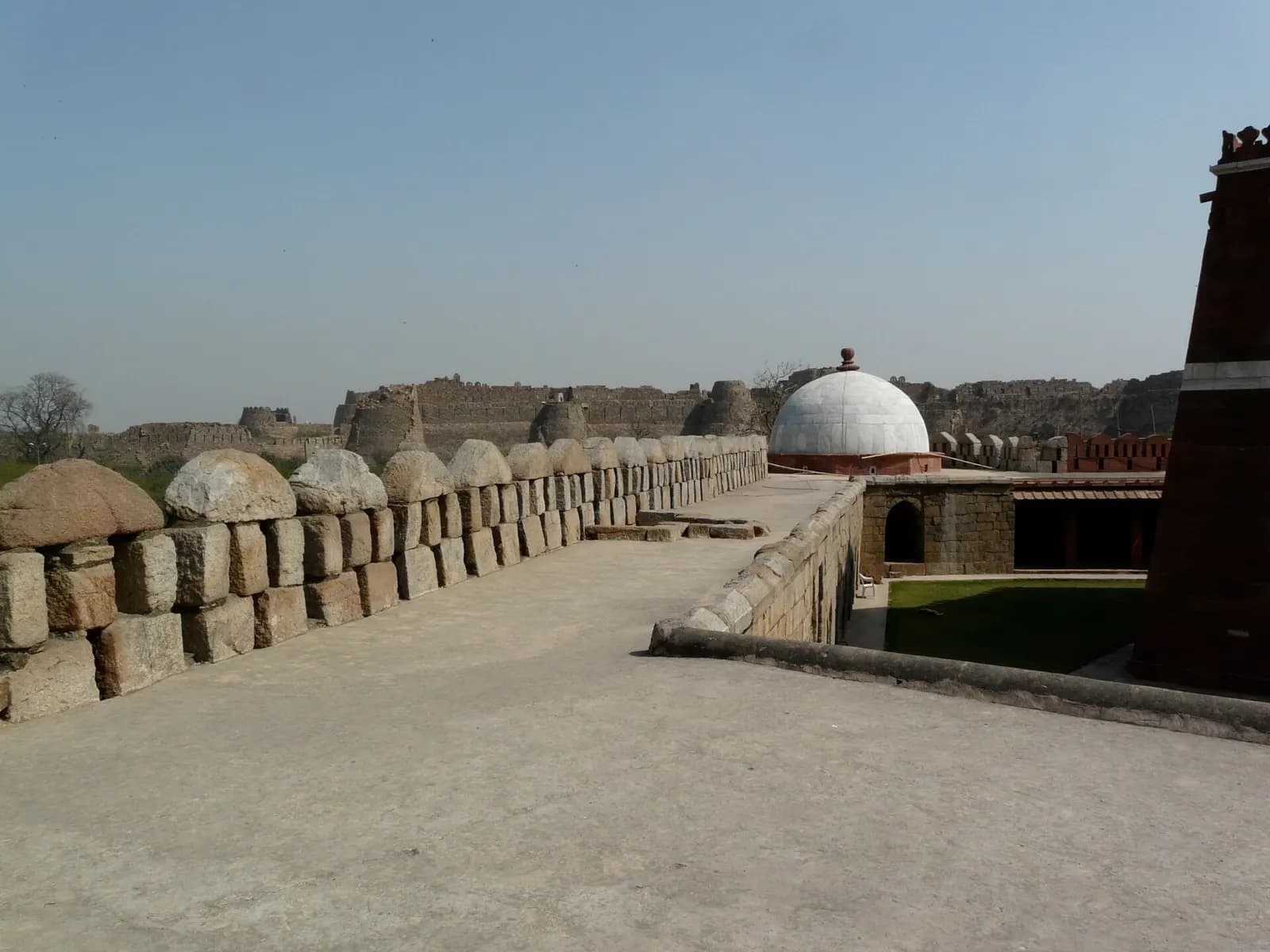
- The material contrast. Unlike the grey rubble of the fort, the tomb chamber is built of smooth, vibrant red sandstone, crowned by a striking white marble dome, a combination that would become a hallmark of later Indo-Islamic and Mughal architecture.
- The structural fusion. The entrance arches show an arcuate-trabeate fusion, combining the Islamic pointed arch with a traditional Hindu flat stone beam or lintel, crossing beneath it, a technique that gave strong support to the heavy marble dome.
- The graves within. Inside lie the graves of the Sultan Ghiyas-ud-din Tughlaq, his wife and his son and successor, Muhammad bin Tughlaq.
The tomb is a gem of early 14th-century architecture and a telling counterpoint to the fort: where the fortress is all grey, sloping, austere power, the tomb is red, white, compact and dignified, pointing forward to the beauty of later ages. Its island setting, reached by the long causeway across the former lake, is wonderfully atmospheric and the arcuate-trabeate arches are a fascinating example of how Islamic and indigenous Indian building techniques were fused in this period. For the visitor, the tomb is an essential part of any visit to Tughlaqabad, both for its beauty and for the chance to stand at the grave of the man whose soaring ambition and swift downfall the whole site commemorates.
What to expect at Tughlaqabad Fort
A visit to Tughlaqabad is an epic, atmospheric and physically demanding experience, quite different from the city's compact, manicured monuments and knowing what to expect helps you make the most of it. This is an enormous ruin spread over rocky, hilly terrain, so a visit involves a good deal of walking, climbing and exploring across uneven ground. The vast residential sectors are heavily ruined, overgrown with thorny scrub and difficult to navigate, so most visitors focus on the more accessible citadel and palace zones, whose elevated walkways and ramparts offer magnificent panoramic views over South Delhi and on the great walls and gateways. The tomb across the road, reached by the causeway, is a highlight and should not be missed. A proper visit takes about one and a half to two hours.
Because the fort is so large, wild and rugged, a few things are worth bearing in mind. Sturdy footwear, water, sun protection and a hat are essential, as there is a lot of exposed walking and little shade and it is wise to carry your own water. The overgrown far sectors can be isolating, so it is best to keep to the main areas, visit in daylight and ideally not go entirely alone in the remoter parts. The fort has also been the subject of encroachment and clearance controversies, so some areas may be affected by ongoing conservation work. The mood, though, with the colossal battered walls, the sweeping views, the brooding air of a great abandoned city and the weight of the famous legend, is genuinely awe-inspiring. Come early, well-equipped and knowing the story and Tughlaqabad rewards you with one of the most powerful and memorable heritage experiences in all of Delhi.
Tughlaqabad Fort timings and entry
Tughlaqabad Fort is open every day from 7:00 AM to 5:00 PM. As a centrally protected monument under the Archaeological Survey of India, it has a modest entry ticket, payable at the main gate, at the standard ASI rates, which are lower for Indian citizens and higher for foreign visitors; the exact current price is best reconfirmed before your visit, as rates change over time. Because the fort is vast and spread over hilly ground, a proper visit, taking in the citadel, the ramparts and the founder's tomb across the road, takes about one and a half to two hours and involves considerable walking. It is strongly advised to arrive early in the day, both to beat the heat on the exposed ruins and to have ample time to explore and to come equipped with sturdy shoes, water, sun protection and a hat. The remote residential sectors are heavily ruined and overgrown, so keeping to the main citadel, palace and tomb areas is wisest. These timings and conditions are current at the time of writing and can vary, so plan a daytime visit, reconfirm the ticket price and allow plenty of time.
Visiting tips and what to carry
Because Tughlaqabad is a huge, rugged, exposed ruin, a little preparation makes a big difference:
- Arrive early. Come soon after the 7:00 AM opening to beat the heat and have time for the vast site.
- Wear sturdy shoes. There is extensive walking and climbing over rocky, uneven ground.
- Carry water and sun protection. The ruins are exposed with little shade, so bring water, a hat and sunglasses.
- Keep to the main zones. The far residential sectors are overgrown and isolating, so focus on the citadel, palace, ramparts and tomb.
- Do not miss the tomb. Cross to the founder's tomb via the causeway, a highlight and a beautiful contrast to the fort.
- Visit in daylight and ideally with company, given the size and isolation of the remote parts.
- Allow 1.5 to 2 hours and reconfirm the ASI ticket price.
The key point is to treat Tughlaqabad as a substantial, half-morning expedition rather than a quick stop, coming early and well-equipped for a lot of walking in the open. Done so, the sheer scale and atmosphere of the fort and the beauty of the tomb, make it one of the most rewarding heritage experiences in the city.
Best time to visit Tughlaqabad Fort
The best time to visit is the cooler months, from October to March and within the day the early morning, soon after opening, both to avoid the heat on the exposed ruins and to have the long hours needed to explore the vast fort in comfort. A clear winter morning is ideal, with pleasant temperatures for the extensive walking and climbing and excellent light and visibility for the panoramic views over South Delhi. The summer is punishing on the shadeless hilltop and is best avoided, while the monsoon turns the ruins green and atmospheric but can make the rocky ground slippery and the overgrowth denser. Because so much of the visit is outdoors and strenuous, the combination of cool weather and an early start matters more here than at almost any other Delhi monument. Allow a good one and a half to two hours. Our guide to the best time to visit Delhi sets out the seasons across the city in more detail.
How to reach Tughlaqabad Fort (nearest metro)
Tughlaqabad Fort stands along the Mehrauli-Badarpur Road in the Tughlakabad area of South Delhi, built upon the rocky outcrops of the Aravalli ridge and it is reached most easily by metro and a short auto. The nearest metro stations are Tughlakabad on the Violet Line and Govindpuri, also on the Violet Line and from either it is a short auto-rickshaw ride to the main ticketing gates of the fort. App cabs and autos serve the area and there is parking near the main entrance if you drive. Because the fort is large and somewhat removed from the central monument cluster, it is best treated as a dedicated outing, ideally in the morning. Set in South Delhi, it pairs naturally with a Delhi day tour or a heritage-focused New Delhi tour that takes in the city's great forts and monuments.
Places to visit near Tughlaqabad Fort
Tughlaqabad Fort sits in South Delhi, within reach of several of the city's other great monuments, so it combines well into a wider heritage plan. The towering Qutub Minar and the sprawling Mehrauli Archaeological Park, with their wealth of Sultanate-era ruins from the same broad period, are a manageable ride to the west, making a natural pairing with this Tughlaq-era fort. The modern Lotus Temple and the magnificent Akshardham also lie in the southern and eastern parts of the city.
A ride further brings you to the heart of the capital and its greatest landmarks: the mighty Red Fort and old city, the serene Humayun's Tomb, the ceremonial India Gate, the old fort of Purana Qila and the citadel of Feroz Shah Kotla, built by a later Tughlaq ruler. For more history, the great circle of Connaught Place, the astronomical Jantar Mantar and the historic Hauz Khas Fort complete the sweep of Delhi's past.
Tughlaqabad Fort in your Delhi itinerary
For most visitors, Tughlaqabad Fort works best as a dedicated half-morning expedition rather than a quick stop squeezed between other sights, given its size, its rugged terrain and the one and a half to two hours a proper visit needs. The natural plan is to come early, explore the citadel, the ramparts and the founder's tomb and then combine it with the nearby Qutub Minar and Mehrauli heritage to the west, which belong to the same broad Sultanate era, for a full day immersed in medieval Delhi. It is a stop for travellers with a genuine interest in history, in grand ruins and in the dramatic stories of the Delhi Sultanate and who are happy to do some real walking, rather than for those seeking a quick or comfortable monument visit and it rewards knowing the story of the Tughlaqs and the saint's curse in advance.
If Delhi is your gateway to the wider Golden Triangle, Tughlaqabad Fort offers an unforgettable encounter with the raw power and swift fate of a medieval dynasty, a colossal fortress built and abandoned in less than a decade and a founder's tomb whose red sandstone and marble point forward to the Mughal splendours you will see in Agra. Many of my history-minded guests find the scale of the walls, the sweeping views and the weight of the legend among the most powerful experiences of their Delhi exploration, a complete contrast to the polished imperial monuments and it adds an epic, atmospheric note to a trip before the journey on to Agra and Jaipur.
Travel tips for visiting Tughlaqabad Fort
A few pointers make the visit smoother and more rewarding:
- Know the story first, the third city, Ghiyas-ud-din Tughlaq and the curse of Nizamuddin Auliya, as they bring the ruins to life.
- Come early in the cooler months, soon after the 7:00 AM opening, to beat the heat and have time for the vast site.
- Wear sturdy shoes and carry water, a hat and sun protection, for extensive exposed walking.
- Explore the citadel and ramparts for the best-preserved structures and the panoramic views.
- Cross to the founder's tomb via the causeway, a beautiful highlight not to be missed.
- Keep to the main zones, as the far residential sectors are overgrown and isolating.
- Allow 1.5 to 2 hours and reconfirm the ASI ticket price.
- Reach it via Tughlakabad or Govindpuri metro, then a short auto to the gates.
If you would like a local guide to bring the epic history and the famous legend of Tughlaqabad to life, message our team on WhatsApp at +91 7302265809 with your travel dates and group size and we will shape the day for you.
Is Tughlaqabad Fort worth visiting?
For history lovers and those drawn to grand, atmospheric ruins, yes, it is a memorable and powerful stop, among the most impressive in the whole city. There are few places in Delhi that convey the raw ambition and sudden downfall of a medieval dynasty as vividly as these colossal battered walls, built in just four years to be impregnable and abandoned in less than seven, haunted by the famous curse of Nizamuddin Auliya and, for centuries, by nothing but herdsmen and their cattle. Add the sweeping views from the ramparts and the beautiful red-and-white tomb of the founder across the causeway and it is a monument of real grandeur. The honest note is that it is a vast, rugged, often overgrown ruin requiring a lot of walking in the open, with the remoter sectors ruined and isolating, so it rewards the fit and the well-prepared more than the casual visitor and it needs an early start and a couple of hours. But for the curious, history-minded traveller willing to make the expedition, it is one of the most awe-inspiring and rewarding heritage sites in Delhi and I love showing it to guests with an appetite for the epic and the offbeat.
Plan your trip with us
At Experience My India, through our Delhi and Golden Triangle travel desk, we design unhurried, well paced trips that make room for grand, atmospheric sites like Tughlaqabad Fort, not just the compact headline monuments and we know how to time and interpret a big, rugged ruin so you get the most from it. Whether you want a relaxed set of Delhi Agra tours or a full Golden Triangle route through Delhi, Agra and Jaipur, we plan around your pace, your interests and the right season, with local guides who know the history and the legends. Share your dates and the kind of trip you have in mind through our enquiry page, tell us your group size and we will put together an honest, tailored plan rather than a rushed checklist.
Related guides
- Places to visit in Delhi, for the wider picture
- Hidden places to visit in Delhi, the city's quieter corners
- Nearby places to visit in Delhi, to extend your trip
Enquire Now
Ready to Explore
The Heart of Delhi?
Explore the Red Fort, Qutub Minar, Humayun's Tomb, and the vibrant streets of Old Delhi with our expert-guided premium tours of India's capital city.

Delhi
Premium Tour Package
Questions
Frequently asked questions
What are the timings of Tughlaqabad Fort?
It is open daily from 7:00 AM to 5:00 PM. Because the fort is vast, allow about 1.5 to 2 hours. Arrive early to beat the heat. Reconfirm, as timings can vary.
What is the entry fee for Tughlaqabad Fort?
Who built Tughlaqabad Fort and when?
What is the curse of Tughlaqabad Fort?
Why was Tughlaqabad Fort abandoned?
Which is the nearest metro station to Tughlaqabad Fort?
What is the tomb at Tughlaqabad Fort?
Is Tughlaqabad Fort worth visiting?
Explore more
Plan your Tughlaqabad Fort trip with us

Interested in Tughlaqabad Fort Delhi: History, Timings and Visitor Guide?
Chat with our travel team for a custom quote, or browse every package.
Related Attractions
9Ready to explore Tughlaqabad Fort Delhi: History, Timings and Visitor Guide?
Book your private tour today and experience the magic of India's rich heritage.