
 Abhaneri village, Dausa district, Rajasthan, Jaipur
Chand Baori Abhaneri: India's Deepest Ancient Stepwell
Chand Baori in Abhaneri near Jaipur is one of India's largest and deepest stepwells, with 3,500 steps. Get its history, timings, entry fee and how to reach.
Quick answer
Chand Baori is a spectacular 13-storey stepwell in Abhaneri village, Dausa district, built in the 8th to 9th centuries by Raja Chanda of the Nikumbha dynasty to store rainwater and cool the surrounding area. With around 3,500 symmetrical steps in an inverted pyramid, it is one of India's largest and deepest stepwells. This guide is prepared by Delhi Agra Tour Packages, a unit of Experience My India.
- #chand-baori
- #jaipur
- #jaipur-attractions
- #jaipur-travel
Sitting just off the Jaipur to Agra highway, Chand Baori makes a perfect stop between the two cities, and its hypnotic geometry has made it famous worldwide, including on the big screen. It pairs beautifully with the forts and palaces on a trip arranged through Delhi Agra Tour Packages or a classic Golden Triangle tour. One thing to know before you go: you view the well from the upper corridors, as walking down the steps is no longer allowed.
I am Abhay Sharma, and I have guided travellers around Jaipur and the Golden Triangle since 2015. Chand Baori is one of the single most photogenic sights I take guests to, a dizzying puzzle of stone steps more than 1,200 years old, and it never fails to astonish. This guide covers its history, who built it and why, its extraordinary architecture, its film fame, and everything you need to plan a visit.
Chand Baori at a Glance
| Detail | Information |
|---|---|
| What it is | 13-storey ancient stepwell, one of India's largest and deepest |
| Location | Abhaneri village, Dausa district, Rajasthan |
| Built | 8th to 9th centuries, by Raja Chanda of the Nikumbha dynasty |
| Steps and depth | Around 3,500 steps; 20 to 30 metres deep |
| Managed by | Archaeological Survey of India (ASI) |
| Beside | Harshat Mata Temple |
| Famous for | Inverted-pyramid geometry, film fame, cool microclimate |
The tables below cover the visitor essentials and the routes, gathered up front for quick planning.
Visitor Information
| Detail | Information |
|---|---|
| Timings | Daily, 8 AM to 6 PM (sunrise to sunset) |
| Entry fee | 25 rupees for Indian and SAARC/BIMSTEC visitors; 300 rupees for foreign nationals |
| Children | Under 15 enter free |
| Access | View from upper corridors and perimeter; walking down the steps is restricted and fenced |
| Time needed | 45 minutes to 1 hour, including the Harshat Mata Temple |
How to Reach Chand Baori
| From | Details |
|---|---|
| Jaipur by road | 2 hours, around 95 km, via NH-21, turning off at Sikandra or Gular |
| Agra by road | 3 to 3.5 hours, 160 to 180 km |
| By train | Bandikui Junction (12 km) or Dausa (35 km), then auto or taxi |
| By air | Jaipur International Airport, 90 to 95 km away |
What Chand Baori Is Famous For
Chand Baori is famous as one of India's largest, deepest and most visually spectacular stepwells, a 13-storey plunge of crisscrossing stone steps that forms a vast inverted pyramid in the ground. More than 1,200 years old, it is a masterpiece of ancient water engineering and geometry, and the sheer, almost optical-illusion beauty of its thousands of symmetrical steps has made it one of the most photographed monuments in Rajasthan.
Its fame rests on three things. The first is the architecture itself, the dizzying, repeating pattern of steps that seems to defy both gravity and the eye. The second is its age and ingenuity, a reminder that medieval India solved the problem of storing water in an arid land with structures of astonishing ambition and beauty. The third is its film fame, having appeared on screen in major international productions, which introduced the well to a global audience. Together these make Chand Baori a genuine bucket-list sight and one of the most rewarding of the hidden places to visit in Jaipur region.
Because it lies outside the city, on the road toward Agra, Chand Baori is a day-trip or en-route highlight rather than a city stop, and that is part of its draw. It ranks among the most distinctive things to do in Jaipur and the wider area, and it belongs on any thoughtful list of places to visit in Jaipur and its surroundings for travellers who want something ancient, grand and genuinely unusual.
Who Built Chand Baori and Why
Chand Baori was built in the 8th to 9th centuries CE by Raja Chanda, a ruler of the Nikumbha dynasty, which gives the well both its name and its great antiquity. At over 1,200 years old, it dates from a period long before the Rajput and Mughal monuments that define most of the region's tourism, and it stands as a rare and precious survival from early medieval Rajasthan. The village around it, Abhaneri, is believed to take its name from a word meaning brightness, linked to the goddess worshipped alongside the well.
Its purpose was intensely practical. In the arid lands of Rajasthan, water was the most precious resource of all, and a stepwell, or baori, was the ingenious answer: a deep, stepped reservoir that reached down to the water table and let the community draw water through the seasons as the level rose and fell. Chand Baori was built to store the monsoon rainwater and to cool the surrounding area, serving as both a water source and a communal gathering place, a cool refuge from the desert heat. It is a monument to survival as much as to beauty.
This dual role, utility and community, is key to understanding Chand Baori. It was never merely decorative; it was civic infrastructure of the highest order, as vital to Abhaneri as a reservoir or a well-house, and it was built with a craftsmanship that turned a practical necessity into a work of art. That blend of function and splendour is what makes India's great stepwells so remarkable, and Chand Baori is among the finest of them all.
Local legend adds its own colour to the history, as it so often does in Rajasthan. Some tales hold that the well was raised in a single night by spirits, a story that grew up around the sheer scale and precision of the work, which seemed almost too great for ordinary hands. Others link it to the goddess Harshat Mata, whose temple stands alongside and who is said to spread joy and brightness over the whole village. Such stories are not history, but they are part of how the place has been understood and loved for centuries, and they add to the sense of wonder you feel standing at the rim. Whatever one believes, the documented truth, a vast royal waterwork of the Nikumbha era, is remarkable enough on its own.
The Architecture of Chand Baori
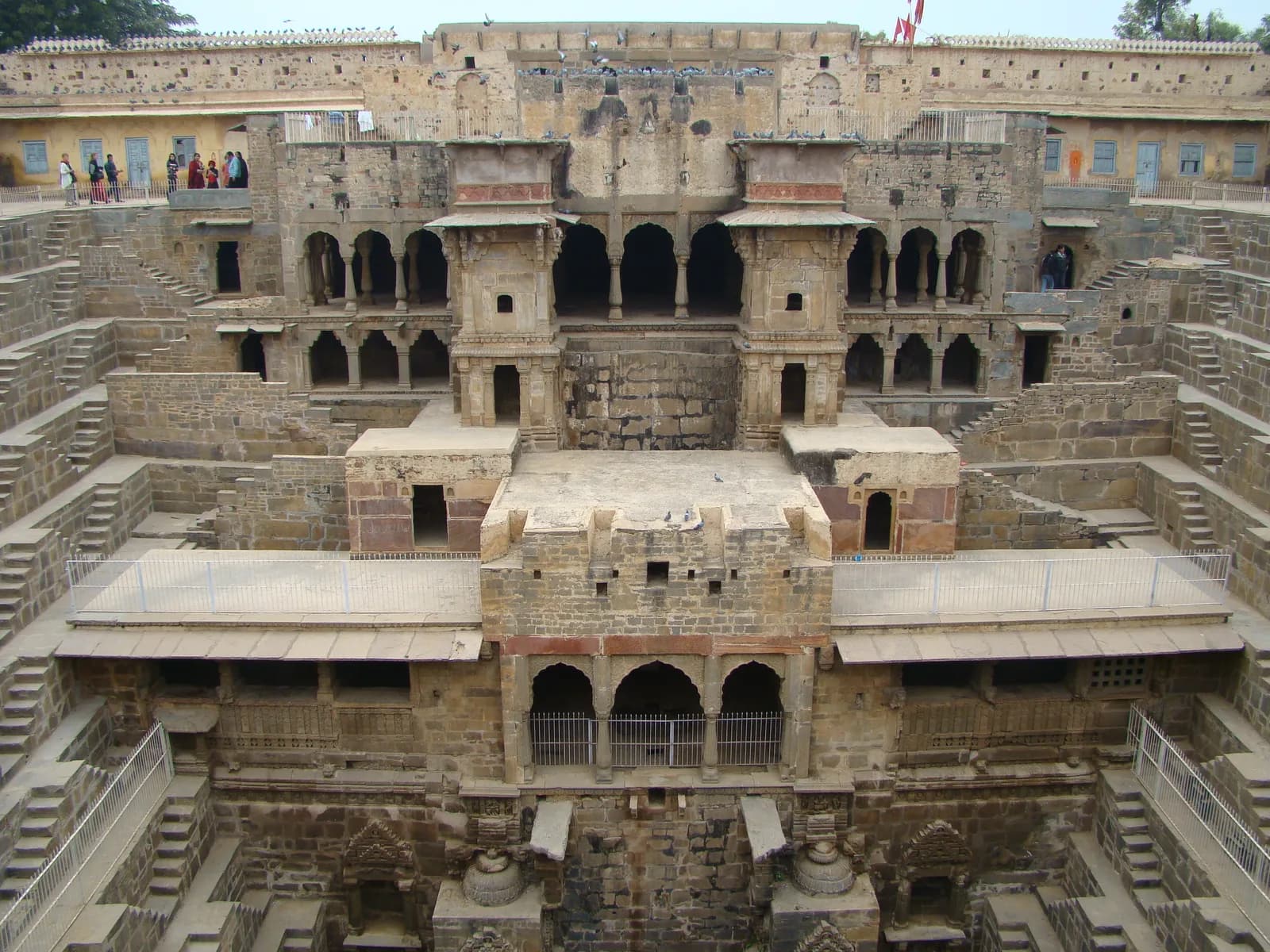
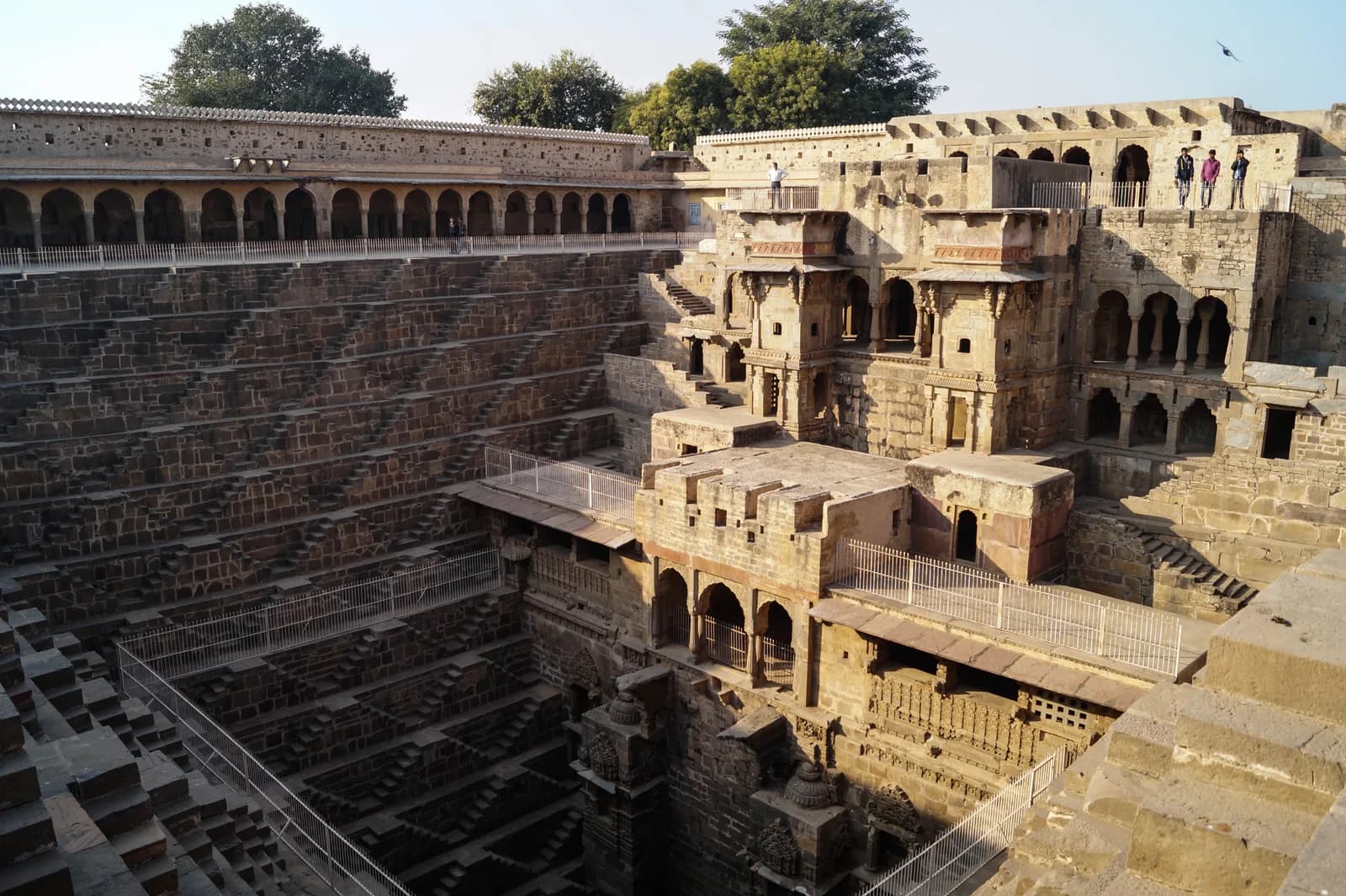
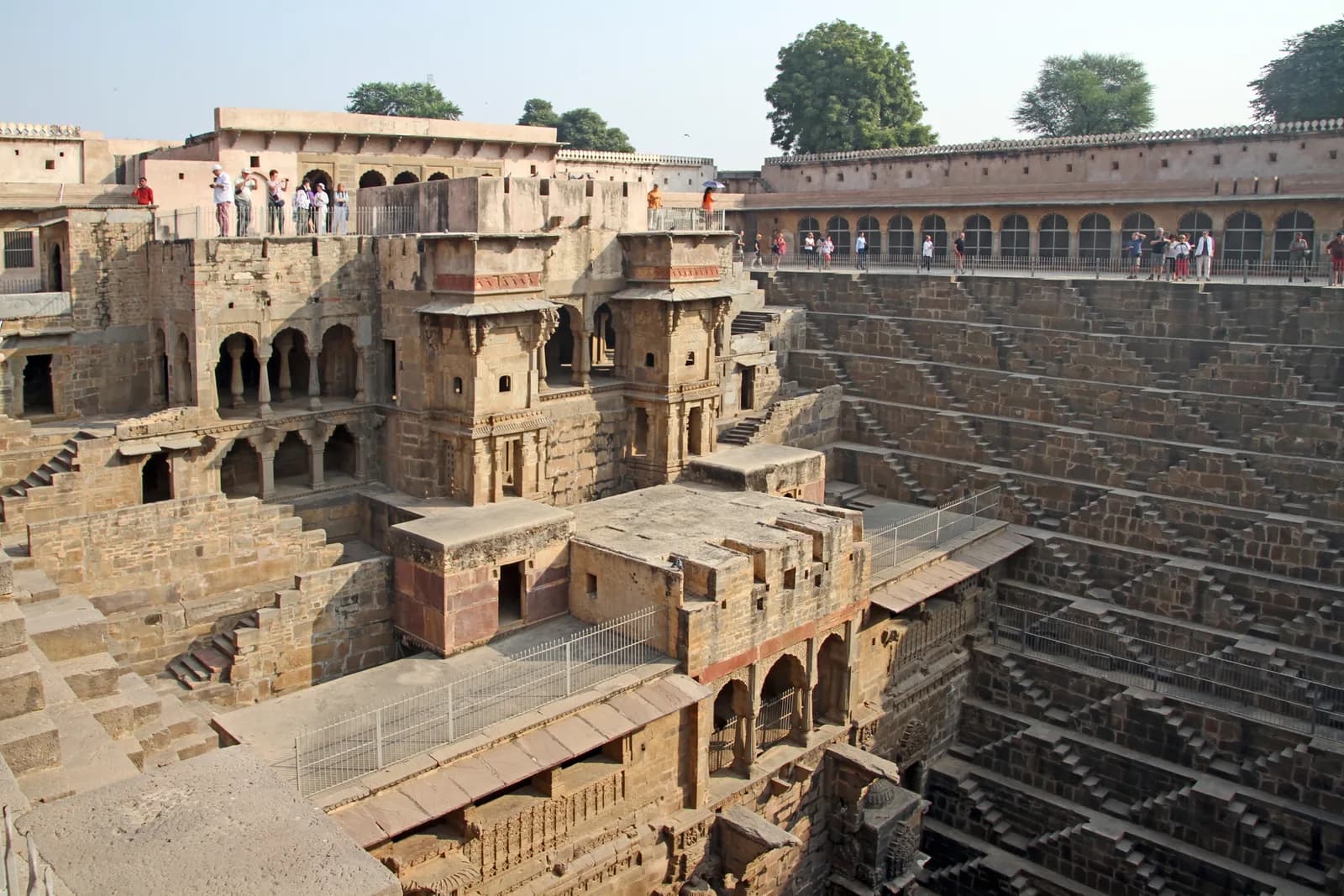
The architecture is what leaves every visitor speechless. Chand Baori is built as an inverted pyramid, a form known as a vijay vapi, with three of its four sides lined by crisscrossing, double-flight staircases that descend in a mesmerising, repeating geometric pattern. Around 3,500 narrow, symmetrical steps march down the walls to a depth of 20 to 30 metres across its 13 storeys, creating the hypnotic, almost dreamlike effect for which the well is famous.
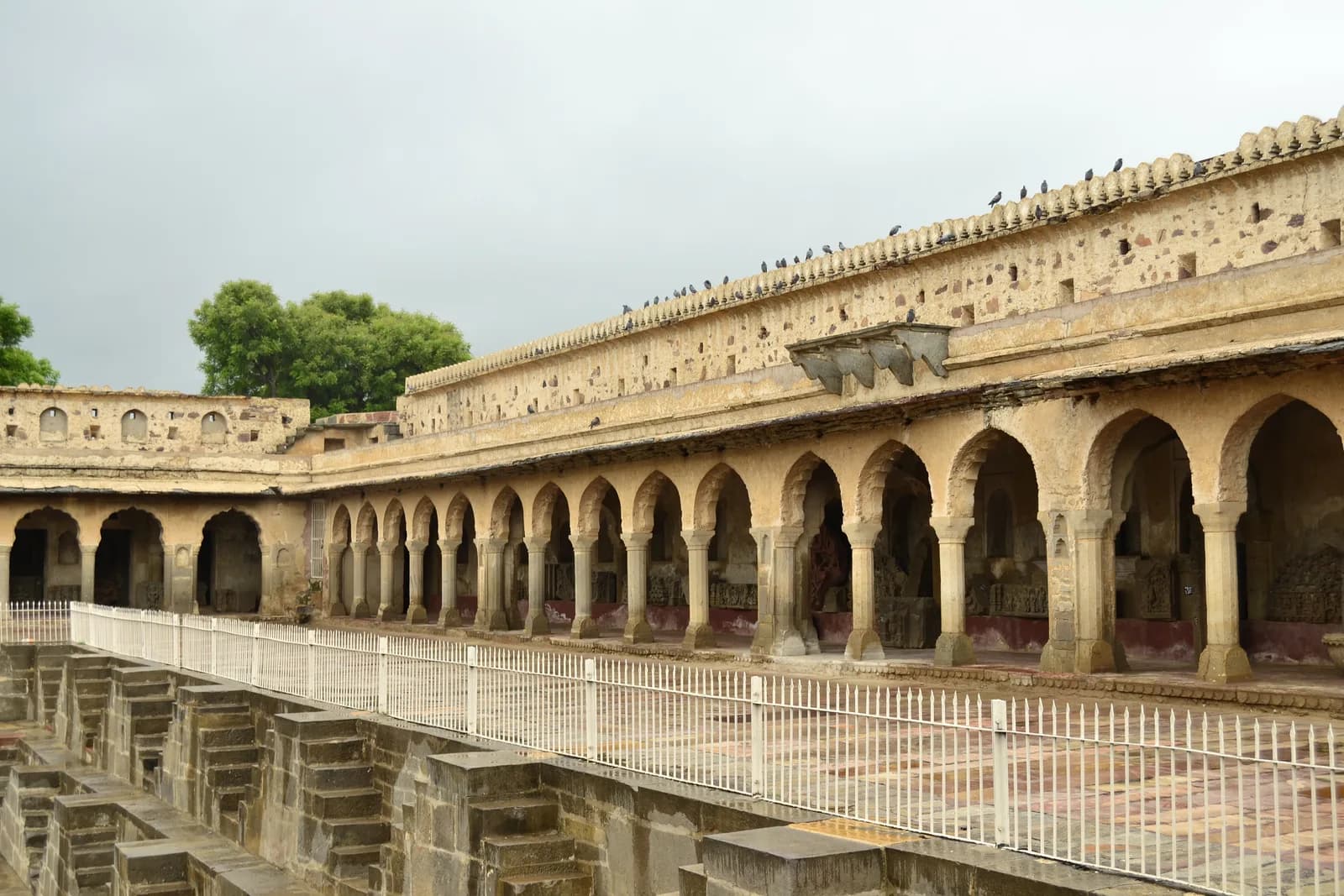
The fourth side is quite different and just as striking. Here a multi-storey pavilion rises, with galleries, balconies and carved niches that once housed sculptures and provided shaded resting places for the royal family and visitors. The upper arcades of this side were added later, during the Mughal period, blending two eras of architecture in one monument, so that the well reads as a layered history in stone. The carved fragments and niches hint at how richly decorated the complex once was.
There is a clever piece of climate engineering at work too. Because the well descends so deep into the earth, the temperature at the bottom is typically 5 to 6°C cooler than at ground level, which made it a natural refuge from the fierce Rajasthan heat as well as a water store. Standing at the edge and looking down at the vast, cool, geometric void, you understand at once why Chand Baori is considered an engineering and artistic marvel, and why it has fascinated travellers, architects and filmmakers alike.
Chand Baori in Film and Pop Culture
Part of Chand Baori's modern fame comes from the screen. Its surreal, otherworldly geometry has made it a magnet for filmmakers, and it has featured in or inspired the set designs of major international productions, most famously the acclaimed film The Fall, which shot at the well, and the Hollywood blockbuster The Dark Knight Rises, whose prison setting drew on the look of such Indian stepwells. These appearances introduced Chand Baori to millions of viewers worldwide and cemented its status as one of India's most visually iconic monuments.
This film fame is a big part of why many international visitors seek the well out, and it adds a layer of pop-culture interest to an already extraordinary sight. Standing at the top, it is easy to see why directors are drawn to it: the endless, repeating steps create a backdrop unlike anywhere else on earth, at once ancient, geometric and slightly vertiginous. For photographers and film buffs, that cinematic quality is a real part of the appeal.
It is worth enjoying the fame for what it is while remembering what the well actually is: a sacred, centuries-old piece of living heritage, not a film set. Visitors who come for the movie connection often leave moved by the deeper history, and that is exactly as it should be. The screen brought them, but it is the ancient stone, and its long human story, that keeps them.
The Harshat Mata Temple
Right beside the stepwell stands the Harshat Mata Temple, and the two are best seen together as a single ancient complex. The temple is dedicated to Harshat Mata, a goddess of joy and happiness, who in local belief blesses the whole village with brightness and good cheer, an association that ties back to Abhaneri's very name. Though damaged over the centuries, the temple retains beautifully carved fragments and sculptural panels that speak to the artistic richness of the site in its prime.
Visiting the temple is a natural and rewarding part of a Chand Baori trip, and the two sit just a few steps apart. Do remember to remove your shoes before entering the temple, as at any Hindu shrine, and to treat it with the respect due a living place of worship. The combination of the vast, secular water architecture of the baori and the sacred space of the temple gives the visit a satisfying balance of the practical and the spiritual, the everyday and the divine.
Together, the stepwell and the temple tell the fuller story of Abhaneri as a complete early-medieval settlement, where water, worship and community life were woven together. Seeing them as a pair, rather than rushing the well alone, is the way to appreciate what this remarkable village once was.
Timings, Entry Fee and Access Rules
Chand Baori is managed by the Archaeological Survey of India and is open daily from 8 AM to 6 PM, essentially sunrise to sunset. The entry fee is modest: 25 rupees for Indian citizens and for SAARC and BIMSTEC visitors, and 300 rupees for other foreign nationals, while children under 15 enter free. It is an excellent value for one of the country's great monuments, and tickets are bought at the site.
The single most important rule to understand is about access. Visitors view the stepwell from the upper corridors and the perimeter walkway only; walking down the steps into the well is strictly restricted and fenced off, for both visitor safety and the preservation of the fragile ancient structure. This is a change from the past and occasionally disappoints those hoping to descend, so it is best to know before you go: the magic of Chand Baori is in seeing the whole geometric sweep from above, which is in fact the finest viewpoint anyway. Respect the barriers, as they protect a 1,200-year-old treasure. Plan 45 minutes to 1 hour to take in both the well and the adjacent Harshat Mata Temple at an unhurried pace.
How to Reach Chand Baori
Chand Baori sits in Abhaneri, in Dausa district, about 95 km east of Jaipur and 160 to 180 km from Agra, just off the Jaipur to Agra highway corridor, which makes it supremely easy to fold into a journey between the two cities. By car or taxi, the most convenient option, it takes 2 hours from Jaipur or 3 to 3.5 hours from Agra via NH-21, turning off the highway at Sikandra or Gular for the short run to the village.
By train, the nearest major railway stations are Bandikui Junction, about 12 km away, and Dausa, about 35 km away, with local autos and taxis available from both to Abhaneri. By air, Jaipur International Airport is the nearest major airport, 90 to 95 km away. Because it lies squarely on the route between the Pink City and the Taj, Chand Baori is the classic en-route stop for Golden Triangle travellers; our Agra to Jaipur distance guide covers that leg in detail, and the well breaks the drive beautifully between the Taj Mahal and the forts of Jaipur. Most of our guests visit it exactly this way, as a chauffeur-driven stop on the Jaipur to Agra road, or as a dedicated day trip from the city.
Best Time to Visit
The best time to visit Chand Baori is from October to March, when the weather across Rajasthan is pleasant and comfortable for being outdoors. The summer months from April to June are intensely hot, punishing for a largely shadeless site, while the monsoon from July to September partially fills the well with rainwater, which can be atmospheric but reduces the sense of depth. For most travellers the cool winter season is the clear choice, aligning with the best time for a wider trip, as our best time to visit Jaipur guide explains.
The time of day matters as much as the season for this particular monument. Visit in the early morning or the late afternoon, because the midday sun casts harsh, flat shadows across the geometric steps, whereas the softer, raking light of the start and end of the day brings out the astonishing architectural depth and the play of light and shade across the stone that makes the well so endlessly photogenic. An early start from Jaipur is well worth it, and it fits neatly into a relaxed one day Jaipur itinerary or a fuller two-to-three day Jaipur itinerary that ranges beyond the city.
Chand Baori on a Jaipur to Agra Trip
What makes Chand Baori especially easy to see is its position on the Jaipur to Agra road, which turns it from a dedicated excursion into a natural break on a journey you are likely making anyway. For anyone travelling the Golden Triangle, stopping at Abhaneri to stretch your legs among 1,200-year-old steps is one of the most memorable ways to break the drive, far better than a roadside halt, and it adds a genuine wonder to the route between the Pink City and the city of the Taj.
A classic plan is to leave Jaipur in the morning, visit Chand Baori and the Harshat Mata Temple in the cooler, well-lit early hours, and continue toward Agra, where the Taj Mahal, the mighty Agra Fort and the red sandstone city of Fatehpur Sikri await. Travellers coming the other way, from Delhi or Agra, can equally make it their first taste of Rajasthan, with our Delhi to Jaipur distance guide covering the onward leg. However you sequence it, Chand Baori rewards the small detour many times over, and it is among the best 3 day trips from Jaipur or add-ons to a Golden Triangle route. For everything waiting at the far end of the drive, the city of the Taj rewards at least a full day of its own.
How Chand Baori Compares to Jaipur's Stepwells
Travellers who have seen the stepwells in Jaipur itself often wonder how Chand Baori compares, and the honest answer is that it is in a different league of scale and age. Jaipur has its own beautiful baoris, the elegant criss-cross steps of Panna Meena ka Kund near Amer and the dramatic wavy flights of the Nahargarh stepwell, both well worth seeing and far easier to reach within the city. They are charming, intimate and photogenic, and they make a fine introduction to the stepwell form.
Chand Baori, though, is the grand ancestor of them all: older by centuries, far deeper, and vastly larger, with its 3,500 steps dwarfing anything in the city. Where the Jaipur wells are lovely details on a city tour, Chand Baori is a destination in its own right, a monument that justifies the drive out on its own. Seeing the city wells first and then Chand Baori is the ideal progression, building from the charming to the staggering, and it gives you a real appreciation of just how ambitious this ancient structure was. If stepwells capture your imagination, Chand Baori is the one that will stay with you.
The World of India's Stepwells
To appreciate Chand Baori fully, it helps to understand the tradition it belongs to. Stepwells, known as baoris, baolis or vavs across different parts of India, were one of the subcontinent's great architectural and engineering achievements, built over many centuries to solve the single hardest problem of life in a dry land: reliable access to water. Unlike an ordinary well, a stepwell let people walk right down to the water on flights of steps, so they could reach it whatever the season and however far the level had dropped, and the deep, shaded descent stayed cool even in the fiercest heat.
Over time these structures became far more than utilitarian. They were adorned with carvings, pavilions, galleries and shrines, and they served as social and religious hubs where travellers rested, women gathered, and communities met, often with a temple close at hand, exactly as Harshat Mata sits beside Chand Baori. They were acts of public generosity and royal piety as much as infrastructure, which is why so many were commissioned by rulers and nobles and lavished with craftsmanship.
Sadly, many of India's thousands of stepwells fell into disuse and ruin as piped water arrived and the old ways faded, and a great number have been lost or filled in. That is what makes the survivors so precious, and Chand Baori, one of the oldest, largest and most complete of them all, is a jewel among them. Seeing it is not just admiring a pretty pattern of steps; it is witnessing one of the high points of a vanished civilisation of water, and understanding why these quiet, sunken monuments are now being celebrated and protected as national treasures.
Is Chand Baori Worth Visiting
Chand Baori is absolutely worth visiting, and for many travellers it is a surprise highlight of a Rajasthan trip. The sight of 3,500 symmetrical steps plunging into the earth in a perfect inverted pyramid is genuinely breathtaking, unlike anything else you will see, and its combination of ancient history, ingenious engineering, sculptural beauty and film fame makes it richly rewarding. Set just off the Jaipur to Agra road, it is also wonderfully easy to include, asking only a short detour for a very large payoff.
It is fair to set expectations. The visit is relatively short, since you view the well from above rather than descending, the village has very limited facilities, and the setting is remote. A traveller expecting a half-day of activities will find it compact. But as a stop of 45 minutes to an hour, taking in one of the most extraordinary pieces of architecture in India, it is hard to beat, and it leaves almost everyone astonished. I recommend it warmly to anyone travelling between Jaipur and Agra, and to any lover of history, architecture or photography; few monuments reward so short a stop with so lasting an impression, and fewer still are so easy to add to a route you are already taking.
Travel Tips for Your Visit
A few pointers make a Chand Baori visit smooth. Go between October and March, and time your arrival for the early morning or late afternoon, when the light brings the geometric steps to life and the heat is bearable. Build it into your Jaipur to Agra drive, turning off NH-21 at Sikandra or Gular, and keep a car or taxi for the trip, as public transport leaves you well short of the village. Remember that you view the well from the upper corridors only, so come to admire the whole sweep from above rather than to climb down. Remove your shoes before entering the Harshat Mata Temple next door, and treat both as the sacred, ancient sites they are. Food and restaurant options in the village are very limited, so carry your own water and snacks, and wear a hat and sun protection, as shade is scarce. Allow 45 minutes to an hour, and if you are planning the wider journey, our Jaipur trip planner helps you slot it in, our where to stay in Jaipur guide covers your base, and the city's food is covered in our guides to places to eat in Jaipur and famous foods in Jaipur. If you visit around September or October, ask whether the Abhaneri Festival of Rajasthani folk music and dance is being held, as it occasionally brings the village to life. The great fort of Amer pairs well on the Jaipur side of the trip.
Plan Your Trip With Us
A stop like Chand Baori is at its best woven smoothly into your route, and that is what we arrange. As Delhi Agra tours specialists, we build private, chauffeur-driven Golden Triangle and Jaipur itineraries that fold Abhaneri in at the right time of day, handling the highway, the turn-off and the timing so you arrive in the best light and simply enjoy the wonder. Our drivers and guides know the route, the monument and the little temple beside it.
Tell us your travel dates, group size and what you most want from your Rajasthan trip, and we will put together a plan and a price built around you. Message us on WhatsApp at +91 7302265809 and we will take it from there.
Related Guides
Enquire Now
What our travellers say
“Our Golden Triangle honeymoon was flawless. Sunrise at the Taj with a private guide felt like a dream — every detail was handled.”
“As a first-time visitor to India, I felt completely safe and looked after. The driver and guide were superb professionals.”
“Travelling with two kids is hard, but they made it effortless. Great pacing, clean cars and zero surprises on price.”
“Booked the Agra day trip on short notice and it went off without a hitch. The guide's history knowledge made the Taj come alive.”
“Best decision of our India trip. Car was spotless, driver was punctual every single day, and the itinerary never felt rushed.”
“Organised a same-day Agra trip for my parents. Communication before and during the trip was excellent — genuinely stress-free.”
“Sunrise at the Taj Mahal was magical. Our guide spoke great English and answered every question with patience.”
“Three generations travelling together and everyone was comfortable — good vehicle, sensible stops, and no hidden costs.”
“I've used a few tour operators across Asia and this was among the smoothest. Fair pricing and they actually answer the phone.”
“Our custom Rajasthan-Agra combo was planned around our budget without cutting corners on comfort. Highly recommend.”
“Solo female traveller here — I felt safe throughout. The driver was respectful and the whole trip was timed perfectly.”
Ready to Explore
The Pink City?
Experience the Amber Fort, Hawa Mahal, City Palace, and the colorful bazaars of Jaipur with our expert-guided premium tours of Rajasthan's capital.

Jaipur
Premium Tour Package
Questions
Frequently asked questions
What is Chand Baori famous for?
Chand Baori is famous as one of India's largest and deepest stepwells, a 13-storey inverted pyramid of around 3,500 symmetrical stone steps in Abhaneri village. More than 1,200 years old, it is celebrated for its hypnotic geometry, its ancient water-engineering ingenuity, and its film fame, having appeared in productions such as The Fall and inspired set designs for The Dark Knight Rises.
Who built Chand Baori and when?
How many steps does Chand Baori have?
Why was Chand Baori built?
Can you walk down the steps of Chand Baori?
What are the timings and entry fee for Chand Baori?
How do I reach Chand Baori from Jaipur?
Is Chand Baori on the way from Jaipur to Agra?
Is Chand Baori a UNESCO World Heritage Site?
Is Chand Baori worth visiting?
Explore more
Plan your Chand Baori Abhaneri trip with us

Interested in Chand Baori Abhaneri: India's Deepest Ancient Stepwell?
Chat with our travel team for a custom quote, or browse every package.
Related Attractions
9Chand Baori Abhaneri on the map
Open in Google MapsReady to explore Chand Baori Abhaneri: India's Deepest Ancient Stepwell?
Book your private tour today and experience the magic of India's rich heritage.