 Sector-3, Naya Khera, Vidhyadhar Nagar, Jaipur 302039, Jaipur
Kishan Bagh Desert Park: Jaipur's Restored Sand Dunes
Kishan Bagh in Jaipur is a restored desert sand dune park near Nahargarh, rich in native flora and birds. Get timings, entry fee, best time and how to reach.
Quick answer
Kishan Bagh is a restored desert sand dune park on the northern edge of Jaipur, at the base of the Nahargarh hills, where stabilised dunes, native desert plants and birdlife have been brought back to life through ecological restoration. Entry is 50 rupees for adults, with seasonal hours that may vary on Tuesdays. This guide is prepared by Delhi Agra Tour Packages, a unit of Experience My India.
- #kishan-bagh
- #jaipur
- #jaipur-attractions
- #jaipur-travel
It is an unusual, peaceful and genuinely interesting stop, a slice of the Thar's desert landscape recreated within the city, loved by nature lovers, walkers and photographers. It makes a quiet, offbeat addition to a trip arranged through Delhi Agra Tour Packages or a wider Golden Triangle tour, and it ranks among the more unusual hidden places to visit in Jaipur for those who like their sightseeing with a touch of wilderness.
I am Abhay Sharma, and I have guided travellers around Jaipur and the Golden Triangle since 2015. Kishan Bagh is where I take guests who love nature and want to understand the desert landscape of Rajasthan without leaving the city, a living lesson in how a barren patch was coaxed back into a thriving habitat. This guide covers its restoration story, its dunes and wildlife, the timings and fees, and how to reach it. One quick note: this is Jaipur's Kishan Bagh desert park, not the Kishan Bagh locality in Hyderabad that shares the name.
Kishan Bagh Desert Park at a Glance
| Detail | Information |
|---|---|
| What it is | Restored desert sand dune park, Jaipur |
| Location | Sector-3, Naya Khera, Vidhyadhar Nagar, Jaipur 302039 |
| Setting | Base of the Nahargarh hills, near the Nahargarh Biological Park |
| Size | Roughly 62 to 65 hectares of restored dunes and desert habitat |
| Created by | Jaipur Development Authority with naturalist Pradip Krishen |
| Entry | 50 rupees for adults; seasonal hours |
| Best time | October to March, early morning or late afternoon |
The tables below hold the hours, fees and routes, gathered up front so you can plan your visit.
Timings and Entry
| Detail | Information |
|---|---|
| Winter hours (Oct/Nov to March) | 8 AM or 8:30 AM to 5:30 PM |
| Summer hours (April to Sept/Oct) | 6:30 AM to 6:30 PM or 7 PM |
| Tuesdays | Some sources note closures; call ahead |
| Adults | 50 rupees per person |
| Students | 25 rupees with valid ID, or free, per current JDA rules |
How to Reach
| Detail | Information |
|---|---|
| Area | Vidhyadhar Nagar, northern Jaipur |
| Route | Toward the Nahargarh Biological Park |
| By road | Private car, cab, auto-rickshaw, taxi or bike |
| Facilities | Limited; carry your own water and supplies |
What Kishan Bagh Desert Park Is Famous For
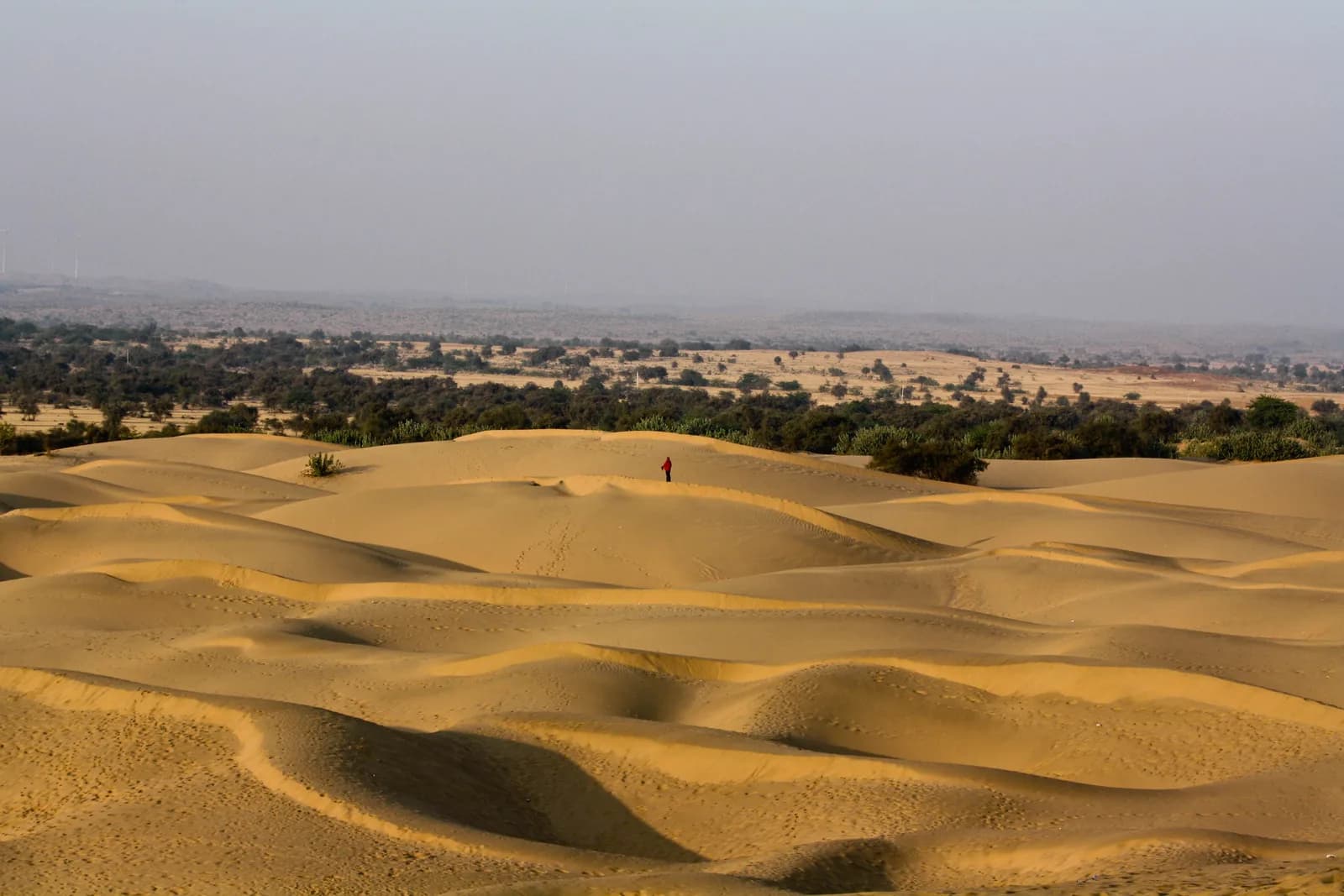
Kishan Bagh is famous as Jaipur's restored desert sand dune park, a remarkable patch of recreated Thar-style landscape on the northern edge of the city, at the foot of the Nahargarh hills. What makes it special is not grandeur but ecology: it is a place where stabilised sand dunes, native desert flora and a surprising variety of birds and wildlife have been deliberately restored, turning a degraded, barren area into a thriving semi-arid habitat. For nature lovers, it is one of the most interesting and unusual sights in the city.
Its appeal lies in offering something no fort or palace can: a quiet, wild, desert landscape within Jaipur itself. Walking its boardwalks among the dunes, rocks and hardy desert plants, with the Nahargarh ridge rising behind, feels a world away from the crowded old city, and the birdsong and the big open sky make it a genuinely restorative place. It is a favourite with birdwatchers, photographers, walkers and anyone curious about the natural heritage of Rajasthan, and it stands among the most rewarding of the quieter things to do in Jaipur.
The park is also notable as a serious piece of ecological restoration rather than a landscaped garden, which gives it real depth and meaning. For travellers who want to understand the desert state they are visiting, Kishan Bagh is a living museum of the Thar's plants and creatures, and it ranks among the more thoughtful and distinctive places to visit in Jaipur for the nature-minded.
The Story: Restoring a Desert
The real fascination of Kishan Bagh is how it came to be. The park was developed by the Jaipur Development Authority together with the naturalist Pradip Krishen, well known for creating Jodhpur's acclaimed Rao Jodha Desert Rock Park, whose expertise in reviving degraded Rajasthan landscapes shaped the whole project. An earlier attempt to make a cactus garden on the site did not succeed, and the thinking shifted to something far more ambitious and appropriate: a full ecological restoration of native desert habitat.
That restoration began in 2016, inspired by the Roee, the desert shrubland of western Rajasthan, with the aim of recreating an authentic semi-arid ecosystem rather than an ornamental park. The barren, eroded ground was stabilised, native desert plants were established, and the dunes and rocky habitats were nursed back into something resembling the wild Thar, with opening milestones reported around late 2021 and 2022. The result is a park that looks and functions like a genuine desert landscape, because in ecological terms that is exactly what it has become.
This story is what lifts Kishan Bagh above an ordinary city park. It is a hopeful example of how a damaged piece of land can be healed and returned to life, and it carries real educational value about the fragile desert ecosystems of Rajasthan. Understanding that you are walking through a deliberately restored habitat, not a natural accident, makes the visit far richer, and it is a quiet source of civic pride for a city better known for its palaces than its ecology.
Why a Restored Desert Park Matters
It is worth pausing on why a project like Kishan Bagh matters, because it changes how you see the place. Rajasthan's natural desert habitats, the dunes, the hardy shrublands and the rocky Aravalli slopes, are under constant pressure from building, grazing, mining and the spread of invasive plants, and much of the original vegetation around fast-growing cities like Jaipur has been degraded or lost. A park that painstakingly restores a patch of genuine native habitat is therefore more than a pretty amenity; it is a small act of conservation and a demonstration of what is possible.
Kishan Bagh shows, in a form anyone can walk through, that damaged land can be healed, that native desert plants can be re-established, and that wildlife will return when the habitat is right. That lesson has value far beyond the park's boundaries, for students, for city planners and for ordinary visitors who may never have thought of the desert as something worth protecting. By presenting the Thar's ecology attractively and accessible, the park quietly builds appreciation for a landscape too often dismissed as barren.
For the traveller, this gives the visit a meaning that a conventional garden lacks. You are not just enjoying a pleasant walk; you are seeing applied ecology at work, and witnessing the slow, patient craft of bringing land back to life. It is a hopeful, thought-provoking place, and it reflects well on a city making room for nature alongside its celebrated heritage. Approached in that spirit, even a short visit becomes genuinely memorable.
The Landscape: Dunes, Rock and Desert Terrain
Kishan Bagh spreads across roughly 62 to 65 hectares, about 150 to 160 acres, of varied desert terrain, which gives it real scale and a genuine sense of wilderness. The landscape mixes three main habitats: restored, stabilised sand dunes that evoke the open Thar, rocky Aravalli outcrops typical of the hills around Jaipur, and stretches of semi-arid desert ground between them. This variety is deliberate, as it supports a wider range of plants and animals than a single habitat would, and it makes the walk through the park constantly changing and interesting.
The park is designed for gentle exploration on foot. Walking paths and boardwalks thread through the dunes and habitats, letting you move through the landscape without damaging the fragile restored ground, and viewing decks, or machaan, offer raised vantage points for watching wildlife and taking in the scenery. There are also rock and Dhok tree habitats, water features and pond areas that draw birds and animals, and fine views of the Nahargarh ridge rising behind the park, which frames the whole scene beautifully.
For a visitor, the effect is of a small, self-contained desert world. The stabilised dunes are the signature feature, soft and sculptural, and the combination of sand, rock, scattered desert trees and the hills behind makes for a landscape that is both wild and photogenic. It is a place to walk slowly, watch for birds and animals, and appreciate the subtle beauty of a desert ecosystem brought back to health.
Native Desert Flora
A big part of what makes Kishan Bagh authentic is its planting, which uses native desert species adapted to arid conditions rather than ornamental imports. Walking the park, you pass a genuine cross-section of the Thar's hardy plant life, trees, shrubs and grasses that can survive the heat and drought of western Rajasthan. Among the species established here are desert plants such as Seenio, Bui, Kheemp, Khejri, Rohida, Munj grass, various acacias and Dhatura.
Several of these are worth knowing. The Khejri is the revered state tree of Rajasthan, a lifeline of the desert that provides shade, fodder and firewood; Rohida is often called the flame of the desert for its bright blooms; and Munj grass has long been used by desert communities for ropes and crafts. Together these plants form a working desert ecosystem, providing food and shelter for the birds and animals that live here, and demonstrating how much life a seemingly harsh landscape can support when it is healthy.
For the nature-minded visitor, the flora is as much a draw as the fauna. Learning to recognise a few of these desert species turns a walk into a rewarding lesson in the botany of Rajasthan, and it deepens your appreciation of how the people and wildlife of the Thar have adapted to one of India's toughest environments. The planting is the foundation on which the whole restored habitat rests.
Birds and Wildlife
Kishan Bagh has become a genuinely good spot for wildlife, especially birds, which is the clearest proof that the restoration has worked. The park attracts a lively variety of birdlife, including green bee-eaters, Indian robins, grey francolins, peacocks, bulbuls, drongos and lapwings, among others, and a patient, early-rising visitor with binoculars can have a rewarding morning here. The mix of dunes, scrub, rock and water gives the birds varied feeding and nesting places, which is why so many species have moved in.
Beyond the birds, the park supports a wider web of desert life. Butterflies flit among the flowering plants, reptiles bask on the warm rocks, and larger desert mammals including desert foxes and nilgai, the large blue bull antelope, can be seen by the lucky and the quiet. Seeing a desert fox trot across the dunes, or a nilgai browsing among the scrub, is a special reminder that this is a real habitat, not a manicured garden, and that genuine wildlife has returned to the restored land.
As with any wild place, sightings are never guaranteed and reward patience, stillness and an early start. The best wildlife watching is in the cool of the early morning and the late afternoon, when birds and animals are most active, so timing your visit well greatly improves your chances. For nature lovers, the chance to watch desert wildlife within the city limits is one of Kishan Bagh's greatest pleasures and its clearest success.
Guided Nature Walks
To get the most out of Kishan Bagh, it is worth asking about a guided walk. Naturalist-led walks, often lasting 1 to 2 hours, are periodically available, and a good guide transforms the visit, pointing out the desert plants, naming the birds, explaining the restoration and helping you spot the wildlife you would otherwise walk straight past. For anyone genuinely interested in ecology and natural history, a guided walk is by far the best way to experience the park.
These walks are not always running, so the sensible approach is to inquire at the ticket counter on arrival, or to call ahead, to confirm current availability and any charges. Because the park is a restoration project with an educational purpose, the guided experience fits its spirit perfectly, and it is especially rewarding for families with curious children and for keen birdwatchers and botanists.
If a formal guided walk is not available when you visit, the park is still easy and pleasant to explore on your own along the marked paths and boardwalks. But if you can join a naturalist, do, as it turns a nice walk into a genuine learning experience and brings the quiet desert landscape vividly to life.
Timings, Entry Fee and the Tuesday Note
Kishan Bagh keeps seasonal hours, so the timings change with the time of year. In winter, roughly October or November to March, it is generally open from 8 AM or 8:30 AM to 5:30 PM, while in summer, roughly April to September or October, the hours shift earlier and longer, from 6:30 AM to 6:30 PM or 7 PM, to make use of the cooler early hours. Importantly, some sources note that the park closes on Tuesdays, so it is wise to call ahead before visiting to confirm the current day and hours, as these can change.
The entry fee is modest. Adults pay 50 rupees per person, and students pay 25 rupees with a valid ID, or enter free, depending on the current JDA rules. For those wanting to use the park for a pre-wedding photoshoot, a separate charge of 5,000 rupees applies. As a rough guide to costs, a family of two adults and two students would pay 150 rupees in total, or 100 rupees if student entry is free that season. It is sensible to confirm the current fees on arrival, as JDA charges can be revised.
Best Time to Visit
The best time to visit Kishan Bagh is from October to March, during Jaipur's pleasant winter, when walking the open, largely shadeless desert terrain is comfortable and the wildlife is active. The summer months bring fierce heat to this exposed landscape, so although the park opens earlier in summer to catch the cool hours, the winter season is far more enjoyable overall, aligning with the best time for a wider trip, as our best time to visit Jaipur guide explains.
Within the day, two windows are ideal. Arrive early in the morning for the coolest weather and the most active birdlife, which is the prime time for birdwatching and a peaceful walk, or come in the late afternoon for the golden-hour light on the dunes and lovely sunset views over the desert landscape and the Nahargarh ridge. Both are beautiful, and photographers in particular will find the soft, low light of these hours far kinder than the harsh midday sun. A visit here slots neatly into a relaxed one day Jaipur itinerary or a fuller two-to-three day Jaipur itinerary.
How to Reach Kishan Bagh
Kishan Bagh is located in Sector-3, Naya Khera, in the Vidhyadhar Nagar area of northern Jaipur, at the base of the Nahargarh hills, and it is easily reached by road. The simplest way is by private car, cab, auto-rickshaw, taxi or bike, heading through Vidhyadhar Nagar toward the Nahargarh Biological Park, near which the park sits. Keeping your own vehicle is sensible, as the park is on the city's edge and return transport is easier to arrange in advance.
Its location on the northern side of the city places it near other attractions on that side, which makes it easy to combine into a half-day. Travellers arriving into Jaipur will find it a manageable add-on; our guides to the Delhi to Jaipur distance and the Agra to Jaipur distance cover the main approaches to the city. Because it sits below the Nahargarh ridge, it pairs well with the fort and palace sights on the northern and western sides, and with the great fort of Amer not far away. Most of our guests visit Kishan Bagh as part of a chauffeur-driven city day, often early in the morning for the birds.
Combining Kishan Bagh With Nearby Nature
Kishan Bagh fits naturally into a nature-themed day in Jaipur, and the city has more to offer the wildlife and outdoors lover than its monuments suggest. Right beside it lies the Nahargarh Biological Park, a larger wildlife park on the same northern hills, making the two an easy pairing for a morning of nature, though they are separate sites with their own tickets and timings. The restored desert habitat of Kishan Bagh and the wildlife enclosures of the biological park together give a full picture of the region's natural heritage.
For keen birders and nature lovers, the city holds further rewards. The lake at Jal Mahal draws waterbirds within easy reach of the centre, as our Jal Mahal timings guide describes, offering a wetland counterpoint to Kishan Bagh's desert. And for those wanting to go further into the wild, a day trip to tiger country is within reach, with our Jaipur to Ranthambore distance guide setting out that route. Kishan Bagh's own restoration story also connects it to the wider desert state, echoing the famous Rao Jodha park in Jodhpur, covered on the road described in our Jaipur to Jodhpur distance guide, for travellers heading on into the Thar proper.
What to Carry and Facilities
Because Kishan Bagh is a restored natural habitat rather than a developed tourist park, on-site facilities such as food stalls and shops are limited or absent, so it pays to come prepared. The single most important thing is to carry your own drinking water, especially as the terrain is open and exposed with little shade. Bring sun protection too, a hat, sunglasses and sunscreen, as the desert landscape offers scant cover from the sun even in the cooler months.
Footwear matters here. Wear comfortable, closed-toe walking shoes, as you will be walking on sand, rock and uneven desert ground where sandals or open shoes are impractical and leave you vulnerable to thorns and hot sand. A small daypack with water, snacks and sun protection, plus binoculars and a camera for the wildlife, is the ideal kit for a Kishan Bagh visit.
Coming prepared turns the visit from a hot, thirsty trudge into a genuinely enjoyable nature walk. Plan to refuel after your visit back in the city rather than at the park, where our guides to places to eat in Jaipur and famous foods in Jaipur point you to the best of the city's food, since dining at the park itself is not an option.
Is Kishan Bagh Worth Visiting
For nature lovers, birdwatchers and the ecologically curious, Kishan Bagh is well worth visiting, offering a genuine, restored desert landscape and a quiet, wild experience quite unlike anything else in Jaipur. The chance to walk among stabilised dunes and native desert plants, watch desert birds and wildlife, and understand a successful ecological restoration, all within the city, is a real and unusual pleasure, and the setting below the Nahargarh ridge is beautiful in the soft light of morning or evening.
It is fair to set expectations. Kishan Bagh is a natural habitat, not a monument or a manicured garden, so it is about subtle natural beauty, wildlife and a peaceful walk rather than grand sights or amenities; it has few facilities, variable seasonal hours and a possible Tuesday closure, and the wildlife rewards patience. A traveller seeking only heritage may skip it. But for those who love nature and come early and prepared, it is one of the most distinctive and rewarding of Jaipur's quieter attractions, and I recommend it warmly to the right traveller who comes early, prepared and with an eye for the wild.
Travel Tips for Your Visit
A few pointers make a Kishan Bagh visit rewarding. Go between October and March, and come early in the morning for the coolest weather and the most active birds, or in the late afternoon for golden-hour light and sunset views. Crucially, call ahead to confirm the current timings and the possible Tuesday closure, as the seasonal hours vary. Travel by private car, cab or auto via Vidhyadhar Nagar toward the Nahargarh Biological Park, and keep your transport for the return. Carry your own drinking water, sun protection and comfortable closed-toe shoes, as facilities are limited and the terrain is open, sandy and rocky. Bring binoculars and a camera for the wildlife, and ask at the ticket counter about a naturalist-led guided walk, which greatly enriches the visit. Move slowly and quietly to spot birds and animals, keep to the paths and boardwalks to protect the fragile habitat, and give yourself an hour or two to take it in. If you are planning the wider trip, our Jaipur trip planner helps you fit this offbeat stop around the essentials, and our where to stay in Jaipur guide covers a base in the city, with the floodlit sights among the places to visit in Jaipur at night for the evening.
Plan Your Trip With Us
An offbeat nature stop like Kishan Bagh is at its best woven into a well-planned Jaipur day, and that is what we do. As Delhi Agra tours specialists, we build private, chauffeur-driven Jaipur itineraries that get you to the park in the cool morning hours for the birds, confirm the current timings in advance, and fit it around the city's forts, palaces and markets, so you simply enjoy the desert landscape and the wildlife. Our guides know the seasons, the hours and the best times to be there.
Tell us your travel dates, group size and what you most want from Jaipur, and we will put together a plan and a price built around you. Message us on WhatsApp at +91 7302265809 and we will take it from there.
Related Guides
Enquire Now
What our travellers say
“Our Golden Triangle honeymoon was flawless. Sunrise at the Taj with a private guide felt like a dream — every detail was handled.”
“As a first-time visitor to India, I felt completely safe and looked after. The driver and guide were superb professionals.”
“Travelling with two kids is hard, but they made it effortless. Great pacing, clean cars and zero surprises on price.”
“Booked the Agra day trip on short notice and it went off without a hitch. The guide's history knowledge made the Taj come alive.”
“Best decision of our India trip. Car was spotless, driver was punctual every single day, and the itinerary never felt rushed.”
“Organised a same-day Agra trip for my parents. Communication before and during the trip was excellent — genuinely stress-free.”
“Sunrise at the Taj Mahal was magical. Our guide spoke great English and answered every question with patience.”
“Three generations travelling together and everyone was comfortable — good vehicle, sensible stops, and no hidden costs.”
“I've used a few tour operators across Asia and this was among the smoothest. Fair pricing and they actually answer the phone.”
“Our custom Rajasthan-Agra combo was planned around our budget without cutting corners on comfort. Highly recommend.”
“Solo female traveller here — I felt safe throughout. The driver was respectful and the whole trip was timed perfectly.”
Ready to Explore
The Pink City?
Experience the Amber Fort, Hawa Mahal, City Palace, and the colorful bazaars of Jaipur with our expert-guided premium tours of Rajasthan's capital.

Jaipur
Premium Tour Package
Questions
Frequently asked questions
What is Kishan Bagh in Jaipur?
Kishan Bagh is a restored desert sand dune park on the northern edge of Jaipur, in Vidhyadhar Nagar at the base of the Nahargarh hills. Developed by the Jaipur Development Authority with naturalist Pradip Krishen, it recreates a native Thar-style desert habitat of stabilised dunes, desert plants and wildlife across roughly 62 to 65 hectares, and is a favourite with nature lovers and birdwatchers.
What are the timings of Kishan Bagh Desert Park?
What is the entry fee for Kishan Bagh?
Who created Kishan Bagh and why?
What wildlife can I see at Kishan Bagh?
What is the best time to visit Kishan Bagh?
How do I reach Kishan Bagh?
What should I carry for a visit to Kishan Bagh?
Is Kishan Bagh the same as Kishan Bagh in Hyderabad?
Is Kishan Bagh worth visiting?
Explore more
Plan your Kishan Bagh Desert Park trip with us

Interested in Kishan Bagh Desert Park: Jaipur's Restored Sand Dunes?
Chat with our travel team for a custom quote, or browse every package.
Related Attractions
9Kishan Bagh Desert Park on the map
Open in Google MapsReady to explore Kishan Bagh Desert Park: Jaipur's Restored Sand Dunes?
Book your private tour today and experience the magic of India's rich heritage.