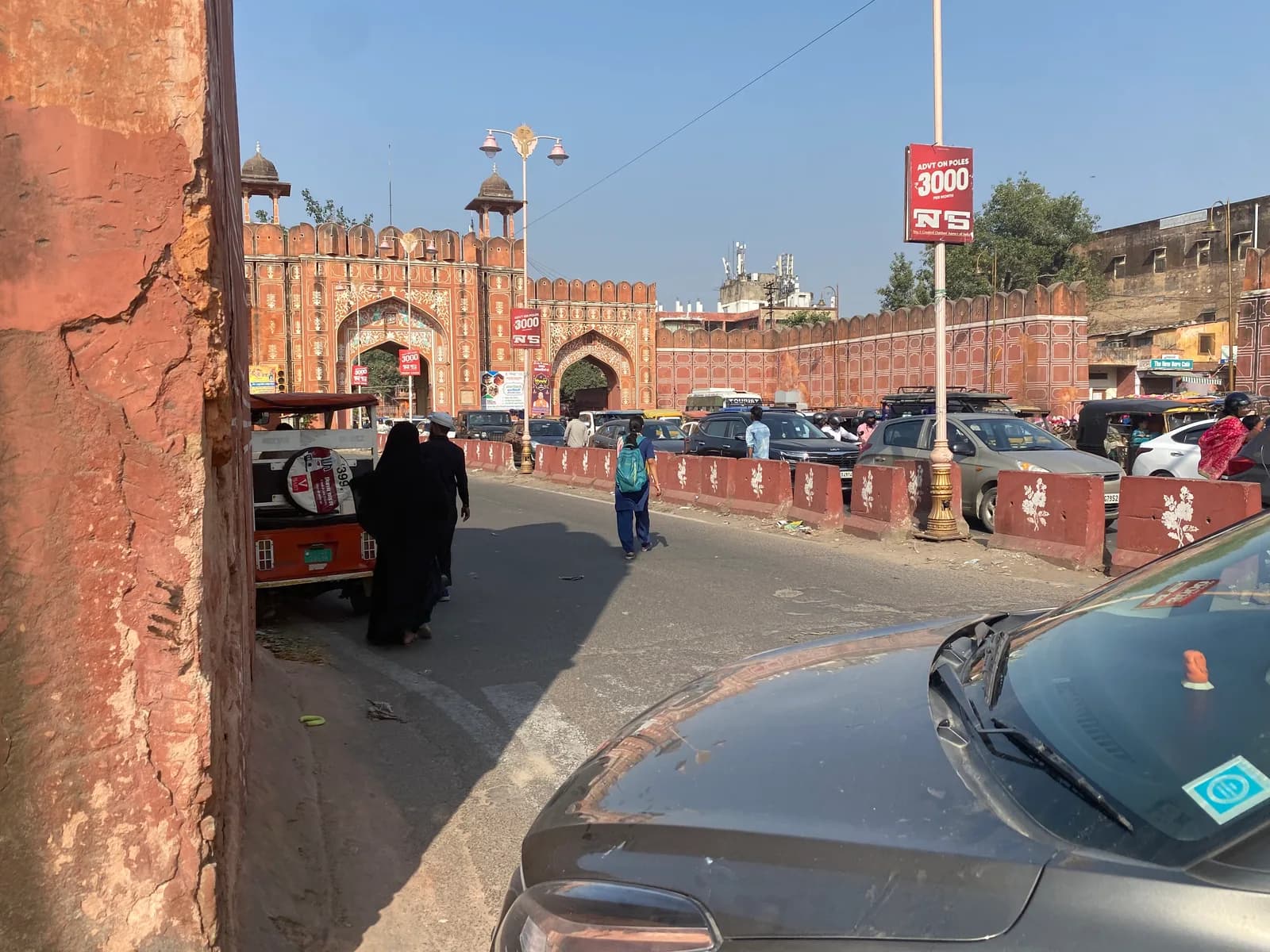
 Johari Bazaar Road, Bapu Bazar, Pink City, Jaipur 302003, Jaipur
Sanganeri Gate, Jaipur: Pink City Gateway to Johari Bazaar
Sanganeri Gate is Jaipur's Pink City gateway into Johari and Bapu Bazaar. History, architecture, free entry, shopping and how to reach, from a local guide.
Quick answer
Sanganeri Gate is an 18th-century gateway at the southern end of Jaipur's walled Pink City, built under Maharaja Sawai Jai Singh II and named after the textile town of Sanganer. It opens straight into Johari Bazaar, is free to pass and photograph, and the roadway is open 24 hours. This guide is by Delhi Agra Tour Packages, a unit of Experience My India.
- #sanganeri-gate
- #jaipur
- #jaipur-attractions
- #jaipur-travel
If you want the Pink City's gates, bazaars and palaces woven into one well-paced day, our Delhi Agra Tour Packages team builds the route around you, so you shop and sightsee in the right order instead of criss-crossing the old city in the heat.
I am Abhay Sharma, and I have guided travellers across Rajasthan and the Golden Triangle since 2015. Sanganeri Gate is one of those places people walk through without realising they are passing a monument, because it frames the entrance to Jaipur's most famous shopping street. But it is a genuine piece of the planned Pink City, a gate in the old wall with three centuries of trade behind it, and it makes a perfect anchor for a morning in the bazaars rather than just a backdrop for a photo. Below is everything I tell my own guests before they go, whether they are shopping for jewellery and block prints or building a full Golden Triangle tour through Delhi, Agra and Jaipur.
Sanganeri Gate at a Glance
| Feature | Detail |
|---|---|
| Location | Johari Bazaar Road, Bapu Bazar, Pink City, Jaipur 302003 |
| What it is | Southern gateway in Jaipur's walled Pink City (Parkota) |
| Built | 18th century, under Maharaja Sawai Jai Singh II |
| Named after | Sanganer, the block-printing town to the south |
| Entry fee | Free |
| Timings | Roadway and exterior open 24 hours |
| Opens into | Johari Bazaar, Jaipur's famous jewellery market |
| Nearest metro | Chandpole, on the Pink Line |
| Best time | Before 9 AM, or evening for the lit facade |
| Time needed | 15 to 30 minutes at the gate, longer for the bazaars |
Sanganeri Gate Timings, Entry Fee and How to Reach
Here are the three things most people check first, grouped so you can plan in one glance. The detail behind each follows further down.
Timings
| Zone | Opening hours |
|---|---|
| Gate exterior and roadway | Open 24 hours |
| Surrounding bazaars | Typically mid-morning to late evening; many shops shut Sunday |
Entry fee
| Item | Charge |
|---|---|
| Passing and photographing the gate | Free |
How to reach
| Mode | Detail |
|---|---|
| Metro | Pink Line to Chandpole, then auto toward Johari Bazaar |
| Auto-rickshaw | Widely available; short Pink City fares 30 to 50 rupees, confirm first |
| On foot | A short walk from Hawa Mahal and the walled-city core |
| By car | Discouraged in the narrow lanes; park near Sanganeri or Ajmeri Gate and walk |
At the time of writing these details are correct, though bazaar hours and auto fares vary, so confirm on the day.
What Is Sanganeri Gate
Sanganeri Gate is one of the historic gateways set into the Parkota, the wall that encircles Jaipur's old walled city, the part of town famously painted in terracotta pink. It stands at the southern end of the Pink City and opens directly into Johari Bazaar, the celebrated jewellery street, which is why so many visitors pass through it on a shopping trip without pausing to notice the monument framing the road.
The gate was always more than decoration. In a planned 18th-century city ringed by a defensive wall, the gates controlled movement in and out, and Sanganeri Gate guarded the southern approach, the road that led toward the town of Sanganer. It served as both a defensive entrance and a trade gateway, the point through which merchants brought cloth, block-printed textiles and goods into the city to sell in the bazaars within. That union of defence and commerce still defines it today, a heritage arch standing guard over one of India's great shopping districts. For anyone interested in the living, working side of the old city, it is a rewarding stop among the wider things to do in Jaipur.
Unlike a fort or a palace, you do not step inside Sanganeri Gate and tour it. It is experienced in passing, as a threshold, the moment the open road narrows into the dense, shop-lined lanes of the walled city. That is exactly how it was meant to be used, and it is why the gate feels so alive even now, with traffic, handcarts, shoppers and shopkeepers streaming through the arches as they have for generations. Treat it as a doorway rather than a destination and it makes perfect sense.
What Is Sanganeri Gate Famous For
Sanganeri Gate is famous for three things above all, and holding them in mind makes the visit richer. First, it is famous as the gateway to Johari Bazaar, Jaipur's legendary jewellery market, so for most people the gate and the shopping street are a single experience. Second, it is famous as a piece of the planned Pink City, one of the ornate terracotta-pink gates set into the historic wall that Jai Singh II built, instantly recognisable as part of Jaipur's signature cityscape. Third, it is famous for its name and its trade link with Sanganer, the block-printing town whose textiles have flowed through this gate for three centuries.
What the gate is not famous for is a grand interior, a museum or a ticketed experience, and it helps to know that going in. Its fame is that of a living landmark and a shopping gateway, not a standalone monument, so the travellers who enjoy it most are those who come for the bazaars and the street life and let the architecture frame the day. Seen that way, it is one of the most atmospheric free stops in the whole old city.
History of Sanganeri Gate: Who Built It and When
Sanganeri Gate dates to the 18th century and was built during the reign of Maharaja Sawai Jai Singh II, the founder of Jaipur, as part of the planned, walled city he laid out from 1727. Jaipur was one of India's first planned cities, built on a grid and enclosed by a protective wall, the Parkota, pierced by a series of gates that regulated trade and defence. Sanganeri Gate was one of these, set to guard and serve the southern side of the capital.
Its name tells its story. The gate faced toward Sanganer, the town just south of Jaipur that was, and remains, famous for its hand-block-printed textiles. The road through this gate was the route by which merchants carried cloth and goods from Sanganer and beyond into the city's markets, so the gate became permanently associated with that trade. Centuries on, the link endures, the gate still opens onto bazaars selling the very textiles and crafts whose trade it was built to channel.
This was deliberate urban design, not an accident. When Jai Singh II laid out Jaipur in 1727, he planned it as a commercial capital as much as a royal one, with wide bazaar streets and gates aligned to the trade routes feeding the city. Each gate had its direction and its purpose, and Sanganeri Gate's was the southern textile trade. Understanding that turns the gate from a pretty arch into a working part of one of history's most carefully planned cities. To see how it fits into Jai Singh's grand plan for the whole capital, it helps to view it alongside the other great set pieces of his city, mapped across our guide to the top places to visit in Jaipur.
Sanganeri Gate Architecture and the Pink City Wall
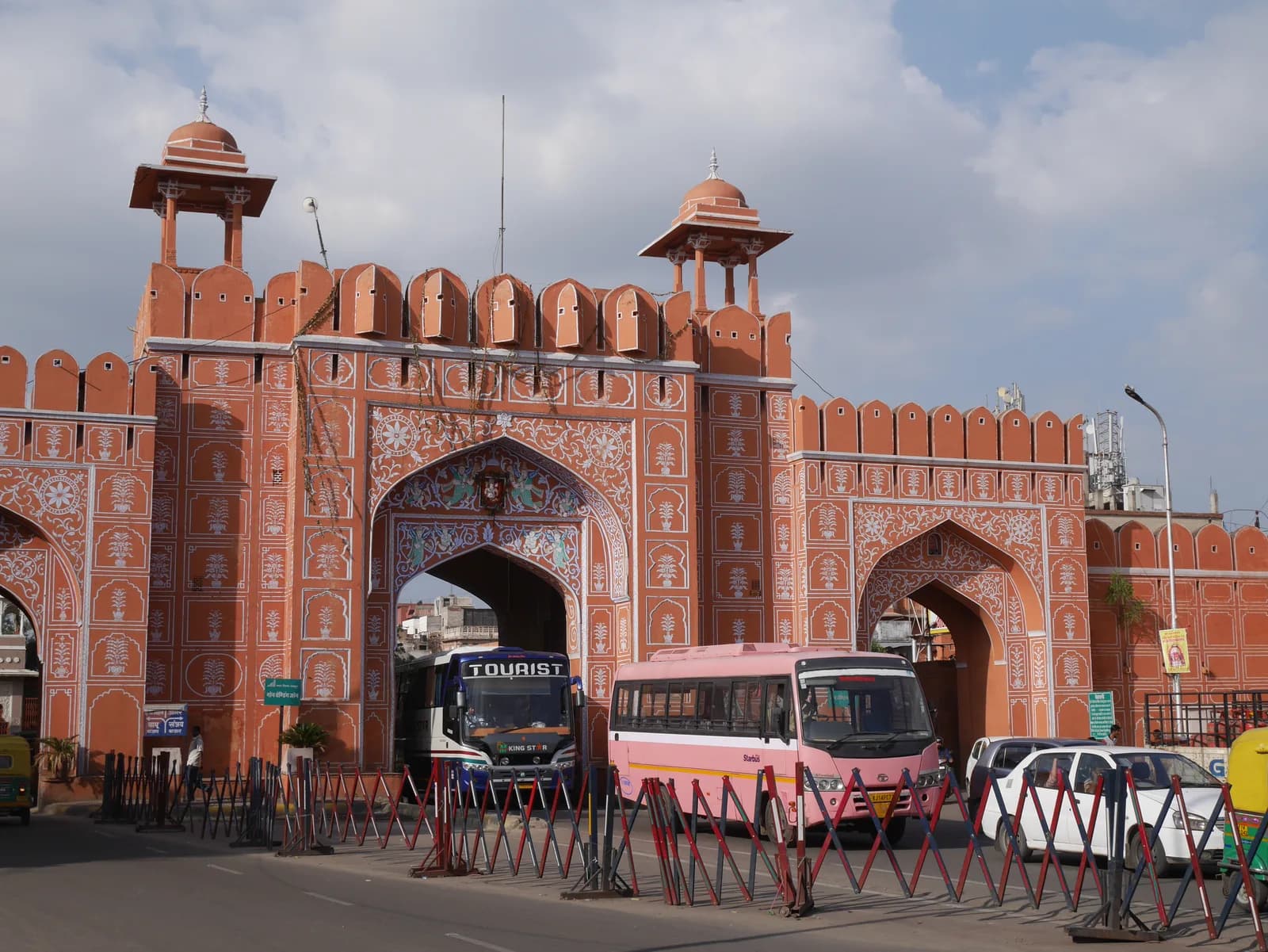
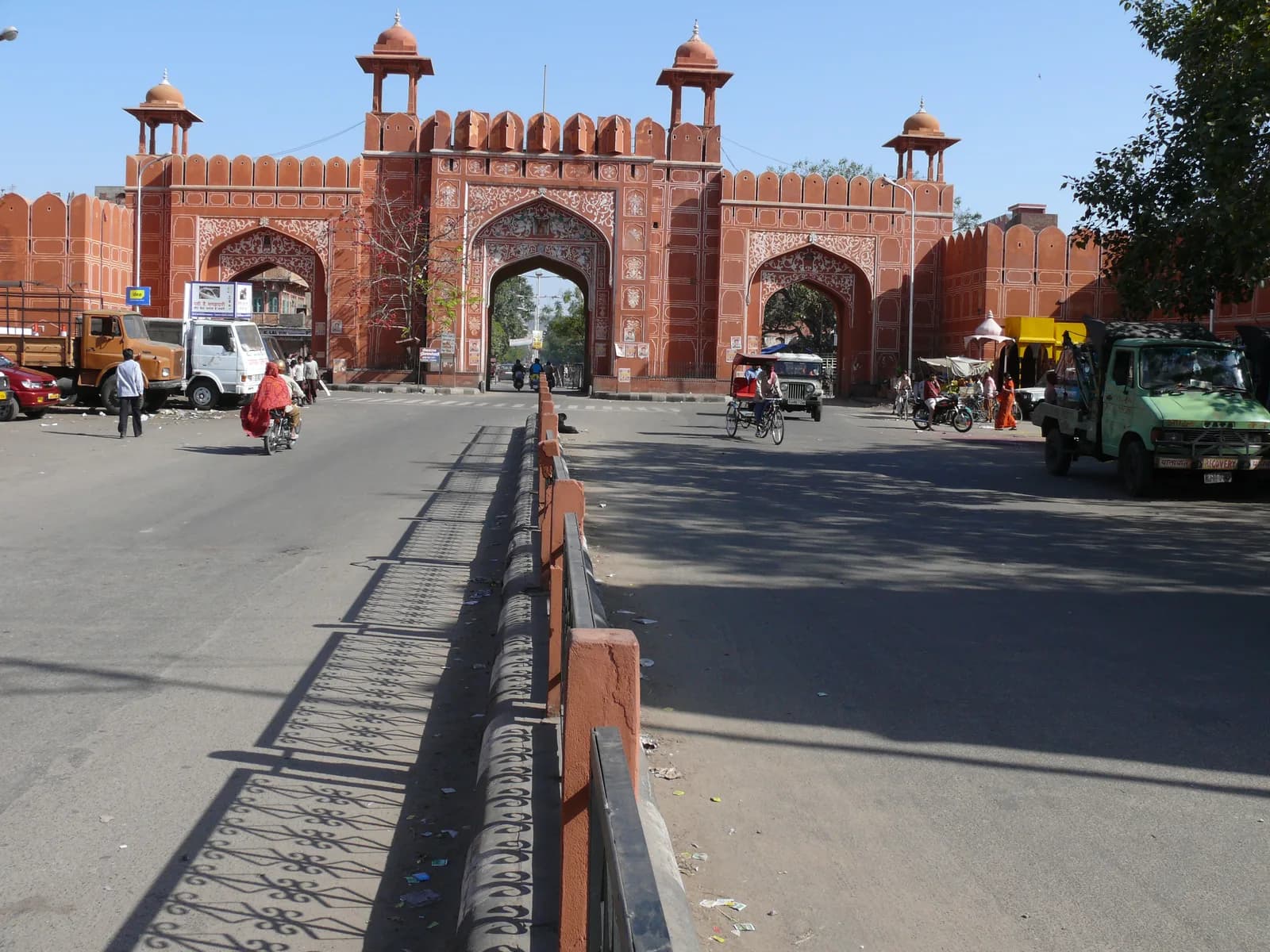
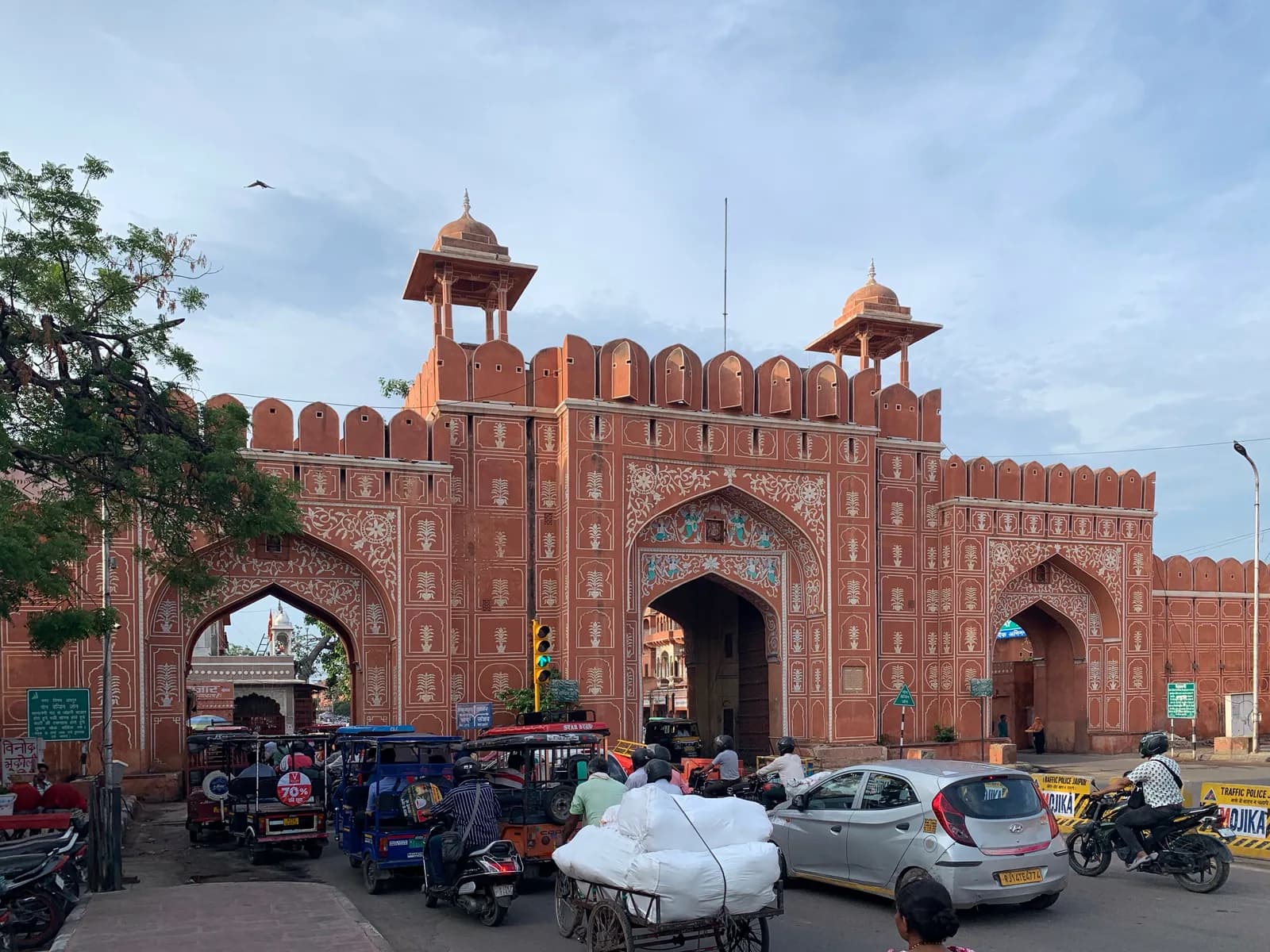
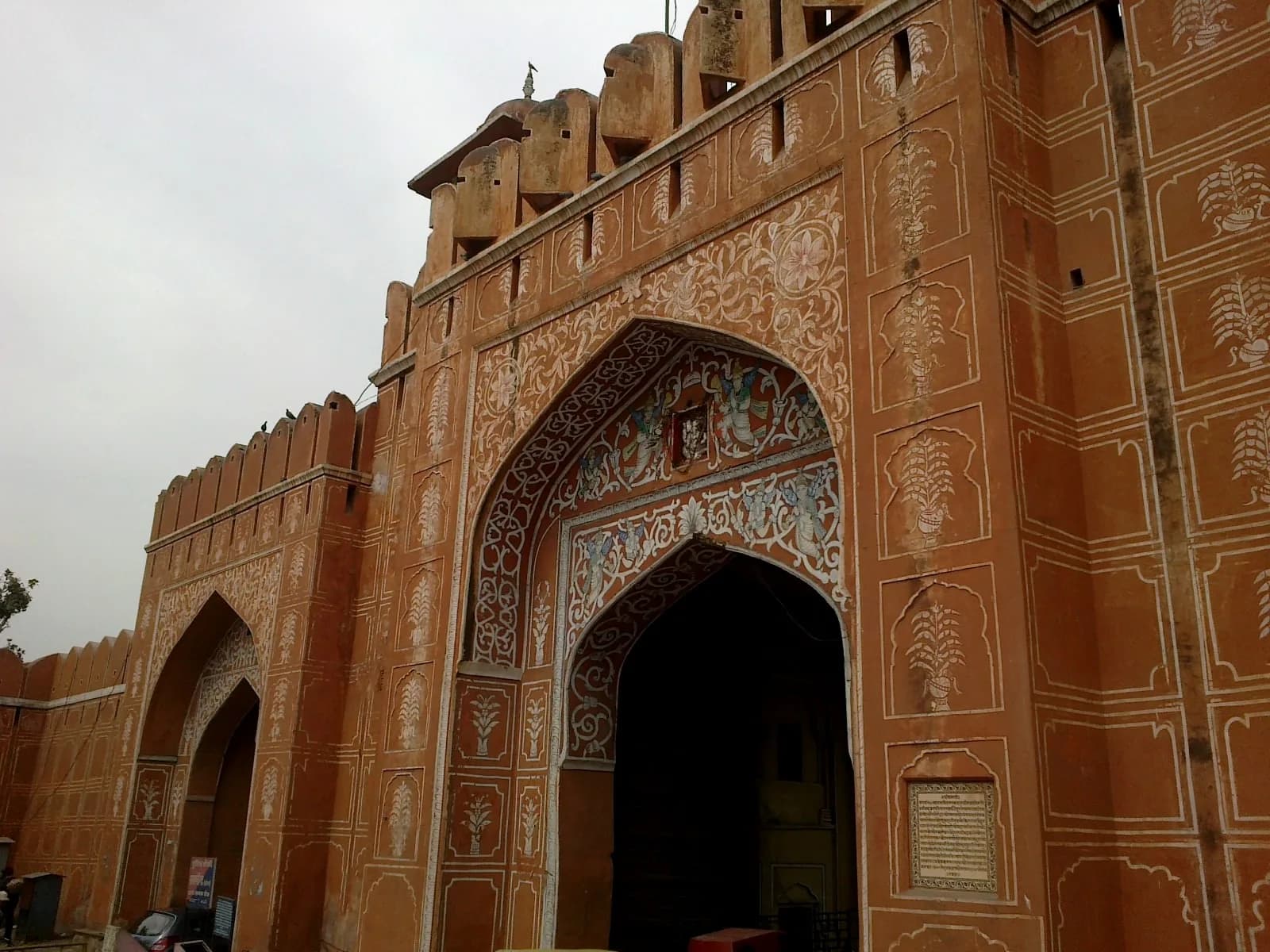
Sanganeri Gate blends Rajput and Mughal architectural elements, finished in Jaipur's signature terracotta pink, so it reads immediately as part of the Pink City rather than a standalone monument. Its most striking feature is a set of three large archways spanning the roadway, tall enough for the traffic of a busy trade gate, framed and decorated in the ornate style of the old city.
Look closer and the craftsmanship shows. The gate carries intricate floral carvings, overhanging jharokhas, the enclosed balconies that are such a signature of Rajasthani architecture, and delicate latticework, the jali screens that filter light and air. These are the same decorative devices you see across the palaces and havelis of Jaipur, applied here to a working city gate, so that even a piece of defensive infrastructure was given the dignity and ornament of royal architecture. The pink wash that covers it is part of the wider story, the colour the whole walled city was painted in, famously tied to a grand civic beautification in the 19th century that gave Jaipur its enduring nickname. The structure is part of the historic Parkota, the city wall that forms part of Jaipur's UNESCO-recognised heritage zone, so it is not an isolated arch but a surviving segment of the planned city's defensive ring. Conservation and streetscape restoration around the junction has been carried out by Jaipur Smart City Limited, part of a wider effort to protect and present the old city's heritage. That heritage pink and this ornate style run right through the walled city, and seeing the gate sharpens your eye for the details on everything from the havelis to the painted sub-part of the City Palace at Chandra Mahal.
Sanganeri Gate or Sanganer? Clearing Up the Name
The name causes predictable confusion, so it is worth settling. Sanganeri Gate is a gate in the Pink City wall, right in the heart of old Jaipur. Sanganer is a separate town and suburb to the south of the city, known for block printing and handmade paper and home to Jaipur's airport. The gate is named after that town because the road through it led there, but the gate itself is not in Sanganer, it is in the walled city, at the top of Johari Bazaar.
A couple of related mix-ups are worth flagging too. Sanganer has its own gates and landmarks, including a Malpura Gate, which are different structures in a different place. And the town of Bhilwara, elsewhere in Rajasthan, also has a Sanganeri Gate of its own, so searches sometimes cross wires. For this guide, Sanganeri Gate means the Pink City gateway in Jaipur that opens into Johari Bazaar, and nothing else. It sits beside its sibling gate, Ajmeri Gate, at the southern edge of the old city, the two often mentioned together as the main southern entrances to the walled town.
Shopping at Sanganeri Gate: Johari Bazaar and Bapu Bazaar
Shopping is the real reason most people come to Sanganeri Gate, because it opens directly onto two of Jaipur's most famous markets. Johari Bazaar, which runs straight from the gate, is the city's historic jewellery street, renowned for Kundan and Meenakari jewellery, loose gemstones, silver ornaments and bridal wear, the trade that has made Jaipur a global gem-cutting centre. Walking up from the gate into Johari Bazaar is one of the classic Pink City experiences.
Running alongside is Bapu Bazaar, the adjacent market street famous for Sanganeri block-printed fabrics, quilts, juttis, clothing and handicrafts, with Sunday markets adding to the bustle. Between the two, the area around the gate is a dense, vivid shopping district that gives you a direct look at Jaipur's traditional trade and craft culture, the living descendant of the commerce the gate was built to serve.
The block-printed textiles are the thread that ties the whole area back to the gate's name. Sanganer, the town the gate faces, is one of the historic centres of hand-block printing, where carved wooden blocks stamp repeating floral and geometric patterns onto cotton in natural dyes, and the fabrics sold in Bapu Bazaar carry on that craft. Buying a block-printed quilt or a length of Sanganeri cloth here is, in a small way, taking part in the very trade the gate was built to channel, which makes the shopping feel connected to the history rather than separate from it. A fuller guide to the textile-and-juttis street is in our write-up of Bapu Bazaar, and if you prefer modern, air-conditioned retail as a break from the lanes, our guide to Jaipur's shopping malls covers that side of the city. Bargaining is part of the experience in these bazaars, so take your time, keep it good-humoured, compare a few shops, and enjoy it.
Sanganeri Gate Entry Fee and Opening Hours
Sanganeri Gate is free and open around the clock. There is no entry fee or ticket to pass through or photograph the gate, and the roadway and exterior are accessible 24 hours a day, since this is a working city gate carrying traffic rather than a ticketed monument. You can walk up to it at any time without planning or payment.
The practical caveat is the bazaars, not the gate. While the arch itself is always open, the shopping streets it serves keep market hours, typically opening mid-morning and running into the late evening, with many shops closed on Sundays, though Sunday also brings informal street markets in places. So the real question is not when the gate is open but when the bazaars and the light suit your visit, which I will cover next. Seeing the gate costs nothing, leaving your budget for the jewellery and textiles it leads to, and for a meal in the old city you can plan with our guide to the best places to eat in Jaipur.
Best Time to Visit Sanganeri Gate
The best time to visit Sanganeri Gate is early in the morning, before 9 AM, when traffic is lighter and the pink facade photographs beautifully without the crush of the day's crowds. The early hour is the photographer's window and the easiest time to actually appreciate the architecture before the bazaars fill and the roadway clogs. The cooler months from October to March are the comfortable season for walking the old city on foot.
There is a second, very different option. In the evening, the gate and the surrounding markets are lit up, and the whole area takes on a festive, glowing energy, which is wonderful to experience, though it comes with heavy crowds and dense traffic. If atmosphere and shopping are your priority, come in the evening; if photography and calm are, come early. One timing note worth knowing, during major festivals like Diwali, the authorities often close nearby stretches to vehicles and turn them into pedestrian-only zones in the evening, when the decorated bazaars are at their most spectacular. The wider after-dark city is covered in our guide to places to visit in Jaipur at night, and you can plan your dates around the season with our guide to the best time to visit Jaipur.
How to Reach Sanganeri Gate: Metro, Auto and Walking
Sanganeri Gate sits in the heart of the walled city, at the southern end of Johari Bazaar, so it is easy to reach by the usual old-city means. The Jaipur Metro is a good start, take the Pink Line to Chandpole, then continue by auto-rickshaw toward the Johari Bazaar and Sanganer Road area to reach the gate. Auto-rickshaws are widely available across the Pink City, with short local fares in the range of 30 to 50 rupees depending on your starting point and the traffic, so agree the fare before you set off.
If you are already in the walled city, the gate is an easy walk from nearby Pink City landmarks such as Hawa Mahal, and walking is genuinely the best way to experience this dense, shop-lined quarter. The old city is compact and the lanes connect, so you can wander from the monumental core down to the gate and the bazaars without ever needing a vehicle, which is both faster and far more pleasant than crawling through the traffic. Driving your own or a rental car into the narrow walled-city lanes is discouraged, because the congestion is heavy and parking is scarce, so the sensible approach is to use the designated parking near Sanganeri Gate or the adjacent Ajmeri Gate and then explore on foot or by auto. However you arrive, treat the gate as the entry point to a walking-and-shopping morning rather than a drive-up photo stop. If you are reaching Jaipur from elsewhere on the Golden Triangle, the practical distances are in our Delhi to Jaipur distance and Agra to Jaipur distance guides.
Things to See Near Sanganeri Gate
Sanganeri Gate sits at the heart of the old city, so it is surrounded by Jaipur's headline sights and markets and is never a standalone trip. Here is what is close by.
- Johari Bazaar, opening straight from the gate, is the jewellery and gemstone street, the obvious first stop.
- Bapu Bazaar, running alongside, is the textiles, block-print and juttis market, with Sunday street markets.
- Hawa Mahal, City Palace and Jantar Mantar, the walled city's monumental core, are a short walk or auto ride north and pair naturally with a bazaar morning.
- Ram Niwas Garden and the Albert Hall Museum, just south of the gate, offer green space and a grand museum when you want a break from the lanes.
- Shri Kali Mata Mandir, a local shrine just outside the gate, is a small devotional stop woven into the daily life of the area.
Because everything clusters so tightly here, you can combine the gate, the two bazaars and the monumental core in a single rich day in the old city, dipping into the cenotaphs at Gaitore Ki Chhatriyan on the way out toward the hills if time allows. The gate also sits beside its sibling, Ajmeri Gate, the other main southern entrance to the walled city, so a short stroll along the wall between the two gives you a feel for the scale of the old Parkota and the rhythm of its gates. This walled quarter is the beating heart of Jaipur, and exactly the sort of walk we build into a day for guests who want the real city, not just the monuments, pacing the shopping and the sightseeing so neither is rushed.
Is Sanganeri Gate Worth Visiting
Yes, Sanganeri Gate is worth visiting, with a clear sense of what it is. It is not a ticketed, standalone monument you would cross the city for on its own, but as the gateway to Johari Bazaar and the anchor of an old-city shopping walk, it is absolutely worth seeking out and appreciating. It costs nothing, it takes only a few minutes to admire, and it adds real heritage context to what might otherwise be just a shopping trip.
Set your expectations that way and it rewards you. Visitors who expect a quiet, manicured attraction will instead find a busy, traffic-filled working gate, which is precisely its charm once you understand it, a living monument doing the same job it has done for three centuries. Those who come for the bazaars, pause to take in the pink arches and the carved jharokhas, and treat the gate as the doorway to Jaipur's trading heart, come away with a far richer experience than the jewellery alone would give. Come early for the architecture or in the evening for the atmosphere, and it earns its place on any thoughtful old-city itinerary.
I rate it for one more reason. It plants you in the real, working, shopping Jaipur, among jewellers and textile merchants and the daily crowd, rather than the monument circuit alone. For the curious traveller that texture is the whole point, and it makes a Jaipur trip feel like the city itself rather than a string of ticketed sights. Stand under the arches for a few minutes, watch the life of the bazaar flow past, and you understand Jaipur's commercial soul in a way no palace tour quite delivers.
Travel Tips for Sanganeri Gate
A few practical pointers will make the visit smoother. Come before 9 AM for lighter traffic and the best photography, or in the evening for the lit facade and markets, bearing in mind the evening brings heavy crowds and congestion. Treat October to March as the comfortable season for walking in the old city. In the surrounding bazaars, remember that prices are often marked up at first, so polite bargaining is expected and part of the fun. Wear sturdy walking shoes for the uneven stones and busy crossings, carry water in warm weather, dress modestly near the temples around the gate, and keep your bags and valuables secure in the crowded lanes. Leave the car behind and arrive on foot or by auto, parking near the gate rather than driving into the lanes. During Diwali and other big festivals, expect evening traffic restrictions and pedestrian-only stretches, which actually make the decorated bazaars more enjoyable to wander. Round off a bazaar morning with the city's food, which you can plan with our guide to famous foods in Jaipur.
Where Sanganeri Gate Fits in Your Jaipur Trip
Sanganeri Gate works best as the anchor of an old-city morning rather than a destination in itself. The natural rhythm is to arrive early, admire the gate and its pink arches before the crowds, then walk up Johari Bazaar for jewellery and into Bapu Bazaar for textiles and juttis, before continuing north to the monumental core of Hawa Mahal, the City Palace and Jantar Mantar. Done this way, the gate opens a full and satisfying day in the walled city.
For a first-time visitor, this old-city bazaar-and-monuments walk is one of the essential Jaipur experiences, and it fits neatly into a one-day plan, as our Jaipur 1 day itinerary shows. With two or three days you can give the bazaars a relaxed morning of their own and still cover the forts, gardens and palaces at an easy pace, the approach our Jaipur itinerary for 2 to 3 days and our places to visit in Jaipur for 2 days plans are built around. However you structure it, the gate is a small, free stop that adds heritage depth to a shopping day, and slotting it into a walled-city morning costs you nothing. For many travellers Jaipur is one leg of a wider Golden Triangle journey, and anchoring the shopping here keeps the rest of the trip flowing.
Plan Your Trip With Us
A great Jaipur visit is really about sequencing, putting the gates, bazaars and palaces of the old city in the right order, at the right time of day, with a driver who knows which lanes to avoid and where to park. That is exactly what we do. We design private, unhurried trips across Jaipur and the wider Golden Triangle, built around you rather than a fixed coach route.
Tell us your dates, how many of you are travelling and what you most want to see and buy, and we will shape an itinerary that threads the shopping, the sights and the hidden corners together without the rush. You can explore our full range of Delhi Agra tours and our classic Golden Triangle tours, or ask us about shorter runs like a same day Agra tour from Delhi, an Agra overnight tour from Delhi or a sunrise Taj Mahal tour to pair with your Jaipur leg.
To start planning, message us on WhatsApp at +91 7302265809 with your travel dates and group size, and we will send back an honest, tailored plan. As a Brajwasi who has hosted travellers across this region for years, I promise you a trip that feels personal, not packaged.
Related Jaipur Guides
Keep exploring with these guides:
- Hidden places to visit in Jaipur for more offbeat corners of the old city.
- Where to stay in Jaipur to base yourself near the walled city.
- Jaipur trip planner to pull the whole visit together.
Enquire Now
What our travellers say
“Our Golden Triangle honeymoon was flawless. Sunrise at the Taj with a private guide felt like a dream — every detail was handled.”
“As a first-time visitor to India, I felt completely safe and looked after. The driver and guide were superb professionals.”
“Travelling with two kids is hard, but they made it effortless. Great pacing, clean cars and zero surprises on price.”
“Booked the Agra day trip on short notice and it went off without a hitch. The guide's history knowledge made the Taj come alive.”
“Best decision of our India trip. Car was spotless, driver was punctual every single day, and the itinerary never felt rushed.”
“Organised a same-day Agra trip for my parents. Communication before and during the trip was excellent — genuinely stress-free.”
“Sunrise at the Taj Mahal was magical. Our guide spoke great English and answered every question with patience.”
“Three generations travelling together and everyone was comfortable — good vehicle, sensible stops, and no hidden costs.”
“I've used a few tour operators across Asia and this was among the smoothest. Fair pricing and they actually answer the phone.”
“Our custom Rajasthan-Agra combo was planned around our budget without cutting corners on comfort. Highly recommend.”
“Solo female traveller here — I felt safe throughout. The driver was respectful and the whole trip was timed perfectly.”
Ready to Explore
The Pink City?
Experience the Amber Fort, Hawa Mahal, City Palace, and the colorful bazaars of Jaipur with our expert-guided premium tours of Rajasthan's capital.

Jaipur
Premium Tour Package
Questions
Frequently asked questions
Who built Sanganeri Gate and when?
Sanganeri Gate was built in the 18th century during the reign of Maharaja Sawai Jai Singh II, the founder of Jaipur, as one of the gates in the planned Pink City's protective wall. It guarded and served the southern approach to the walled city.
Why is it called Sanganeri Gate?
Is Sanganeri Gate the same as Sanganer?
What are the timings of Sanganeri Gate?
Is there an entry fee for Sanganeri Gate?
What market opens from Sanganeri Gate?
What is the nearest metro station to Sanganeri Gate?
How do I reach Sanganeri Gate?
How much time do you need at Sanganeri Gate?
Is Sanganeri Gate worth visiting?
Explore more
Plan your Sanganeri Gate trip with us
Interested in Sanganeri Gate, Jaipur: Pink City Gateway to Johari Bazaar?
Chat with our travel team for a custom quote, or browse every package.
Related Attractions
9Sanganeri Gate, Jaipur on the map
Open in Google MapsReady to explore Sanganeri Gate, Jaipur: Pink City Gateway to Johari Bazaar?
Book your private tour today and experience the magic of India's rich heritage.