


Hauz Khas Delhi: Fort, Lake, Village and Complete Visitor Guide
Visiting Hauz Khas in Delhi? Explore the 14th century fort, lake and Firoz Shah's madrasa, plus the village cafes and nightlife, timings, metro and tips.
In a Nutshell
“Hauz Khas is a South Delhi neighbourhood where a 14th century medieval complex, a royal lake, Firoz Shah Tughlaq's madrasa and his tomb, sits right beside a trendy urban village full of cafes, boutiques and nightlife. The historic fort ruins and the lake are free to enter and open daily, while the village lanes buzz from late morning until past midnight. The nearest metro is Hauz Khas or Green Park and it is one of Delhi's best spots to mix history, a lakeside sunset and a good dinner. It is looked after by a unit of Experience My India.”
Hauz Khas is one of Delhi's most enjoyable contrasts, a place where you can wander six hundred year old ruins above a serene lake and then step straight into a lane of rooftop bars and designer shops. If you want heritage, a sunset and a night out in one easy outing, this is the spot. Our team at Delhi Agra Tour Packages often builds it into a South Delhi afternoon and evening and it pairs naturally with the nearby monuments on a wider Golden Triangle tour.
I am Abhay Sharma, Delhi born and a Golden Triangle guide since 2015 and Hauz Khas is one of my favourite places to send guests for a late afternoon. You get the quiet, atmospheric ruins and the golden light on the water, then the easy pleasure of the village right next door. This guide gathers everything I would tell a guest before a visit, checked against current information, so you can plan the timing just right.
Details
Hauz Khas at a glance
| Detail | Information |
|---|---|
| Location | Hauz Khas Village, South Delhi |
| Built | 14th century, Delhi Sultanate |
| Lake | Hauz-i-Alai, a royal tank from the early 1300s |
| Key monuments | Firoz Shah Tughlaq's madrasa, his tomb, chhatris, the lake |
| Fort entry fee | Free |
| Nearest metro | Hauz Khas or Green Park, then an auto to the village |
| Time needed | 2 to 3 hours for the fort, lake and village together |
| Known for | Medieval ruins, a lakeside sunset, cafes, boutiques and nightlife |
Details
Hauz Khas timings
| Zone | Timings |
|---|---|
| Fort, ruins and lake | About 10:30 AM to 6:00 PM, daily (varies with sunset) |
| Hauz Khas Village (cafes, pubs, shops) | Roughly 11:00 AM to around midnight |
| Weekly closure | None |
The historic fort and lake area generally opens around 10:30 AM and closes by about 6:00 PM, broadly with daylight, so aim to be inside well before sunset. The village keeps much later hours, with restaurants and bars running late into the night. Treat these as a guide and reconfirm if your timing is tight.
Details
Entry ticket prices
| Zone | Fee |
|---|---|
| Fort ruins and lake | Free |
| Walking the village lanes | Free |
| Cafes, bars and shops | Individual spending applies |
Entry to the historic fort ruins and the lake is completely free, with no ticket. The village is free to walk through; you only pay for what you eat, drink or buy. Casual photography in the ruins is free and hugely popular.
Details
How to reach
| From | Route |
|---|---|
| Hauz Khas metro (Yellow and Magenta interchange) | About 2 km from the village; take an e-rickshaw or auto |
| Green Park metro (Yellow Line) | Equally close, an easy auto ride to the village gates |
| By car | Vehicles are restricted in the narrow lanes; use the paid parking at the village entrance and walk in |
What is Hauz Khas and why is it famous?
Hauz Khas is a historic neighbourhood in South Delhi built around a medieval royal lake and a cluster of 14th century Islamic monuments, now wrapped by one of the city's most fashionable urban villages. It is famous precisely for that double identity: on one side a serene, atmospheric complex of sultanate era ruins overlooking a tranquil lake and on the other a warren of lanes packed with cafes, rooftop bars, art galleries and designer boutiques.
What makes it such a rewarding stop:
- The medieval complex. Firoz Shah Tughlaq's grand madrasa, his tomb and scattered domed pavilions, all set above the water, among the finest sultanate ruins in the city.
- The lake and the sunset. The restored royal tank gives the ruins a rare lakeside setting and the sunset view from the madrasa balconies is one of Delhi's loveliest.
- The village. A genuinely buzzing hub of food, drink, fashion and art, so the history flows straight into a night out.
- The Deer Park. A sprawling green park right beside the complex, full of deer, peacocks and birdlife, for a quiet walk.
- It is free and central to South Delhi. The ruins cost nothing and sit close to the metro and other big sights.
It belongs on any thoughtful list of things to do in Delhi and it is one of the best entries on any guide to the city's more atmospheric places to visit.
What does the name Hauz Khas mean?
The name Hauz Khas comes from Persian and means, roughly, the Royal Tank. Hauz means a water tank or reservoir and khas means royal or special, so the whole area takes its name from the great royal lake at its heart. That lake and the water it held, is the reason everything else was built here, which is a useful thing to carry in your mind as you explore: the monuments are not random ruins but the surviving pieces of a planned royal water and learning complex that grew up around a reservoir.
What is the history of Hauz Khas?
The history of Hauz Khas unfolds in two great chapters, both from the 14th century. The first is the lake. The large royal tank, known as the Hauz-i-Alai, was excavated in the early 1300s by the Khalji ruler Alauddin Khalji to supply water to his new city of Siri nearby. Over time the tank silted up and fell into disuse.
The second chapter is the one that gives the site most of its surviving character. Decades later, the Tughlaq ruler Firoz Shah Tughlaq had the tank cleared and restored and around it he built a magnificent madrasa, an Islamic college, together with his own tomb. Under him Hauz Khas became one of the leading centres of learning in the medieval Islamic world, drawing scholars and students to its halls above the water. The ruins you see today, the madrasa, the tomb, the pavilions, are essentially this Tughlaq era complex of the mid to late 1300s, built around the older Khalji lake. Standing here, you are looking at a medieval university campus and royal waterworks rolled into one.
It is worth pausing on how unusual that combination was. Water and knowledge were the two things a medieval city prized most and Hauz Khas brought them together in a single royal project. The lake was not just scenery, it was infrastructure, the reservoir that had once kept a whole city alive and by restoring it Firoz Shah was reviving a piece of working heritage as much as creating a beauty spot. Placing his great college on its banks tied learning to this life giving water in a very deliberate way. In the centuries after the Tughlaqs, the complex slowly lost its original purpose, the college faded, the lake shrank and the area drifted into quiet obscurity on the edge of the growing city, until modern Delhi grew out to meet it and the village reinvented the neighbourhood once again. That long arc, from royal waterworks to forgotten ruins to fashionable villages, is written all over the place today.
What can you see in the Hauz Khas fort complex?
The historic complex is compact and easy to explore and every part of it looks out over the lake. The main things to see:
- The lake (Hauz-i-Alai). The restored royal tank that gives the area its name, now a calm expanse of water fringed by greenery, with the ruins rising along its edge.
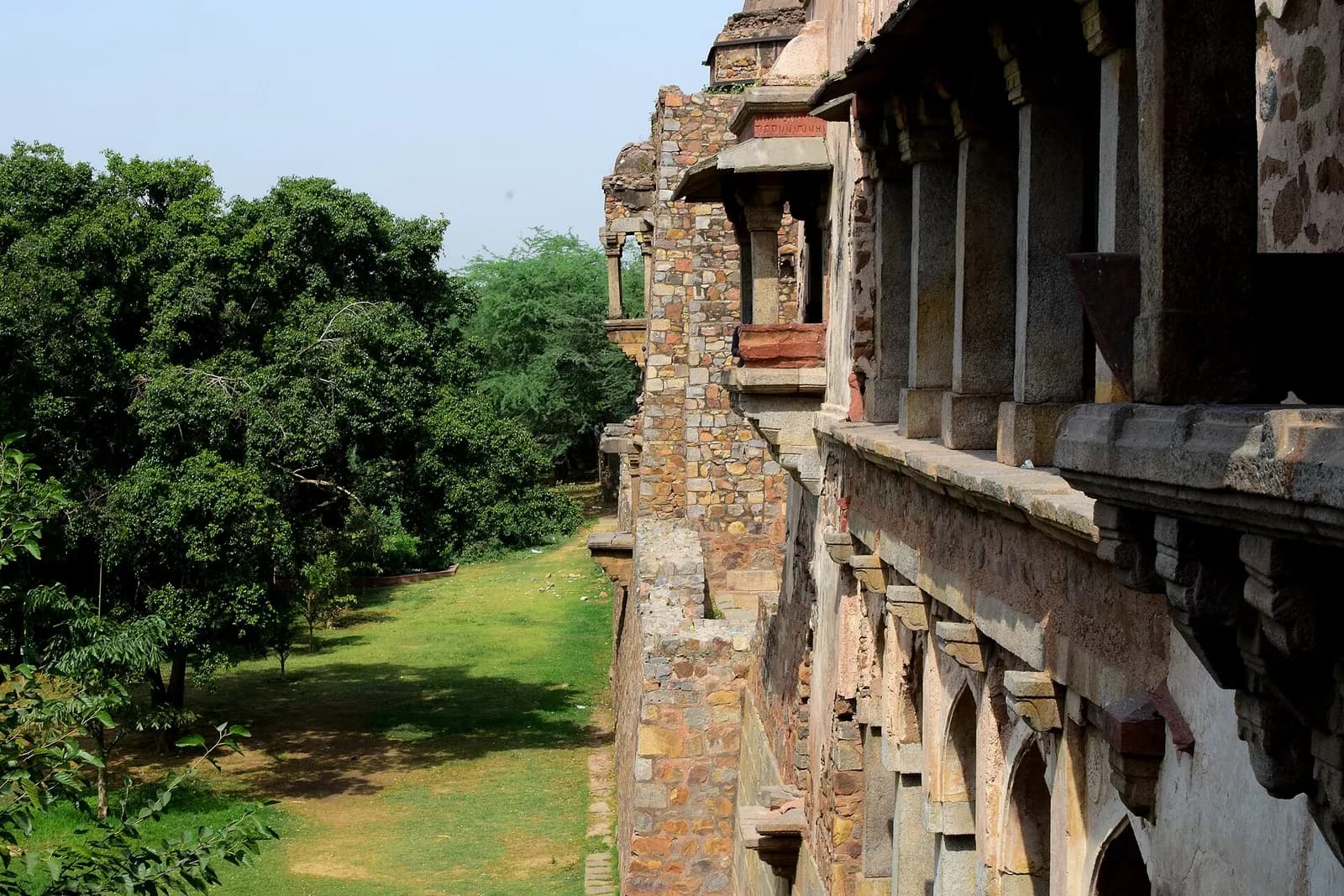
- The madrasa. A large, double storeyed, L-shaped seminary built by Firoz Shah Tughlaq, with pillared halls, small residential cells for students and balconies and terraces looking straight out over the water. It is the heart of the complex.
- The tomb of Firoz Shah Tughlaq. Set at the junction where the two wings of the madrasa meet, a square, domed tomb with thick stone walls and plasterwork carrying Quranic inscriptions, the resting place of the ruler who built it all.
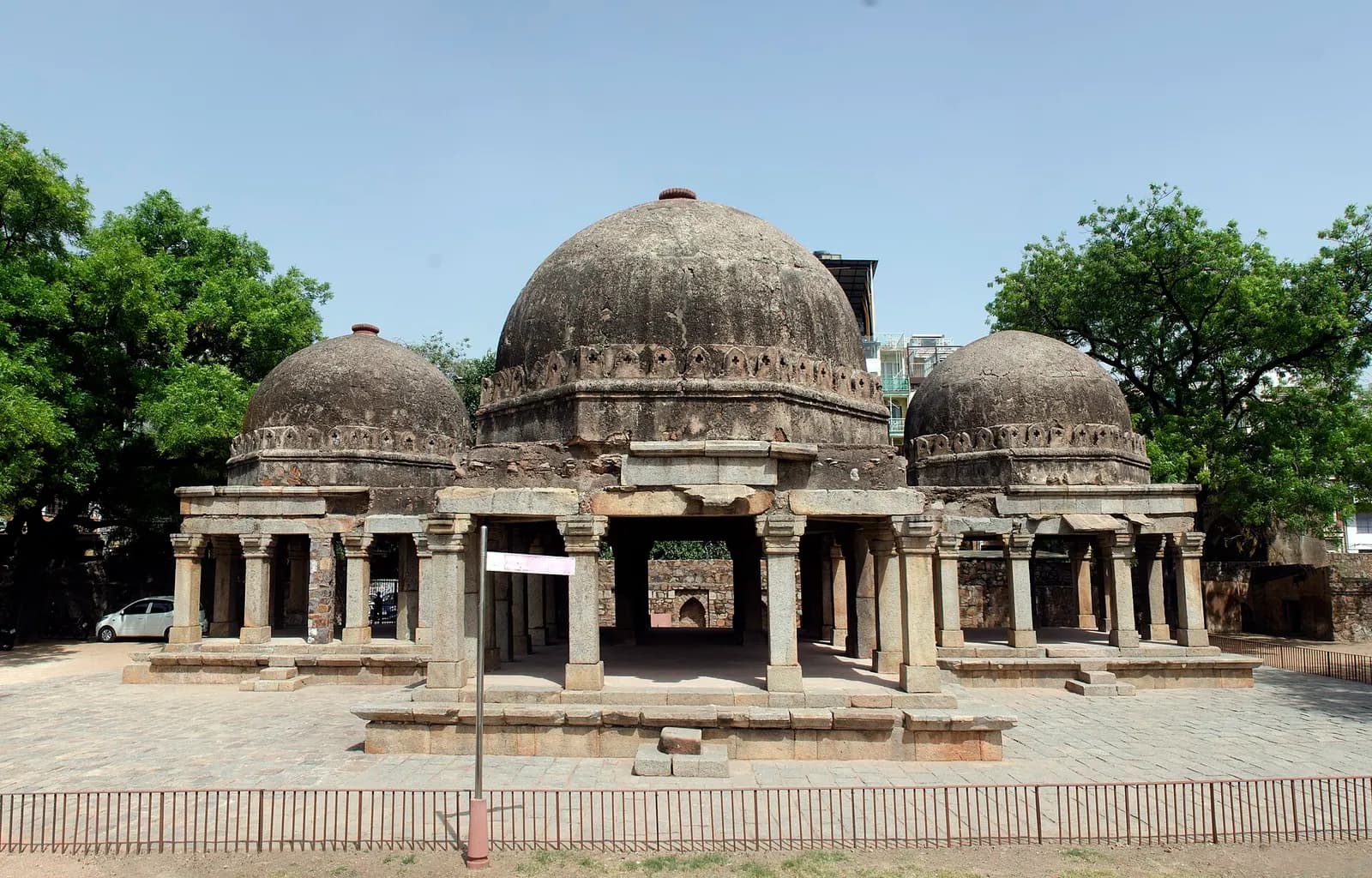
- The chhatris. Several small, domed pavilions dotted across the lawns, which served as graves for teachers and nobles connected with the medieval college.
- The lawns and terraces. Open green spaces and stone platforms that make wonderful spots to sit, take photos and watch the light change over the lake.
Give yourself time to walk out onto the madrasa balconies; the view over the water, especially towards sunset, is the single best thing in the complex.
The whole site is compact enough to explore in under an hour, yet it rewards a slower pace. Unlike a single grand monument, Hauz Khas is a collection of linked structures to wander between, up and down worn stone steps, through pillared halls, out onto terraces, so it feels more like exploring than ticketing off a sight. The ruins are not heavily restored, which gives them an authentic, weathered character and because the complex is free and relatively uncrowded on weekdays, you can often have a quiet corner above the lake almost to yourself. Birds wheel over the water, the city hum fades and the contrast with the buzzing village a few steps away makes the calm feel all the more striking.
What was the madrasa and why did it matter?
The madrasa is the heart of Hauz Khas and it repays knowing a little about it. A madrasa is an Islamic college and the one Firoz Shah Tughlaq built here was among the most important in the medieval Islamic world, a renowned seat of higher learning that drew scholars and students from far afield. In its day it taught theology, law, logic, astronomy and the sciences of the age and its reputation reached well beyond Delhi.
The architecture reflects that purpose beautifully. The long, double storeyed, L-shaped building runs along the edge of the lake, so that the pillared teaching halls and the small residential cells, the hujras, where students lived, all open towards the water and the breeze. Terraces and balconies step down towards the lake, giving students and teachers cool, shaded places to read and debate with one of the finest views in the city. Walking through the halls today, with the arches framing the water at every turn, it is easy to imagine how inspiring a place this must have been to study. The integration of building, learning and landscape is what makes the madrasa far more than a ruin; it is the surviving shell of a great medieval university and the reason Hauz Khas mattered so much in its time.
Who was Firoz Shah Tughlaq?
Firoz Shah Tughlaq was a 14th century ruler of the Delhi Sultanate, remembered above all as a great builder and patron rather than a conqueror. He founded cities, dug canals and raised mosques, tombs and colleges across his realm and he took a particular interest in restoring and preserving older monuments. His decision to clear the silted royal tank at Hauz Khas and build a major madrasa and his own tomb beside it is very much in character, a ruler investing in learning, water and lasting architecture. His tomb at the heart of the complex means the man who shaped Hauz Khas as we know it still lies at its centre, which gives the ruins a satisfying sense of unity.
What is Hauz Khas Village?
Hauz Khas Village is the lively urban village that has grown up right beside the historic complex and for many Delhiites it is as much the draw as the ruins. Its narrow lanes are packed with an ever changing mix of multi cuisine restaurants, rooftop bars, hidden speakeasies, art galleries, boutiques and craft cafes, many of them stylish and design led. A number of the premium restaurants and bars have upper floors and balconies that look directly out over the historic lake and the wooded Deer Park, so you can eat or drink with a view of the very ruins you explored earlier. The village is where Hauz Khas earns its reputation as a nightlife and dining hotspot and the seamless step from medieval history to a rooftop dinner is exactly what makes the area special. It is free to wander the lanes; you spend only on what you choose to eat, drink or buy.
The village has a character all its own. It grew up organically in the old lanes beside the ruins, which means it is a maze of narrow, winding streets rather than a planned market and half the fun is wandering and discovering places tucked up staircases and behind unmarked doors. The crowd is young, creative and fashion conscious and the mix changes constantly as venues open and close, so no two visits are quite the same. By day it is calmer, good for browsing boutiques and lingering over coffee; by night it transforms into one of the city's liveliest scenes, with music, rooftops and crowds filling the lanes. Prices tend to be higher than ordinary Delhi markets, in keeping with its upmarket reputation, but you are paying for the setting and the atmosphere as much as the food. Whatever your budget, simply walking the lanes and taking in the energy, with the floodlit ruins never far away, costs nothing.
What is the Deer Park at Hauz Khas?
Right beside the fort complex lies the sprawling Deer Park, part of a larger district park and rose garden and it is a lovely, quieter counterpart to the busy village. As the name suggests, it is home to spotted deer, along with peacocks, rabbits and plenty of birdlife and it is popular with local walkers, joggers and birdwatchers. The park connects directly to the historic complex, so you can combine a walk among the trees and wildlife with your visit to the ruins. For anyone who wants a green, peaceful interlude in the middle of the city or a gentle stroll before the village gets going in the evening, the Deer Park is a welcome bonus that many first time visitors do not expect. The park is large and leafy, with shaded walking paths, open lawns and a rose garden and it draws a steady stream of local walkers and families in the mornings and evenings. Keep an eye out for the resident deer in their enclosure and the peacocks that roam more freely and carry water if you plan a longer loop. Together the ruins, the lake and the park make the historic side of Hauz Khas a genuine half day of its own, before the village even enters the picture.
What are the Hauz Khas timings and entry fee?
Hauz Khas works on two different clocks. The historic fort, ruins and lake area is generally open every day from about 10:30 AM to 6:00 PM, broadly in step with daylight, so it closes earlier in winter; aim to be inside well before sunset to enjoy the view. Entry to the ruins and the lake is completely free, with no ticket. The village, by contrast, runs on evening and night hours, with cafes, restaurants and bars typically open from late morning until around midnight or later, especially at weekends. Walking the village lanes is free; you pay only for what you eat, drink or buy. Because the two zones keep such different hours, the ideal plan is to see the ruins in the late afternoon while they are open and the light is good, then move into the village as it comes alive for the evening. Treat all timings as a guide and reconfirm if your schedule is tight.
What is the best time to visit Hauz Khas?
The best time to visit is the late afternoon, roughly 3:30 PM to 6:00 PM and this is the tip that makes the whole outing work. Arriving in the late afternoon lets you explore the stone ruins comfortably as the heat eases, catch a breathtaking golden sunset over the lake from the madrasa balconies and then step straight into the village for dinner or drinks as it lights up for the night. It is one of the most satisfying few hours you can spend in Delhi. By season, the cool months from October to March are the most pleasant for the outdoor ruins and the park, though the village is enjoyable year round thanks to its indoor and rooftop venues. Weekday evenings are calmer than the packed Friday and Saturday nights, if you prefer a quieter visit. If your main interest is the history and the lake rather than the nightlife, a weekday late afternoon is close to perfect: the ruins are quiet, the light is golden and you can still enjoy an early dinner in the village before it fills up. If you are mainly here for the social scene, a weekend night delivers the full, buzzing Hauz Khas experience, just be ready for crowds in the narrow lanes. Either way, late afternoon into evening is the window that shows the place at its best.
Is Hauz Khas good for photography?
Yes, Hauz Khas is one of South Delhi's most photogenic spots, for very different kinds of photos. The ruins offer dramatic stone arches, pillared halls and domed pavilions and above all the view of the medieval architecture reflected in the lake, which is magical in the golden light before sunset. The Deer Park adds greenery and wildlife and the village itself is full of street art, quirky cafe interiors and rooftop views for a more urban, lifestyle feel. A few pointers:
- Shoot the ruins in the late afternoon for warm light and the sunset over the lake from the madrasa balconies.
- Look for the lake reflections of the arches and domes, the signature Hauz Khas shot.
- Explore the village lanes for murals, cafe aesthetics and rooftop skyline views after dark.
- Casual photography is free in the ruins; be considerate inside private cafes and galleries.
How do you reach Hauz Khas?
Hauz Khas is easy to reach by metro, though the station is a little way from the village itself. The nearest stations are Hauz Khas, an interchange on the Yellow and Magenta lines, about 2 km from the village and Green Park on the Yellow Line, equally convenient. From either, you will find e-rickshaws and autos waiting to drop you at the village entrance, which is the simplest last leg. Driving is less appealing: motor vehicles are heavily restricted in the narrow village lanes, so the practical option is the paid multi level car park at the village entrance, from which you walk in.
Its position in South Delhi, close to the Qutub Minar and the Mehrauli belt, means it slots neatly into a southern sightseeing plan. If you are threading a wider route, a dedicated New Delhi tour can tie it together with the imperial sights, while a broader Delhi day tour folds the complex and village into the full span of the capital.
What is there to see near Hauz Khas?
Hauz Khas sits in a rich part of South Delhi, so it pairs easily with plenty nearby. About ten minutes away by auto is Shahpur Jat, another urban village, famous as a hub for independent designer clothing, bridal boutiques and quirky craft cafes, a natural companion if you enjoy the shopping and cafe side of Hauz Khas. A short fifteen minute ride down Aurobindo Marg brings you to the towering Qutub Minar and the surrounding Mehrauli Archaeological Park offers an even deeper dive into medieval Delhi, with its own ruins and stepwells.
Further afield the heritage keeps coming, from the lawns and tombs of Lodhi Garden and the grand Safdarjung's Tomb to the modern Garden of Five Senses near Saket. For food ideas across the city, our roundup of where to eat in Delhi has you covered, though in Hauz Khas you are spoilt for choice. Together these turn Hauz Khas into the anchor of a rewarding South Delhi day and you can see the fuller picture in our guide to the important monuments of Delhi.
How does Hauz Khas fit into a Delhi itinerary?
For most visitors, Hauz Khas works best as a late afternoon and evening, the natural second half of a South Delhi day. A classic plan pairs it with the Qutub Minar and Mehrauli in the earlier afternoon, then moves to Hauz Khas for the ruins and sunset over the lake, rolling into the village for dinner. It is one of the few sights in the city that carries you comfortably from daytime history into nightlife in a single, walkable spot. History minded travellers often link it with the city's other great monuments across a fuller itinerary, the serene Humayun's Tomb, the mighty Red Fort, the imperial avenues of India Gate and the modern Lotus Temple and the hidden stepwell of Agrasen ki Baoli in the centre.
If Delhi is your gateway to the wider Golden Triangle, Hauz Khas adds a relaxed, contemporary evening to a trip otherwise full of grand monuments, a reminder that Delhi is a living city as much as a historic one. Many of my guests love ending a day of sightseeing here, with a lakeside sunset and a good meal. For the best season across the capital, our guide to the best time to visit Delhi is a useful companion and for more atmospheric corners, see our guide to the city's hidden places to visit.
Travel tips for visiting Hauz Khas
A few pointers make the outing much better:
- Go in the late afternoon, around 3:30 PM onwards, to get the ruins, the sunset over the lake and the village all in one visit.
- See the ruins first, since they close by about 6:00 PM, then move into the village for the evening.
- Catch the sunset from the madrasa balconies, the best view in the complex.
- Come by metro to Hauz Khas or Green Park and take an auto, as driving and parking in the lanes is a hassle.
- Wear comfortable shoes, as the ruins have uneven steps and the village lanes involve a fair bit of walking.
- Weekday evenings are calmer; Friday and Saturday nights get very crowded in the narrow lanes.
- Use registered app cabs or autos from the village entrance if heading home late at night.
- Combine it with the Deer Park for a quiet green walk before the village gets busy.
If you would like a local to build Hauz Khas into a wider Delhi plan, message our team on WhatsApp at +91 7302265809 with your travel dates and group size and we will help you shape the day.
Plan your trip with us
At Experience My India, through our Delhi and Golden Triangle travel desk, we design unhurried, well paced trips that make room for places like Hauz Khas, where history and modern life meet, not just the headline monuments. Whether you want a relaxed set of Delhi Agra tours or a full Golden Triangle route through Delhi, Agra and Jaipur, we plan around your pace, your interests and the right season, with local guides who know when to reach the lake for the sunset and where to eat afterwards. Share your dates and the kind of trip you have in mind through our enquiry page, tell us your group size and we will put together an honest, tailored plan rather than a rushed checklist.
Related guides
- Akshardham temple, for a very different, modern Delhi landmark
- Nearby places to visit in Delhi, to extend your day
Enquire Now
Ready to Explore
The Heart of Delhi?
Explore the Red Fort, Qutub Minar, Humayun's Tomb, and the vibrant streets of Old Delhi with our expert-guided premium tours of India's capital city.

Delhi
Premium Tour Package
Questions
Frequently asked questions
What are the timings of Hauz Khas fort?
The historic fort, ruins and lake are generally open daily from about 10:30 AM to 6:00 PM, broadly with daylight. The village cafes and bars stay open much later, until around midnight.
What is the entry fee for Hauz Khas?
Which is the nearest metro station to Hauz Khas?
What does Hauz Khas mean?
Who built Hauz Khas?
What can you see in the Hauz Khas complex?
Is Hauz Khas worth visiting?
What is Hauz Khas Village known for?
What is the best time to visit Hauz Khas?
Is there a deer park at Hauz Khas?
Is Hauz Khas safe at night?
Explore more
Plan your Hauz Khas trip with us

Photo credits
Photos from Wikimedia Commons, used under their licences:
- Photo 1 by Samridhiupadhyay, CC BY-SA 4.0
- Photo 2 by Rangan Datta Wiki, CC BY-SA 4.0
- Photo 3 by Rsapmech, CC BY-SA 4.0
- Photo 4 by Prateek Gupta, CC BY-SA 4.0
- Photo 5 by Saarthak Gupta, CC BY-SA 4.0
Interested in Hauz Khas Delhi: Fort, Lake, Village and Complete Visitor Guide?
Chat with our travel team for a custom quote, or browse every package.
Related Attractions
9Ready to explore Hauz Khas Delhi: Fort, Lake, Village and Complete Visitor Guide?
Book your private tour today and experience the magic of India's rich heritage.