
Lodhi Garden Delhi: Timings, Entry, Monuments and Full Visitor Guide
Planning Lodhi Garden Delhi? Timings, free entry, the tombs and Bada Gumbad, best time to visit, the nearest metro, photography and visitor tips.
In a Nutshell
“Lodhi Garden is a free, 90 acre heritage park in central New Delhi, open daily and famous for its 15th and 16th century Sayyid and Lodhi tombs set among lawns, old trees and birdlife. Entry is free, the nearest metro is Jor Bagh and most visitors spend ninety minutes to a couple of hours. It is one of the capital's best loved spots for a morning walk, a history stroll or a picnic, run by a unit of Experience My India.”
Lodhi Garden sits at the heart of New Delhi, a rare place where medieval monuments, wide green lawns and an easy walking culture all share the same space. If you want a calm, free, genuinely historic morning in the capital, start here. Our team at Delhi Agra Tour Packages folds it into Delhi days for travellers who want heritage without crowds or ticket queues and it pairs naturally with the bigger monuments on a wider Golden Triangle tour.
I am Abhay Sharma, Delhi born and a Golden Triangle guide since 2015 and Lodhi Garden is one of the places I send people to first. I have walked it at dawn with birdwatchers and at dusk with photographers and it never loses its quiet magic. This guide gathers everything I would tell a guest before a visit, checked against current information, so you can plan your morning with no surprises.
Details
Lodhi Garden at a glance
| Detail | Information |
|---|---|
| Location | Lodhi Road, Lodhi Estate, New Delhi, between Khan Market and Safdarjung's Tomb |
| Spread | Over 90 acres |
| Built by | Sayyid and Lodhi dynasties, 15th and 16th centuries |
| Entry fee | Free for everyone |
| Nearest metro | Jor Bagh (Yellow Line), roughly a 5 to 7 minute walk |
| Time needed | About 1.5 to 2.5 hours |
| Known for | Tombs, lawns, old trees, birds, morning walks, photography |
| Managed by | Landscaped public park, monuments protected by the Archaeological Survey of India |
Details
Lodhi Garden timings
| Season | Opening hours |
|---|---|
| October to March (winter) | About 6:00 AM to 8:00 PM |
| April to September (summer) | About 5:00 AM to 8:00 PM |
| Weekly closure | Open all seven days |
Timings are commonly reported as roughly sunrise to about 8:00 PM and the exact opening shifts a little with the season, so treat the hours above as a guide and reconfirm if you are planning a very early dawn visit.
Details
Entry ticket prices
| Visitor | Fee |
|---|---|
| Indian visitors | Free |
| Foreign nationals | Free |
| Children | Free |
| Photography and videography | Free (casual personal use) |
Entry is completely free for everyone, with no ticket, no counter and no charge for ordinary personal photography. This is one of the reasons the park is so loved and so democratic, used every single day by residents of every background.
Details
How to reach
| From | Route |
|---|---|
| Jor Bagh metro (Yellow Line) | Roughly a 5 to 7 minute walk to the pedestrian gates |
| JLN Stadium metro (Violet Line) | A close alternative on the other side |
| Khan Market metro (Violet Line) | Ideal if you want to eat before or after |
| By car | Free public parking outside Gate 1 and Gate 3, fills fast on weekend mornings and evenings |
What is Lodhi Garden and why is it so special?
Lodhi Garden is a landscaped city park of more than 90 acres in the heart of New Delhi that wraps a cluster of 15th and 16th century tombs and monuments in lawns, flowerbeds and old trees. It is special because it does something very few places in the world manage: it lets you walk among six hundred year old mausoleums while joggers, yoga groups, young couples and families carry on an ordinary morning all around you. History here is not roped off and ticketed, it is lived in.
For a visitor, the appeal is the blend. You get genuinely important Indo Islamic architecture, the serene domes and carved plaster of the Sayyid and Lodhi rulers, set in one of the loveliest and best kept green spaces in the capital. It costs nothing, it is open from early morning and it rewards a slow wander far more than a quick look. It belongs on any thoughtful list of things to do in Delhi, especially for travellers who want a calm, green counterpoint to the busier forts and bazaars.
What is the history of Lodhi Garden?
The history of Lodhi Garden runs far deeper than the park you see today. Long before the lawns, the monuments stood scattered across agricultural land in a village called Khairpur, on the edge of the shifting cities of medieval Delhi. The tombs were raised by the Sayyid dynasty and then the Lodhi dynasty, the last two ruling houses of the Delhi Sultanate, across the 15th and into the early 16th century.
The garden as a designed landscape is much more recent. In the colonial era the area around the tombs was cleared and laid out as a park and it was formally inaugurated in 1936 as Lady Willingdon Park, named after the wife of the then Viceroy. To create it, the old village of Khairpur that had grown up among the tombs was moved and the monuments were set free to stand as features in an ornamental landscape rather than ruins in a field. After independence it was renamed Lodhi Garden, after the dynasty whose monuments give it its character and in the decades that followed it was relandscaped again into the shaded, contoured, carefully planted park visitors now know, with winding paths, water features and avenues of mature trees.
The result is a layered site where three different eras sit on top of one another. There is the medieval layer of sultanate tombs, the colonial layer of a viceregal pleasure park and the modern layer of a beloved public green space that the city uses every single day. Few parks anywhere let you read their own making so clearly and it is part of what gives Lodhi Garden its unusual depth. When you walk it, you are not just visiting old monuments, you are walking through several centuries of how Delhi has chosen to treat its own past.
Who were the Sayyids and Lodhis buried here?
The Sayyid dynasty ruled Delhi in the early 15th century and the Lodhi dynasty, an Afghan line, followed them and governed until 1526, when Babur defeated Ibrahim Lodi at Panipat and founded the Mughal empire. These were turbulent, transitional years and the architecture in the garden reflects a style caught between the austere sultanate tradition and the richer Mughal manner that would follow. The tombs here are the quiet survivors of that late sultanate world, which makes the garden one of the best places in Delhi to read a chapter of history that is easy to overlook between the grand Mughal monuments.
What monuments can you see inside Lodhi Garden?
The garden is dotted with monuments protected by the Archaeological Survey of India and they are among the finest examples of late sultanate, Indo Islamic architecture in the city. Each one has a board explaining it and a slow loop takes in all of them.
| Monument | What to know |
|---|---|
| Bada Gumbad | Large late 15th century domed structure with an attached carved mosque, famous for its plasterwork |
| Sheesh Gumbad | Tomb that once glittered with glazed blue tiles, holding unnamed graves of the Lodhi period |
| Tomb of Sikandar Lodi | Octagonal tomb in a fortified walled enclosure, India's earliest surviving enclosed garden tomb |
| Tomb of Muhammad Shah | The earliest tomb in the garden, 1444, the sole major relic of the Sayyid dynasty here |
| Athpula | A 16th century stone bridge of eight piers and seven arches, from the reign of Akbar |
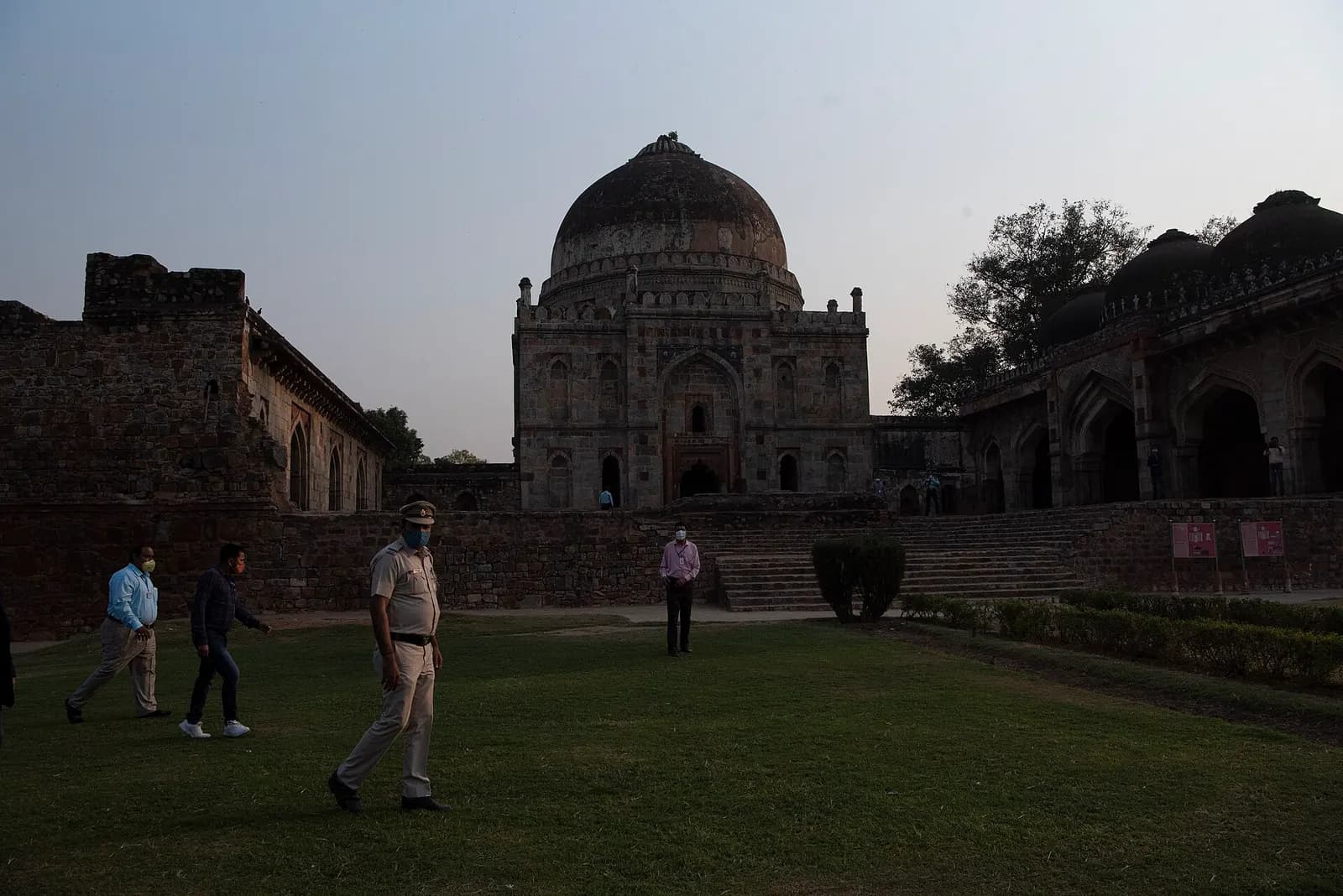
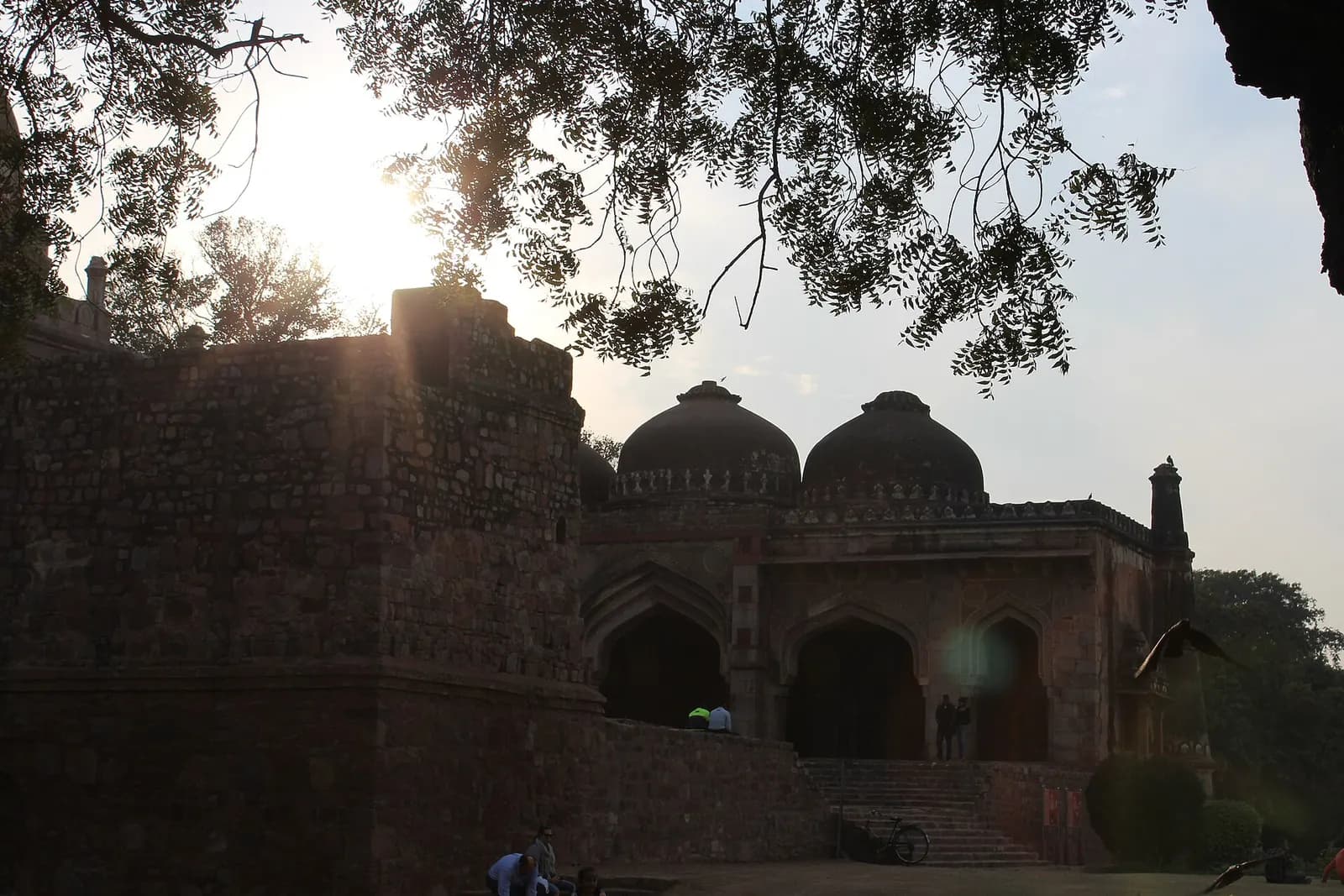
The Bada Gumbad or big dome, is the first great building most people meet, often just inside Gate 1. It is a massive, square, domed structure raised on a plinth around 1490 and it carries one of the earliest full domes built in Delhi. Attached to it is a beautiful three domed mosque, usually dated to about 1494, covered in the intricate incised plaster and inscriptions that are the glory of Lodhi craftsmanship. Look closely at the carving and you will see the characteristic mingling of Islamic and Hindu decorative traditions that took root during the sultanate period, lotus motifs and bell and chain patterns sitting alongside Quranic calligraphy. It is some of the finest incised plasterwork of its era anywhere in Delhi and easy to walk past without noticing, so give it a moment.
Directly across the lawn stands the Sheesh Gumbad, the glass dome, which takes its name from the glazed blue tiles that once sheathed its facade, a few of which survive near the top. Inside are graves whose occupants are not certainly known, thought to belong to the Lodhi family or court. Architecturally it is a near twin of the Bada Gumbad and the pair framing the lawn is one of the garden's signature views.
Set a little apart in its own walled, almost fortress-like enclosure is the Tomb of Sikandar Lodi, built by his son Ibrahim Lodi around 1517 and 1518. It is an octagonal mausoleum ringed by battlemented walls and it is often described as the earliest surviving enclosed garden tomb in India, a form the Mughals would later perfect. It is the quietest and least visited corner of the park and for many the most atmospheric.
The Tomb of Muhammad Shah, built in 1444 for a ruler of the Sayyid dynasty, is the oldest monument in the garden and its only significant Sayyid relic. It is an octagonal tomb wrapped in an arched verandah with sloping eaves and small domed turrets, a template you will see echoed in Sikandar Lodi's tomb nearby.
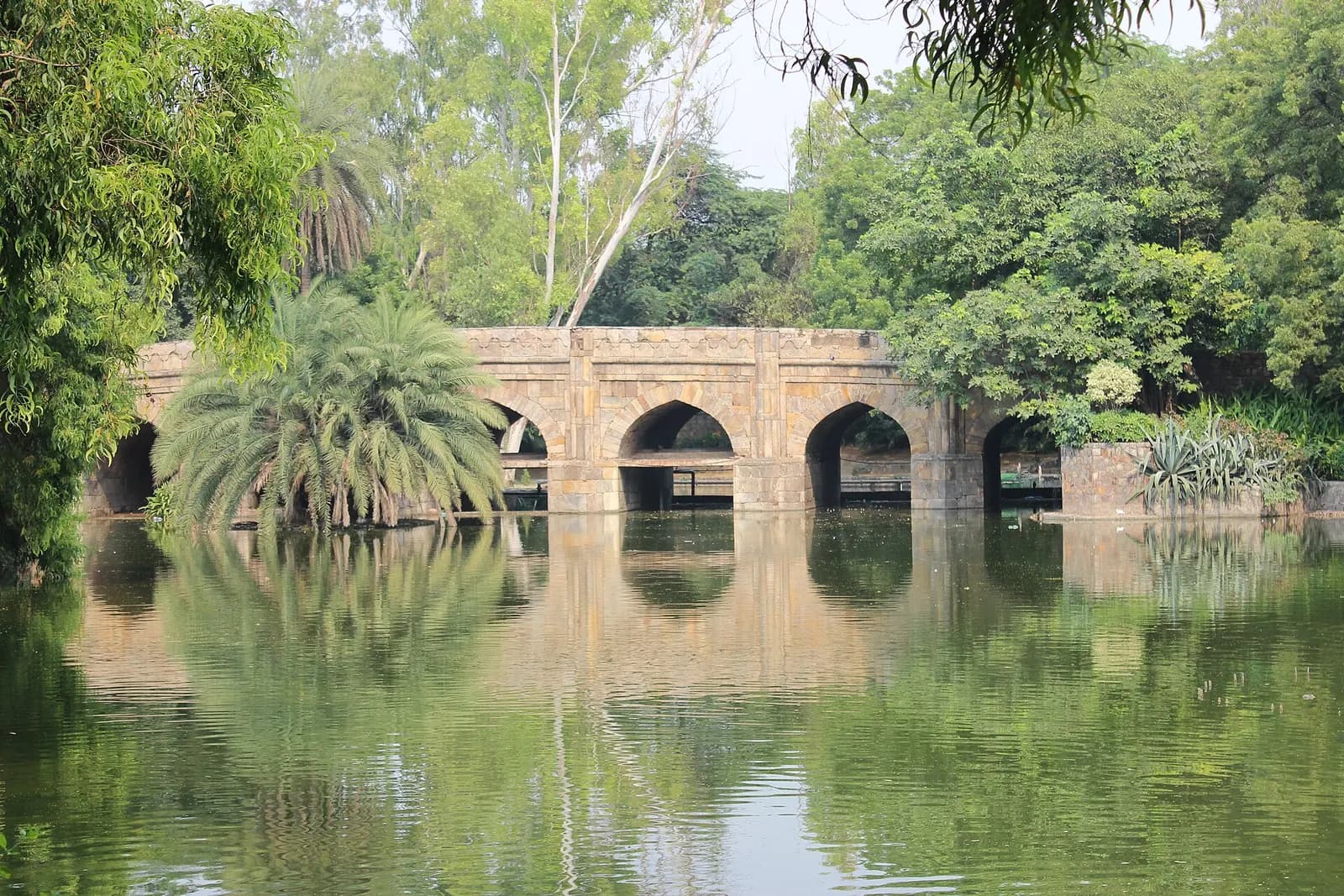
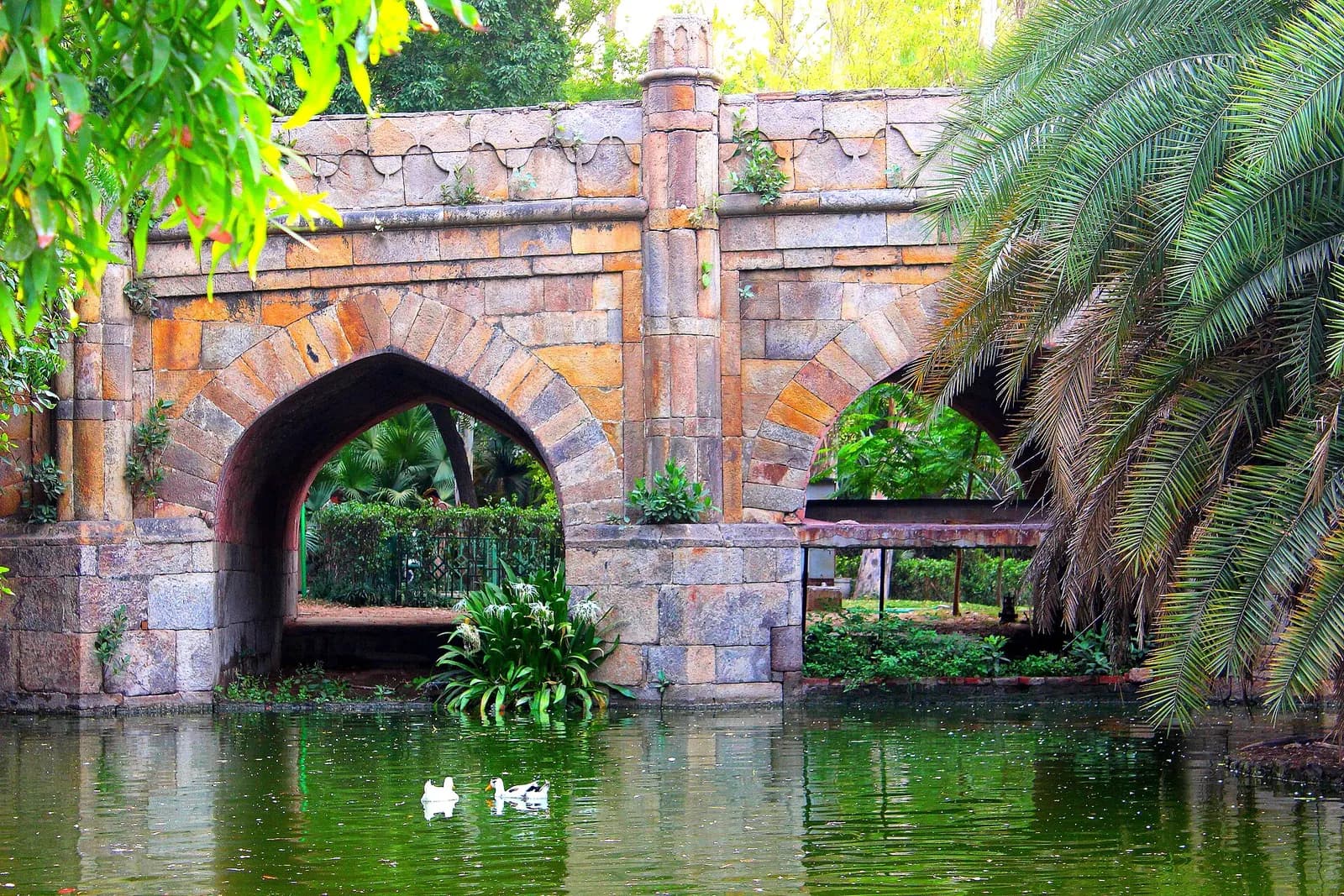
Finally, in the garden's quieter reaches, the Athpula, meaning eight piered, is a graceful stone bridge of seven arches built in the 16th century during the reign of the Mughal emperor Akbar. It is one of the few surviving Akbar era structures in this part of Delhi and it makes a lovely final stop on a walking loop.
Is Bada Gumbad actually a tomb?
This is the garden's most interesting puzzle and it is worth knowing before you visit. Despite its scale and its tomb-like shape, the Bada Gumbad contains no grave or cenotaph inside. For a long time it was assumed to be the mausoleum of an unnamed Lodhi noble, but many historians now read it differently, as a grand monumental gateway, most likely leading to the adjoining mosque or built as a tribute structure rather than a burial place. Whoever raised it, probably Sikandar Lodi in memory of his father Bahlul Lodi, meant it to impress rather than to inter. Knowing this changes how you look at it: not a tomb that lost its occupant, but a statement of power and piety in stone and plaster. It is exactly the kind of detail the rushed guidebooks miss and the kind that makes a slow visit rewarding.
What are the Lodhi Garden timings and entry fee?
Lodhi Garden is open every day of the week, with no weekly closure, broadly from sunrise to about 8:00 PM. In the winter months, roughly October to March, it generally opens around 6:00 AM and in the summer months, April to September, it tends to open earlier, around 5:00 AM, to make the most of the cool dawn. Closing is usually around 8:00 PM year round. Because the exact hours shift a little with the season and with occasional advisories, I always suggest treating these as a guide and confirming if you plan to arrive at first light.
Entry is free for absolutely everyone, Indian and foreign visitors alike, with no ticket, no counter and no charge for casual personal photography. There is simply nothing to buy to get in. That combination of free access and early opening is why the park is so woven into daily life in this part of Delhi and why it costs you nothing to add it to a morning.
What is the best time to visit Lodhi Garden?
The best time to visit Lodhi Garden is early morning or late afternoon and the best season is the cool stretch from October to March. At sunrise, roughly between 6:00 AM and 8:30 AM, the air is crisp, the birds are active and you share the park with the dedicated regulars who walk it every day; it is the finest window for birdwatching and for a peaceful loop of the monuments. In the late afternoon and around sunset, roughly 4:30 PM to 6:30 PM in winter, the low golden light falls beautifully on the sandstone and plaster of the tombs, which makes it the prime time for photography.
I would gently steer you away from the deep summer midday. From April to June the Delhi heat can climb well above 40 degrees Celsius and the open lawns offer limited shade in the hottest hours, so an early start matters even more in summer. In the monsoon the garden is green and dramatic but the paths can be slippery. Winter mornings, cool and clear, are simply unbeatable.
What are the gardens, trees and birds like?
Beyond the monuments, Lodhi Garden is a genuine botanical treasure and for many regulars the greenery is the main draw. The park holds well over a hundred species of trees, many of them old and grand and features a dedicated National Bonsai Park, a rose garden and a glass house nursery. Shaded avenues, contoured lawns and water features make it a designed landscape rather than a plain field, which is why it repays a slow, wandering pace.
It is also one of the best spots for birdlife in central Delhi. Early walkers regularly see parakeets, mynas, hornbills, kingfishers, owls and birds of prey wheeling over the lawns and the mix of old trees, open grass and water draws a surprising variety for a city park. If you carry binoculars, a winter dawn here is a small delight. Many of the trees are tagged, some with QR codes that identify the species, part of the careful conservation that keeps this an outstanding green lung for the city. Butterflies are common in the warmer months and the ponds and water channels draw their own wildlife, so even a slow circuit without a single monument in mind can feel like a proper nature walk in the middle of the capital. For regulars, the changing flowers through the seasons, roses in winter, bougainvillea and flowering trees in spring, are as much the reason to return as the history.
What can you do at Lodhi Garden?
Lodhi Garden rewards almost any gentle pace. The most popular use is simply walking: the paved tracks run for several kilometres and are busy from first light with joggers, power walkers, yoga and laughter groups and people doing their daily rounds. There is an open air gym area and the wide lawns invite stretching, reading or just sitting under a tree. History walkers come for the monuments, photographers for the light and families for a low key, green day out.
It is a wonderful place to slow down. I often tell guests to leave an hour more than they think they need, to actually sit on the grass by the Bada Gumbad or wander out to the Athpula bridge rather than ticking off the tombs in a rush. The whole character of the garden only reveals itself when you stop hurrying.
Can you picnic at Lodhi Garden and what are the rules?
Yes, casual family picnicking on the lawns is widely permitted and genuinely popular and people happily spread a mat with snacks and a book for a lazy afternoon. It is one of the friendliest green spaces in the city for a simple outdoor meal.
A few sensible rules keep the atmosphere calm and they are worth respecting. Open fires and outdoor cooking are not allowed, loud music is discouraged and rough field sports like full cricket matches are prohibited so the park stays peaceful and the monuments and planting stay protected. Carry your litter out, keep groups considerate and the garden stays the shared pleasure it is meant to be.
Is Lodhi Garden good for photography and shoots?
Lodhi Garden is one of the most photographed green spaces in Delhi and for good reason. The combination of six hundred year old domes, framed avenues, flowering beds and soft, filtered light gives you a huge range of backdrops in a compact loop. At sunrise and again near sunset the low sun warms the sandstone and plaster of the tombs and throws long shadows across the lawns, which is when the park looks its absolute best through a lens. The arched verandahs of the Muhammad Shah and Sikandar Lodi tombs, the twin domes of the Bada Gumbad and Sheesh Gumbad across the grass and the seven arches of the Athpula bridge are the classic compositions, but the quieter corners reward anyone willing to wander.
It is also a long standing favourite for portrait, fashion and pre wedding shoots and on a winter weekend morning you will often see couples and small crews working around the monuments. Casual personal photography is free and welcome. For anything on a professional scale, with large crews, lighting rigs or props, it is worth checking current rules and any permissions in advance, since the garden is a protected heritage site and the authorities balance shoots against the comfort of the thousands of ordinary visitors who use the park every day. Keep groups considerate, avoid blocking paths and the garden gives you some of the finest heritage backdrops in the capital at no cost at all.
How do you reach Lodhi Garden?
Lodhi Garden is very easy to reach. By metro, the closest station is Jor Bagh on the Yellow Line, from which it is roughly a 5 to 7 minute walk to the pedestrian gates; JLN Stadium on the Violet Line is a close alternative from the other side and Khan Market, also on the Violet Line, is ideal if you want to combine the visit with a meal. From any of these an auto for the short last stretch is simple if you prefer not to walk.
By car, there is free public parking outside Gate 1 and Gate 3, though the spaces fill quickly on weekend mornings and evenings when the park is at its busiest, so arrive early or be ready to wait for a spot. Taxis and app cabs drop easily at the main gates. The garden's position in central Delhi, close to India Gate and the institutional heart of the city, means it slots neatly into almost any day plan. If you are building a wider route, a dedicated New Delhi tour can thread it together with the imperial sights, while a broader Delhi day tour folds the garden into the full span of the capital.
What is there to see near Lodhi Garden?
Lodhi Garden sits in one of the richest parts of Delhi for pairing, so it rarely stands alone in a plan. Just a few minutes' walk from the Jor Bagh side is Safdarjung's Tomb, a grand marble domed 18th century Mughal mausoleum often called the last great garden tomb of the dynasty and a natural companion to the earlier tombs inside the park; our guide to Safdarjung Tomb covers it in full. Right down the road, Khan Market is one of the capital's most premium dining and lifestyle hubs, perfect for a coffee, a bookshop browse or a meal and you can find ideas in our roundup of where to eat in Delhi.
A little further out, the heritage keeps coming. The sprawling Mehrauli Archaeological Park offers an even deeper, wilder dive into medieval Delhi, the leafy Hauz Khas complex pairs a lake and ruins with cafes and the stepwell of Agrasen ki Baoli is a striking hidden stop nearby. For a contrasting modern green space, the Garden of Five Senses makes a good second garden and the antique lanes of Sunder Nagar market are close by. Together these turn Lodhi Garden into the anchor of a rewarding day in central and south Delhi.
How does Lodhi Garden fit into a Delhi or Golden Triangle itinerary?
For most visitors, Lodhi Garden works best as a calm early morning, before the day heats up and the big monuments fill. A classic pairing is a dawn walk here followed by nearby Safdarjung's Tomb, then a late breakfast at Khan Market, which makes a gentle, green first half of a Delhi day. History minded travellers often link it with the great Mughal monuments across the city, the serene Humayun's Tomb whose garden tomb form grew out of exactly the tradition you see at Sikandar Lodi's tomb and the towering Qutub Minar at the older end of the city's story. Those who want contrast fold in the Red Fort and the serene Lotus Temple later in the day.
If Delhi is your gateway to the wider Golden Triangle, Lodhi Garden adds a quiet, human scale chapter to the Mughal and sultanate story before you head south to Agra and on to Jaipur, so the architecture unfolds roughly in order. It is the kind of unhurried, free, deeply local experience I like to open a trip with and in the cooler months, a winter morning with crisp air, old domes and birdsong, it is as fine an introduction to Delhi as any ticketed sight. For the best season across the capital, our guide to the best time to visit Delhi is a useful companion.
Travel tips for visiting Lodhi Garden
A few pointers make the visit smoother. Come in the cooler months, October to March and aim for early morning or late afternoon, since the lawns offer limited shade in the heat of the day. Wear comfortable walking shoes, because the tracks run for several kilometres and you will cover a lot of ground across the 90 acres. Carry water and in summer start as early as the gates allow. Enter from Gate 1 to meet the Bada Gumbad first, follow the boards to each monument and leave time for the quieter Sikandar Lodi tomb and the Athpula bridge at the garden's edges. Bring binoculars for the birds at dawn, respect the no fires, no loud music and no rough sports rules if you picnic, carry your litter out and give the park the slow, unhurried wander its calm, historic character deserves. Entry is free, so the only thing it costs you is time well spent.
If you would like a local to build Lodhi Garden into a wider Delhi plan, message our team on WhatsApp at +91 7302265809 with your travel dates and group size and we will help you shape the day.
Plan your trip with us
At Experience My India, through our Delhi and Golden Triangle travel desk, we design unhurried, well paced trips that make room for places like Lodhi Garden, not just the headline monuments. Whether you want a relaxed Delhi Agra tours or a full Golden Triangle route through Delhi, Agra and Jaipur, we plan around your pace, your interests and the right season, with local guides who know which gate to enter and when the light is best. Share your dates and the kind of trip you have in mind through our enquiry page, tell us your group size and we will put together an honest, tailored plan rather than a rushed checklist.
Related guides
- Important monuments of Delhi, a wider tour of the capital's heritage
- Places to visit in Delhi, the full sightseeing picture
- Connaught Place, the colonial heart of New Delhi nearby
- Akshardham temple, for a very different, modern Delhi landmark
Enquire Now
Ready to Explore
The Heart of Delhi?
Explore the Red Fort, Qutub Minar, Humayun's Tomb, and the vibrant streets of Old Delhi with our expert-guided premium tours of India's capital city.

Delhi
Premium Tour Package
Questions
Frequently asked questions
Is there an entry fee for Lodhi Garden?
No. Lodhi Garden is completely free to enter for everyone, with no ticket, no counter and no charge for ordinary personal photography.
What are the timings of Lodhi Garden?
Which is the nearest metro station to Lodhi Garden?
How much time do I need at Lodhi Garden?
What is the best time to visit Lodhi Garden?
What monuments are inside Lodhi Garden?
Is Bada Gumbad a tomb?
Can you picnic at Lodhi Garden?
Is Lodhi Garden good for photography?
Is Lodhi Garden worth visiting?
What is near Lodhi Garden?
Explore more
Plan your Lodhi Garden trip with us

Photo credits
Photos from Wikimedia Commons, used under their licences:
- Photo 1 by U.S. Secretary of Defense, CC BY 2.0
- Photo 2 by Arpit225, CC BY-SA 4.0
- Photo 3 by Mithil Haldankar, CC BY-SA 4.0
- Photo 4 by Utkarshnarang, CC BY-SA 4.0
- Photo 5 by Deeptijacob1980, CC BY-SA 4.0
Interested in Lodhi Garden Delhi: Timings, Entry, Monuments and Full Visitor Guide?
Chat with our travel team for a custom quote, or browse every package.
Related Attractions
9Ready to explore Lodhi Garden Delhi: Timings, Entry, Monuments and Full Visitor Guide?
Book your private tour today and experience the magic of India's rich heritage.