


Purana Qila Delhi: Timings, Tickets, History and Complete Visitor Guide
Planning Purana Qila? Timings, ticket prices, the Sher Mandal and Humayun's fall, the mosque, the excavations, boating, metro and visitor tips.
In a Nutshell
“Purana Qila, the Old Fort, is one of Delhi's oldest forts, built in the 16th century by Humayun and Sher Shah Suri on the legendary site of Indraprastha. It is open every day, from about 7:00 AM to 5:00 PM. Entry is roughly ₹20 to ₹25 for Indians and ₹250 to ₹300 for foreign visitors, free for children under 15. Allow one to two hours for the quiet, atmospheric ruins. Delhi Agra Tour Packages, a unit of Experience My India, pairs it with the nearby sights.”
Purana Qila is one of Delhi's great overlooked treasures, an enormous sixteenth century fort that most first time visitors walk straight past on their way to the Red Fort. That is a shame, because few places tell the city's story so completely, from the legendary capital of the Mahabharata beneath its soil to the Mughal and Afghan rulers who built the walls you see and it is far quieter and cheaper than the more famous forts. If you are planning a trip, Delhi Agra Tour Packages is where I set the capital's sights in a sensible order and I love slipping Purana Qila in for travellers who want history without the crowds. It sits easily on our Golden Triangle tour routes for exactly that reason.
I am Abhay Sharma, Delhi born and a Golden Triangle guide since 2015. Over 11 years I have taken more than 50,000 travellers around this city and Purana Qila is a place I wish more of them knew about. Visitors are often unsure who actually built it, miss the tower where an emperor met his death and arrive expecting an evening show that may not be running. This guide fixes all of that. You will get the real timings and ticket prices, the honest story of who built the fort, what to see inside including the famous Sher Mandal, the truth about the sound and light show and boating and the practicalities that make the visit smooth. It is one of the best value, most atmospheric monuments in the city and it rewards anyone who makes the small effort to explore it.
Purana Qila at a glance
Here are the essentials before we go deeper. Treat the fees as a guide and reconfirm, since they change.
| Detail | Information |
|---|---|
| What it is | One of Delhi's oldest forts, the Old Fort |
| Location | Mathura Road, near the Delhi Zoo and Pragati Maidan |
| Built | 16th century, by Humayun and Sher Shah Suri |
| Earlier identity | The citadel of Dinpanah, later Shergarh, the sixth city of Delhi |
| Walls | Massive curtain walls stretching about 1.9 km |
| Entry fee | Modest, free for children under 15 |
| Time needed | 1 to 2 hours |
| Best time | October to March, early morning or late afternoon |
Details
Purana Qila timings
| Item | Detail |
|---|---|
| Opening hours | About 7:00 AM to 5:00 PM |
| Open days | Every day, no weekly closure |
| Note | Some sources list sunrise to sunset, so confirm for an early or late visit |
Details
Entry ticket prices (2026, reconfirm)
| Visitor type | Fee |
|---|---|
| Indian and SAARC or BIMSTEC | About ₹20 online, ₹25 cash |
| Foreign nationals | About ₹250 online, ₹300 cash |
| Children under 15 | Free |
| Note | A small extra ticket covers the museum and the boating lake |
Details
How to reach
| Mode | Detail |
|---|---|
| Nearest metro | Supreme Court (Blue Line), about 1.5 to 2 km away |
| Alternative metro | Khan Market, also nearby |
| From the metro | A short auto rickshaw or app cab to the fort entrance |
| Parking | Paid parking outside the fort and the adjacent Delhi Zoo |
What is Purana Qila and why is it so famous?
Purana Qila, which simply means Old Fort, is one of the oldest forts in Delhi, a sixteenth century citadel on the banks of the Yamuna that showcases some of the finest early Indo Islamic architecture in the city. It is famous on two counts. Beneath it lies one of the oldest continuously inhabited sites in Delhi, a mound long linked to Indraprastha, the legendary capital of the Pandavas from the Mahabharata and above it rise the walls and monuments of the Mughal and Afghan rulers who built the fort you see today. Few places compress so much of India's history into one enclosure.
For a traveller, the appeal is the combination of significance and serenity. Purana Qila has the scale and the history of the Red Fort but a fraction of the crowds, with sprawling green lawns, atmospheric ruins and a quiet that lets you actually feel the age of the place. It is also excellent value, with a ticket far cheaper than the headline forts. It belongs on any thoughtful list of things to do in Delhi, especially for anyone who has already seen the busier monuments and wants something deeper and calmer.
Who built Purana Qila?
This is the question visitors get wrong most often, because the fort was the work of two rival rulers, not one. The citadel was founded by the second Mughal emperor, Humayun, who began a new city here called Dinpanah in the 1530s. Before it was finished, Humayun was defeated and driven out of India by the Afghan warrior Sher Shah Suri, who occupied the fort, renamed it Shergarh, strengthened its fortifications, completed the walls and added its finest surviving buildings during his short but vigorous reign. Humayun later returned to power and the fort once more.
So the honest answer is that both men built Purana Qila, Humayun founding the city and choosing the site, Sher Shah raising much of what still stands, including the mosque and the tower inside. Historians genuinely dispute the exact division of credit and you will see the fort attributed to one or the other depending on the source, but the fair reading gives both their due. This rivalry is the fort's real story, two of the most consequential rulers of sixteenth century India, their destinies intertwined within these very walls, which is what makes Purana Qila so much more than a pile of old stone.
Is Purana Qila really Indraprastha?
This is the fort's most romantic claim and it has real substance behind it. For centuries, tradition has identified this mound beside the Yamuna with Indraprastha, the magnificent capital that the Pandavas are said to have built in the Mahabharata, the great Indian epic. The village of Indrapat stood on the site into modern times and the association is deeply woven into Delhi's sense of its own antiquity.
What makes it more than legend is archaeology. Purana Qila is a major active excavation site and digs here by the Archaeological Survey of India have unearthed evidence of continuous human settlement across an astonishing span of time, with pottery and artefacts from the Maurya, Sunga, Kushan, Gupta, Rajput and Mughal eras and the famous Painted Grey Ware pottery associated with the period of the Mahabharata. Whether or not you take the epic literally, the hard evidence of thousands of years of continuous occupation is extraordinary and it is on display in the on-site museum. Standing on these lawns, you are on one of the oldest inhabited spots in one of the world's oldest cities.
The excavations are not a one off either. The ASI first dug here in the 1950s under the archaeologist B. B. Lal returned in the late 1960s and early 1970s and has reopened trenches again in recent years, each season adding another layer to the sequence. What makes the site so valuable to historians is precisely this unbroken stack of occupation levels, one culture settling on top of the last without a long gap, which is rare for any single spot. For a visitor, the practical upshot is that the open trenches near the Bada Darwaza and the labelled finds in the museum let you read that depth with your own eyes rather than taking it on trust, which is part of what sets Purana Qila apart from a monument you simply walk around.
What are the Purana Qila timings and entry fee?
Purana Qila is open every day of the week, with no weekly closure, generally from about 7:00 AM to 5:00 PM, though some listings describe it as sunrise to sunset, so confirm if you are planning a dawn or dusk visit. Entry is modest and among the best value of any major monument in the city. For Indian visitors and those from SAARC and BIMSTEC countries the fee is around ₹20 if paid online and a little more at the cash counter, while foreign nationals pay roughly ₹250 to ₹300. Children under 15 enter free. A small additional ticket covers the on site archaeological museum and the boating lake and these can be bought in combination.
As always, I quote these as current at the time of writing, because the Archaeological Survey of India adjusts fees from time to time and the figures for the museum and lake vary a little between sources. Buy online where you can for the cheaper rate and to skip the counter and carry a little cash for any small extras like the cloakroom. For the price, Purana Qila gives you a huge, historic complex to explore at your own pace, which makes it one of the most rewarding tickets in Delhi.
What can you see inside Purana Qila?
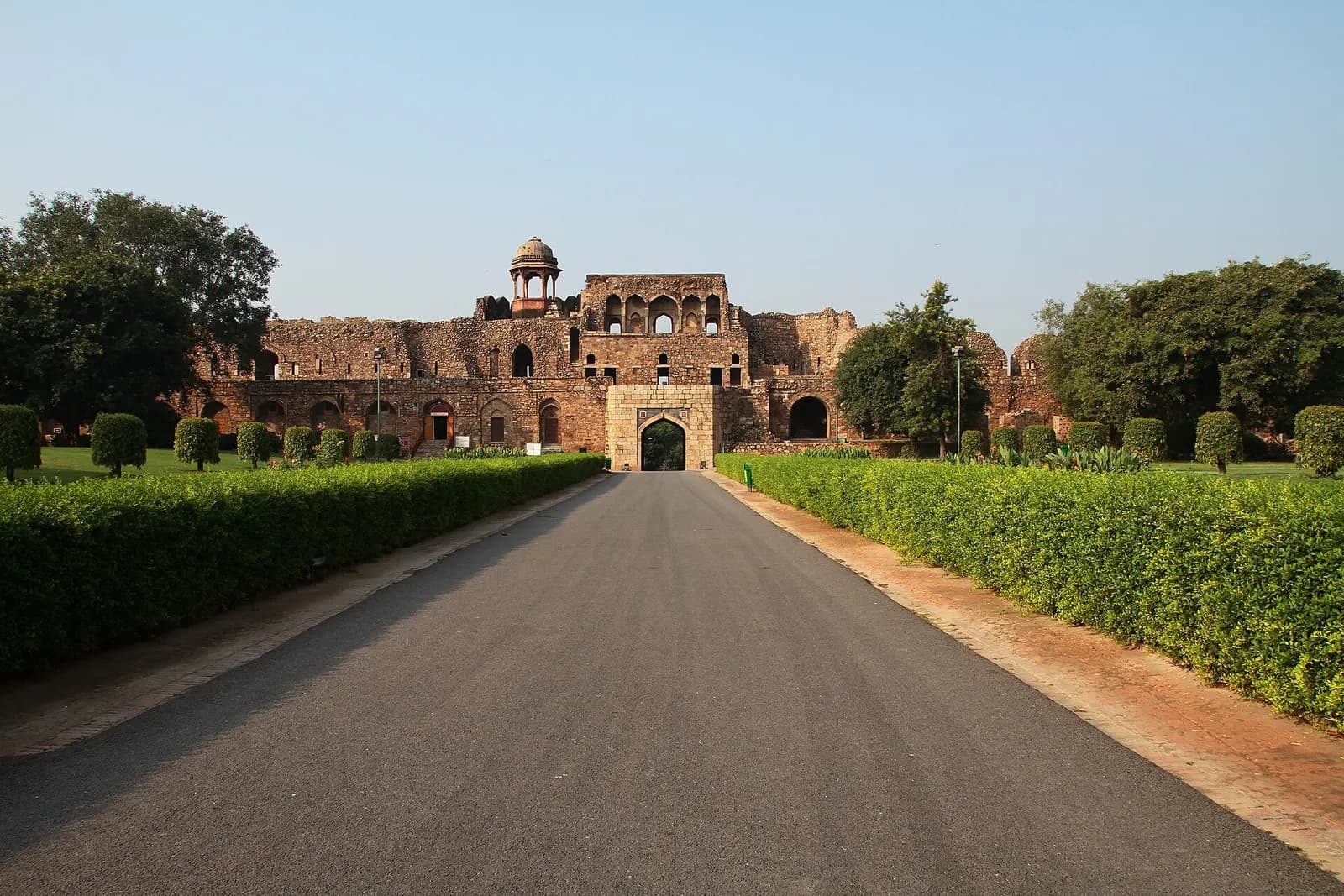
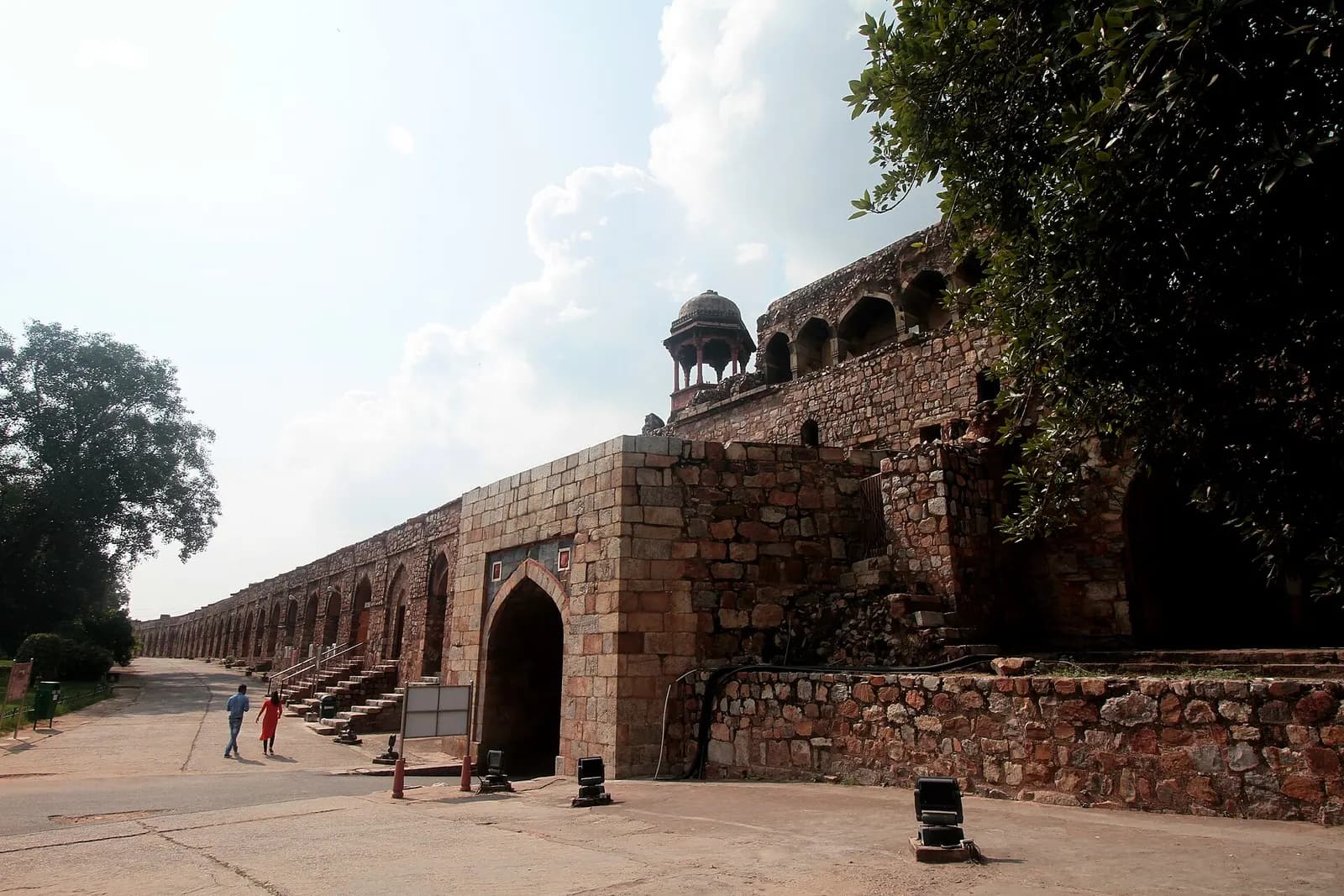
The fort is large and open, so here is what to look for as you walk it. You enter through the Bara Darwaza, the Big Gate facing west, which is the current visitor entrance and one of three monumental double storied gateways in the walls, the others being the Humayun Darwaza and the Talaqi Darwaza or Forbidden Gate. The curtain walls themselves stretch for nearly two kilometres, punctuated by bastions and walking a stretch of them gives a real sense of the fort's scale.
Inside, two buildings stand out above the rest. The Qila-i-Kuhna Mosque, built by Sher Shah Suri in 1541, is a masterpiece of early Mughal and Afghan architecture and the best preserved building in the fort, its single dome rising over a facade of red sandstone inlaid with white and black marble, carved with fine geometric patterns and calligraphy and pierced by elegant pointed arches. A short walk away stands the Sher Mandal, a double storied octagonal tower of red sandstone originally planned as a pleasure pavilion and later used by Humayun as his library and observatory and the site of the fort's most famous event, covered below. Beyond these, the lawns hold the excavation trenches and the small Archaeological Museum, while a hammam or bathhouse and other ruins dot the grounds. It is a complex that rewards slow wandering rather than a quick look.
How did Humayun die at Purana Qila?
The Sher Mandal is the setting for one of the most famous and poignant stories in Mughal history. The octagonal tower, with its steep, narrow stone staircase, was used by the emperor Humayun as his personal library. In January 1556, soon after he had regained his throne, Humayun was descending these stairs, reportedly hearing the call to prayer and moving to kneel, when he slipped and fell, suffering injuries from which he died a few days later. It was an almost absurdly ordinary end for an emperor and it changed the course of the dynasty, bringing his young son Akbar to the throne.
It is worth clearing up a common error here, because many accounts and even some signboards confuse it. The ruler who fell to his death on the Sher Mandal stairs was Humayun, not Sher Shah Suri, who had died years earlier in 1545. Standing at the foot of this modest tower, knowing that one of the great emperors of India met his end on its steps, gives the whole fort a quiet drama. His magnificent garden tomb, built soon afterward, is just a short distance away, which is why the two sites pair so naturally.
What is the Qila-i-Kuhna Mosque?
The Qila-i-Kuhna Mosque is the architectural jewel of Purana Qila and the best preserved structure in the complex. Built by Sher Shah Suri in 1541 as a private congregational mosque for the ruler and his court, it marks a crucial moment in the evolution of Indian architecture, the transition from the earlier Lodi and sultanate styles toward the mature Mughal manner that would follow. It is a single domed prayer hall fronted by five arched doorways, each framed by a true horseshoe shaped pointed arch and it was among the earliest buildings in the region to make such extensive and confident use of the pointed arch.
The beauty is in the materials and the detail. The facade combines red sandstone with white and black marble in striking patterns, carved with geometric designs and calligraphic inscriptions, so that the whole mosque feels both powerful and refined. Spend time on the prayer hall, where the proportions and the play of light reward a closer look and notice how the design blends Hindu, Afghan and Islamic elements, a fusion that became characteristic of Delhi's architecture. For anyone interested in how the great Mughal style was born, this mosque is one of the most important buildings in the city.
Is there a sound and light show and boating at Purana Qila?
Both are part of Purana Qila's appeal, but both come with a caveat worth knowing before you plan around them. The fort has long hosted an evening sound and light show, Ishq-e-Dilli, staged on the lawns with the ramparts as a backdrop, which narrates the epic story of Delhi, the city destroyed and rebuilt again and again across five thousand years. It is a wonderful idea and when running it is a highlight. However, the show has periods when it is suspended and at the time of writing it has been paused for an upgrade with its online booking disabled, so do not count on it and check whether it is currently operating before you make an evening trip for it.
Boating on the lake just outside the fort walls is the other draw, a relaxing activity especially popular with families and couples in the late afternoon, with the historic ramparts as a backdrop. Here too there is a history of interruption, as boating was suspended for several years and has only recently been reintroduced on a trial basis, so confirm it is running on the day. When both are operating, an late afternoon of exploring the fort, a boat ride on the lake and the evening show makes a lovely outing, but because neither is guaranteed, I would plan the daytime fort visit as the sure thing and treat the show and the boating as bonuses.
What is the architecture of Purana Qila like?
Purana Qila is a textbook of sixteenth century military and religious architecture, built in the characteristic red sandstone that would define Mughal Delhi. The defining feature is the massive curtain wall, nearly two kilometres around, thick and high and punctuated by sturdy bastions and three grand double storied gateways, so that even in ruin the fort projects real strength. The gateways themselves, with their overhanging balconies and small domed pavilions or chhatris, show features that would become hallmarks of the full Mughal style.
Within the walls, the surviving buildings show the architecture at a moment of transition. The Qila-i-Kuhna Mosque looks back to the pointed arches and carved stone of the sultanate era while reaching toward the refinement of the Mughals and the octagonal Sher Mandal is an elegant, compact tower that would not look out of place in a later Mughal garden. The overall impression is of a fort caught between two ages, older and more austere than the Red Fort and all the more atmospheric for it. Seeing it alongside the early sultanate grandeur of the Qutub Minar at one end and the later Mughal perfection of Humayun's Tomb nearby at the other shows the whole arc of the style in one city.
How do you reach Purana Qila?
The fort sits on Mathura Road, next to the Delhi Zoo and close to Pragati Maidan, so it is central and easy to reach. The nearest metro is the Supreme Court station on the Blue Line, roughly 1.5 to 2 km away, from where you can take an auto rickshaw or an app based cab the short distance to the entrance. The Khan Market station is another nearby option. Because the fort is a little way from the metro, factor in that last short hop rather than planning to walk the whole way.
By road, ample paid parking is available right outside the fort complex and the adjacent zoo entrance, which makes Purana Qila easier to reach by car than many of the old city monuments. Its location, close to Humayun's Tomb and the Nizamuddin area, means it slots neatly into a day in this part of the city, which our New Delhi tour can handle, while a broader Delhi day tour folds the fort into the wider sights.
When is the best time to visit and how much time do you need?
Across the year, October to March is the comfortable season for Purana Qila, since the complex is large and the lawns are largely unshaded, so walking it in the heat of summer is hard going. Within the day, aim for early morning, around the 7:00 AM opening, for a quiet, cool stroll with soft light on the walls or from about 3:30 PM in the afternoon to explore the ruins and enjoy the mellow evening atmosphere, with the option of the lake and, when it runs, the show.
On time, allow one to two hours for the fort itself, the gateways, the mosque, the Sher Mandal, the museum and a wander across the lawns and walls. Add more if you include boating on the lake or stay for an evening show and remember the adjacent Delhi Zoo can easily turn the outing into a full day for families. It is not a place to rush, since half its charm is the unhurried, uncrowded calm, but it is also compact enough to fit comfortably into a half day. For the wider question of when to plan your trip, see our guide to the best time to visit Delhi.
What is there to see near Purana Qila?
Purana Qila sits in a rich part of the city, so it combines well with several neighbours. Directly adjacent is the National Zoological Park, the Delhi Zoo, which shares the fort's setting and is a natural pairing for families. A short distance away lie the great Mughal monuments of the Nizamuddin area, above all Humayun's Tomb, whose story connects directly to the emperor who died here, along with the elegant Chausath Khamba by the Nizamuddin dargah.
The wider neighbourhood adds more. The antique lanes of Sunder Nagar market are close by, the lovely tombs and lawns of Lodhi Garden are a short drive and for a deeper dive into medieval Delhi the sprawling Mehrauli Archaeological Park is one of the city's finest. The imperial avenues around India Gate are also near. Together these make Purana Qila the anchor of a rewarding day in central and southern Delhi.
How does Purana Qila fit into a Delhi or Golden Triangle itinerary?
For most visitors Purana Qila works best paired with Humayun's Tomb and the Nizamuddin monuments, a half day of Mughal history in this part of the city, with the quiet fort as a calm, atmospheric contrast to the busier sights. Families often combine it with the adjacent zoo for a full day. It is the sort of place I add for travellers who want to go a little deeper than the standard circuit and who appreciate history without crowds.
If Delhi is your gateway to the wider Golden Triangle, Purana Qila adds real depth to the Mughal story before you head south, since this is where Humayun founded his city and met his end and his descendants went on to build the monuments of Agra. Many of my guests fold it into a Delhi day before an early sunrise Taj Mahal tour and the Taj Mahal the next morning, so the dynasty's story unfolds in order. Delhi for its layered history, Agra for its masterpiece and Jaipur for Rajasthan, tied into one trip, is the whole idea behind how we plan routes, with a day or two more for easy day trips within 50 km.
Travel tips for visiting Purana Qila
A few pointers make the visit smoother. Come in the cooler months and aim for early morning or late afternoon, since the fort is large and the lawns offer little shade. Buy your ticket online for the cheaper rate and carry a little cash for the museum, the lake or the cloakroom. Wear sturdy, comfortable walking shoes, because the complex spans dozens of acres and you will cover a lot of ground and carry water and sun cover. Do not plan your trip around the evening sound and light show without first checking if it is actually running, as it is sometimes suspended and treat the boating the same way. Do not miss the Qila-i-Kuhna Mosque or the Sher Mandal and read the museum displays for the extraordinary span of history beneath the site. Combine the visit with the adjacent zoo or nearby Humayun's Tomb, use an auto from the metro for the last stretch and give the fort the unhurried wander its calm, historic atmosphere deserves.
Want Purana Qila and the Mughal heart of Delhi explored properly, with the history brought to life? Message our team on WhatsApp at +91 7302265809 and we will build it into a Delhi itinerary that flows.
Plan your trip with us
Purana Qila rewards a visitor who knows its story, from the rival rulers who built it to the emperor who died here, so it is far richer with a guide and the right context. At Experience My India we design trips that put the history first and pair the fort with the sights around it in a sensible order, with the logistics handled. Whether you want a focused half day of Mughal Delhi or a full day across the capital, our Delhi Agra tours suit every style of traveller and our wider Golden Triangle tours carry the Mughal thread south to Agra. Tell us your travel dates and group size and we will shape a plan around you, with a licensed guide who brings the old fort to life.
Related guides
Keep planning with these hand picked reads from our team:
- Important monuments of Delhi, a fuller rundown of the city's historic sites
- Jama Masjid, Shah Jahan's great mosque in Old Delhi
- Hauz Khas Fort, lakeside medieval ruins in South Delhi
Enquire Now
Ready to Explore
The Heart of Delhi?
Explore the Red Fort, Qutub Minar, Humayun's Tomb, and the vibrant streets of Old Delhi with our expert-guided premium tours of India's capital city.

Delhi
Premium Tour Package
Questions
Frequently asked questions
What are the Purana Qila timings?
Purana Qila is open every day, generally from about 7:00 AM to 5:00 PM, with no weekly closure. Some sources list sunrise to sunset, so confirm for an early or late visit.
What is the Purana Qila ticket price in 2026?
Who built Purana Qila?
Is Purana Qila the site of Indraprastha?
How did Humayun die at Purana Qila?
What is the Qila-i-Kuhna Mosque?
Is the Purana Qila sound and light show running?
Can you go boating at Purana Qila?
Which is the nearest metro station to Purana Qila?
How much time do I need at Purana Qila?
Is Purana Qila worth visiting?
Explore more
Plan your Purana Qila trip with us

Photo credits
Photos from Wikimedia Commons, used under their licences:
- Photo 1 by Ujala.chowdhry, CC BY-SA 4.0
- Photo 2 by Dhruvaeng, CC BY-SA 4.0
- Photo 3 by Dhruvaeng, CC BY-SA 4.0
- Photo 4 by Mahi zahidi, CC BY-SA 4.0
- Photo 5 by Ujala.chowdhry, CC BY-SA 4.0
Interested in Purana Qila Delhi: Timings, Tickets, History and Complete Visitor Guide?
Chat with our travel team for a custom quote, or browse every package.
Related Attractions
9Ready to explore Purana Qila Delhi: Timings, Tickets, History and Complete Visitor Guide?
Book your private tour today and experience the magic of India's rich heritage.