



Sunder Nursery Delhi: Timings, Tickets, Monuments and Visitor Guide
Visiting Sunder Nursery in Delhi? Timings, tickets, the heritage monuments, arboretum, lake and picnic rules, nearest metro, best time and visitor tips.
In a Nutshell
“Sunder Nursery is a beautifully restored 90-acre heritage park in central Delhi, beside Humayun's Tomb, combining Mughal-era monuments, formal gardens, a lake and an arboretum of nearly 300 tree species. Immaculately revived by the Aga Khan Trust for Culture, it is one of the city's loveliest green spaces, ideal for a walk, a picnic or birdwatching. It is open daily from early morning until late evening, charges a modest ticket and the nearest metro is JLN Stadium. It is explored on our Delhi tours, run by a unit of Experience My India.”
Sunder Nursery is, quite simply, the most elegant green escape in Delhi, a place where restored Mughal pavilions rise from manicured gardens, water channels lead to a tranquil lake and families picnic on sweeping lawns. If you want a calm, beautiful half day away from the city's rush, it is one of my favourite recommendations. Our team at Delhi Agra Tour Packages often pairs it with the adjacent Humayun's Tomb and it is a serene highlight of any wider Golden Triangle tour.
I am Abhay Sharma, Delhi born and a Golden Triangle guide since 2015 and I love sending guests here for a gentle morning among the monuments and trees. This guide gathers everything I would tell a visitor beforehand, checked against current information, including tickets, the combo with Humayun's Tomb and the best time to come.
Details
Sunder Nursery at a glance
| Detail | Information |
|---|---|
| Location | Opposite Humayun's Tomb, Nizamuddin, central Delhi |
| Size | Over 90 acres |
| Restored by | The Aga Khan Trust for Culture |
| Known for | Mughal monuments, formal gardens, a lake and an arboretum |
| Trees | Nearly 300 species, Delhi's first dedicated arboretum |
| Entry fee | A modest ticket, with a combo option for Humayun's Tomb |
| Nearest metro | JLN Stadium (Violet Line) or Hazrat Nizamuddin (Pink Line) |
| Time needed | 3 to 4 hours to explore without rushing |
Sunder Nursery timings
| Detail | Information |
|---|---|
| Opening | Daily, about 6:00 AM to 10:00 PM |
| Last entry | Ticket counters close around 9:00 PM |
| Best season | November to January for the flowers and crisp weather |
The park is open daily from about 6:00 AM to 10:00 PM, with the ticket counters closing around 9:00 PM. Timings can vary a little by season, so reconfirm and aim to arrive with plenty of daylight if you want to see the gardens and monuments at their best.
Entry ticket prices
| Visitor | Fee (at the time of writing, reconfirm) |
|---|---|
| Indian and SAARC citizens | Around ₹50 |
| Foreign nationals | Around ₹200 |
| Children 5 to 12 and senior citizens | Around ₹25 |
| Children under 5 and differently-abled visitors | Free |
| Combo ticket | Covers Sunder Nursery, Humayun's Tomb and the Humayun's Tomb museum |
The ticket is modest and a combined ticket at the counter covers Sunder Nursery along with the adjacent Humayun's Tomb and its museum, which is excellent value if you plan to see both. Rates can be revised, so reconfirm at the gate.
How to reach
| From | Route |
|---|---|
| JLN Stadium metro (Violet Line) | About a 5 minute auto ride away |
| Hazrat Nizamuddin metro (Pink Line) | Also very close |
| By car | Via Mathura Road; search for the Sunder Nursery main gate; paid parking on site |
What is Sunder Nursery and why is it special?
Sunder Nursery is a 90-acre heritage park in the heart of Delhi, laid out beside Humayun's Tomb, that brings together centuries-old Mughal monuments, formal gardens, water features, a lake and a rich arboretum in one immaculately restored landscape. Once a colonial-era plant nursery grown up around a scatter of neglected 16th-century tombs and pavilions, it was comprehensively revived by the Aga Khan Trust for Culture into what is now widely regarded as the finest public garden in the city, blending living heritage, horticulture and ecology on a grand scale.
It is special for several reasons worth spelling out:
- Restored Mughal monuments. Beautifully conserved 16th-century tombs and pavilions, with intricate plasterwork and geometric symmetry, set among the gardens.
- A world-class landscape. Formal Mughal-style gardens, a grand central axis with water channels, a lake and fountains, designed and planted to the highest standard.
- Delhi's first arboretum. Nearly 300 species of trees, including rare specimens, make it a living tree museum as well as a park.
- A haven for wildlife. Dedicated biodiversity and butterfly zones draw dozens of bird and butterfly species into the centre of the city.
- A premium picnic culture. One of the few Delhi parks that actively welcomes picnics, games and families, with cafes, markets and clean facilities.
It belongs on any thoughtful list of things to do in Delhi and it is one of the most beautiful and relaxing of all the places to visit in Delhi.
What is the history of Sunder Nursery?
The history of Sunder Nursery is a story of neglect and remarkable revival. The site lies on the old Grand Trunk Road just north of Humayun's Tomb and in the 16th century, during the Mughal era, several fine tombs and garden pavilions were built here. In the early 20th century the British established a plant nursery on the grounds to grow trees for the new capital of New Delhi and it came to be known as Sunder Nursery after the Sunder Burj, one of the monuments within it. For much of the 20th century, though, the historic structures were neglected and the gardens were a working nursery rather than a public park.
The transformation came in the 21st century, when the Aga Khan Trust for Culture, as part of the wider conservation of the Humayun's Tomb area, undertook a years-long restoration of the monuments and a complete redesign of the landscape, reopening it as a magnificent public heritage park. The project carefully conserved the old tombs, revived Mughal-style garden layouts with water channels and a central axis, created the arboretum and biodiversity zones and added the lake, pathways and visitor facilities. Knowing this, that you are walking through a once-forgotten corner of Mughal Delhi, lovingly brought back to life, adds real depth to a visit and explains why the park feels at once historic and freshly, beautifully designed.
The restoration is widely regarded as a model of how heritage, ecology and public space can be combined and it has won international recognition for its conservation and landscaping. Rather than simply fencing off old monuments, the project set out to create a genuinely useful, living public park around them, with the gardens, arboretum, biodiversity zones and visitor facilities all designed together. The water features draw on the same catchment and channel principles the Mughals used, the planting was chosen to support wildlife and showcase India's trees and the monuments were conserved using traditional materials and craft. The result is a place that works on many levels at once, a heritage site, a botanical collection, a wildlife habitat and a much-loved city park, which is exactly why it is so often held up as the finest urban green space in Delhi and a benchmark for projects elsewhere. For a visitor it simply means everything feels considered and cared for, from the sightlines between the monuments to the labelling of the trees.
What monuments can you see at Sunder Nursery?
Scattered through the gardens are several restored heritage monuments, mostly 16th-century Mughal tombs and pavilions and they give the park its historic soul. The key structures:
- Sunder Burj. An elegant domed tomb that gives the park its name, with beautifully restored incised plasterwork and a finely proportioned interior.
- Lakkarwala Burj. A striking domed garden tomb, one of the park's architectural highlights, set among lawns and trees.
- Sunderwala Mahal. A larger monument within the grounds, part of the ensemble of restored structures.
- The garden pavilions and Mughal features. Walls, gateways and the restored Azim Bagh and other garden areas, laid out with the symmetry characteristic of Mughal design.
Several of these monuments stand within the wider zone of the Humayun's Tomb World Heritage ensemble and their careful conservation is part of what makes Sunder Nursery as much a heritage site as a garden. Unlike a formal ticketed monument, here you come upon them naturally as you wander the gardens, which is part of the pleasure. Take time to look closely at the plasterwork and the geometry; the craftsmanship is exquisite.
What makes these monuments special is their setting. In most of Delhi, such tombs stand isolated behind railings or marooned in traffic; here they are woven into a living garden exactly as their builders intended, approached across lawns and along water channels, framed by trees and flowers. The Sunder Burj in particular, with its restored incised plaster and fine dome, repays a slow circle and the Lakkarwala Burj makes a striking focal point from across the lawns. Because the park is so uncrowded compared with the big ticketed monuments, you can often have one of these jewels almost to yourself, which is a rare luxury in Delhi. Together they turn a garden walk into a quiet encounter with Mughal architecture at its most human scale and most beautifully presented.
What is the arboretum and biodiversity zone?
Beyond the monuments and formal gardens, Sunder Nursery is a serious haven for trees and wildlife, which sets it apart from an ordinary park. It is home to Delhi's first dedicated arboretum, a living collection of close to 300 species of trees, carefully planted and labelled, including rare specimens said to be the only ones of their kind in India. For anyone interested in plants and trees, it is a treasure and even for the casual visitor the variety of foliage, shade and seasonal colour is a delight. Beyond the arboretum, the park includes dedicated biodiversity and wilderness zones and a butterfly garden, deliberately planted to attract and sustain wildlife and these harbour a remarkable richness for a city-centre park, with reports of more than 80 species of birds and 60 species of butterflies. Early mornings are wonderful for birdwatching and the butterfly garden is a quiet delight. This ecological dimension, a genuine effort to create habitat and biodiversity in the middle of Delhi, is one of the park's finest and most forward-looking features.
For visitors who care about nature, it is worth lingering in these zones rather than only admiring the formal gardens. The arboretum is laid out so you can walk among trees gathered from across India's many climates and regions, many of them labelled, which turns a simple stroll into a gentle education in the subcontinent's astonishing botanical variety. The wilder biodiversity areas, with their marshy patches, native grasses and water, are deliberately left less manicured to shelter wildlife and on an early morning you may spot kingfishers, parakeets, hoopoes, owls and birds of prey, along with clouds of butterflies in the warmer months. Carrying a pair of binoculars rewards an early visit. This blend of the formal and the wild, a clipped Mughal garden on one side and a buzzing, bird-filled thicket on the other, is unusual and delightful and it means Sunder Nursery appeals as much to naturalists as to history lovers and picnickers.
What are the gardens, lake and central axis like?
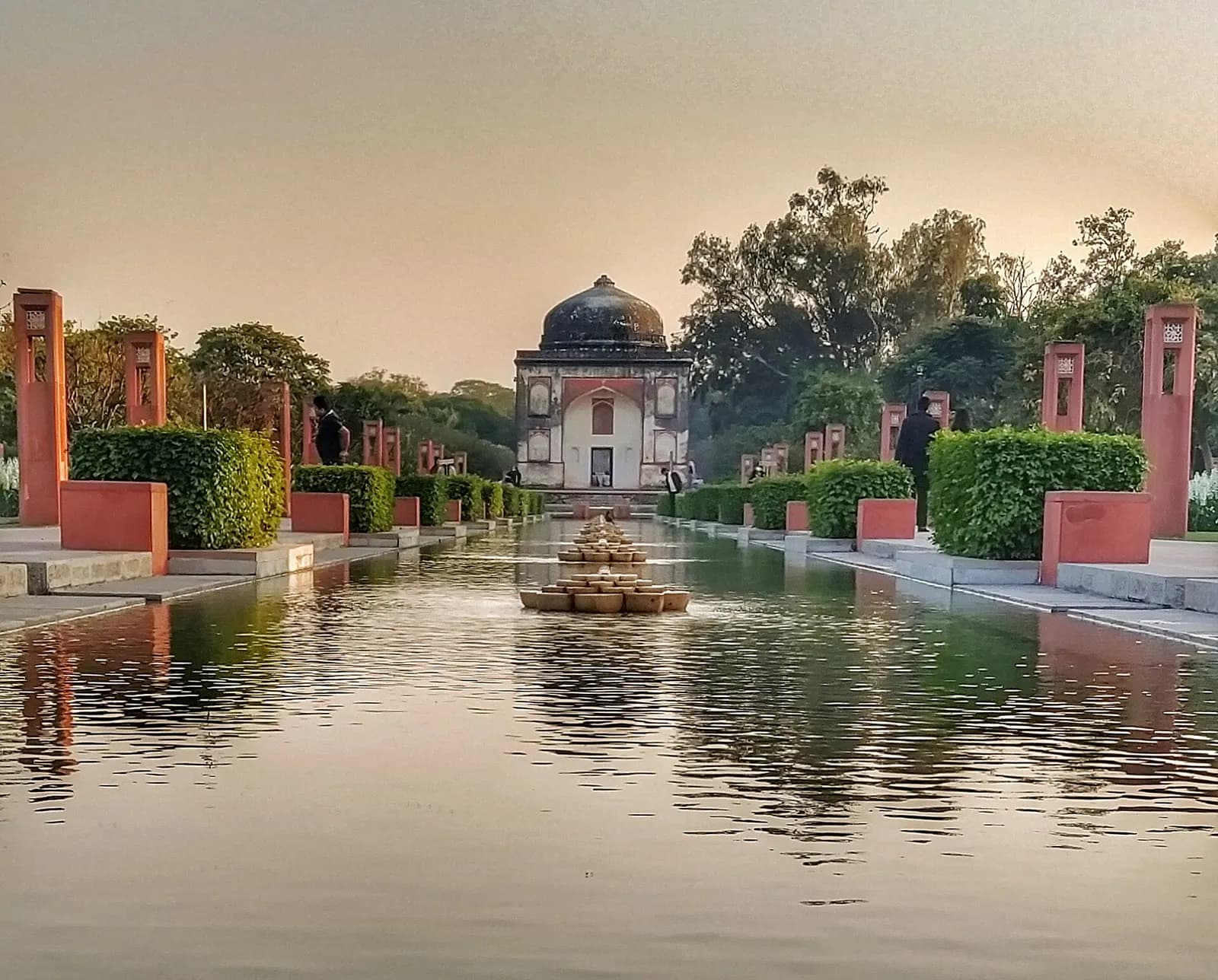
The designed landscape is the heart of the Sunder Nursery experience and it is beautifully done. A grand central axis runs through the park in the Mughal tradition, a formal walkway lined with water channels and flanked by symmetrical flower beds and lawns, leading the eye and the feet towards the monuments and the lake. In the flowering season the beds blaze with colour and the whole composition, water, greenery and restored tombs in careful symmetry, is a modern re-creation of the Mughal garden ideal of paradise on earth. The central lake, with its fountains that are lit in the evening, is a serene focal point, drawing visitors to sit on its banks as the day cools. Elsewhere the park opens into broad lawns perfect for picnics and play, shaded avenues of the arboretum and quieter wilder corners. The combination of formal design and relaxed, usable green space is exactly what makes Sunder Nursery so loved, grand enough to impress, yet welcoming enough to spend a lazy afternoon in.
What is a visit to Sunder Nursery like?
A visit to Sunder Nursery is a calm, restorative pleasure quite unlike the rush of Delhi's ticketed monuments. You enter off the busy Mathura Road and within moments find yourself on broad, clean pathways among lawns, flower beds and old trees, with restored Mughal domes rising here and there and the city's noise fading behind you. The scale means it never feels crowded even when busy: families picnic on the grass, couples stroll the water-channel axis, photographers frame the monuments against the greenery and birdsong fills the quieter corners. It is beautifully maintained, with none of the litter or neglect that can mar other city parks and there is a gentle, civilised atmosphere that makes you want to slow right down.
Unlike a monument you tour and tick off, Sunder Nursery is a place to spend time in, to walk, sit, read, picnic or simply watch the light move across the gardens. You might start with a loop of the central axis and the lake, detour to the monuments and the arboretum, pause at the butterfly garden and end with a coffee at the lakeside cafe or a mat on the lawn. Early mornings have a soft, meditative quality; weekend afternoons buzz with the market and families. Either way, most visitors leave feeling refreshed rather than footsore, which is a rare thing for a Delhi sight and a large part of the park's appeal.
Is Sunder Nursery worth visiting?
Yes, emphatically and it is one of Delhi's genuine highlights for anyone who appreciates gardens, heritage or simply a beautiful place to relax. It offers a rare combination: world-class landscape design, carefully restored Mughal monuments, a serious arboretum and wildlife habitat and a welcoming, picnic-friendly spirit, all in one immaculate 90-acre park. For a modest ticket and especially on the combined ticket with Humayun's Tomb next door, it is excellent value. The only reasons to skip it would be a very short, monument-focused trip with no time to slow down or the peak of summer when the open gardens are hot; otherwise it suits almost everyone, from history and nature lovers to families and those simply wanting a calm half day. For many of my guests, a morning here is the most relaxing and unexpectedly beautiful part of their time in Delhi and it pairs so naturally with Humayun's Tomb that seeing the two together is one of the best things you can do in the city.
What are the Sunder Nursery timings and entry fee?
Sunder Nursery is open every day, generally from about 6:00 AM to 10:00 PM, with the ticket counters closing around 9:00 PM, so it suits everything from an early morning walk to an evening by the lit fountains. Entry is modest: Indian and SAARC citizens pay around ₹50, foreign nationals around ₹200, children aged 5 to 12 and senior citizens around ₹25 and children under 5 and differently-abled visitors enter free. A combined ticket is available at the counter covering Sunder Nursery along with the adjacent Humayun's Tomb and its museum, which is great value if you plan to see both on the same visit. These figures are current at the time of writing and can be revised, so reconfirm at the gate. Paid parking is available on site, with charges varying between weekdays and weekends and, as a nice touch, if you buy plants worth a certain amount at the nursery inside, the parking fee may be refunded. Allow three to four hours to explore the grounds properly.
What is the best time to visit Sunder Nursery?
The best season is the heart of winter, roughly November to January, when Delhi's weather is at its most pleasant for walking and sitting on the lawns and the seasonal flower beds are in full, spectacular bloom. On any given day there are two lovely windows. An early weekday morning is ideal for a quiet, soul-stirring visit, with birdsong, soft light and few people, perfect for walks, birdwatching and photography. A weekend afternoon has a completely different, livelier feel, with families, picnics, food pop-ups and the organic market bringing a buzzing community atmosphere. Choose according to the mood you want: serenity on a weekday morning or sociable energy on a weekend. Evenings are also pleasant, with the fountains lit, though aim to enter well before the counters close. Avoid the peak summer midday, when the open gardens offer limited shade and the heat makes long walks tiring. A special mention goes to the flowering season: in the depths of winter the beds along the central axis are planted with seasonal blooms that turn the whole garden into a riot of colour and many visitors time a trip specifically for this. If you are in Delhi then, it is one of the prettiest sights in the city and a particular treat for photographers, so it is well worth building your visit around a clear winter morning.
What are the picnic rules and facilities?
One of the best things about Sunder Nursery is that, unlike most Delhi parks, it actively encourages a relaxed, premium picnic culture, which makes it a wonderful place for families and groups. The key things to know:
- Picnics are welcome. You can bring outside food, picnic mats and even outdoor games like badminton and spread out on the lawns, something few other heritage spaces in Delhi allow.
- The weekend organic market. On Saturday and Sunday mornings a vibrant farmers' market offers organic produce, local crafts and artisanal food stalls.
- Dining on site. If you do not pack a picnic, there is a lovely lakeside cafe along with smaller quick-service food kiosks around the central area.
- Accessibility. The park is highly inclusive, with wheelchair-accessible pathways and restrooms and complimentary wheelchairs at the main gate against a valid ID.
- Clean, managed facilities. Well-kept restrooms, clear pathways and good upkeep throughout make it comfortable for a long, relaxed visit.
This welcoming, family-friendly approach, rare for a heritage site, is a big part of why locals treasure Sunder Nursery.
How do you reach Sunder Nursery?
Sunder Nursery is easy to reach in central Delhi, on Bharat Scouts and Guides Marg opposite Humayun's Tomb in the Nizamuddin area. By metro, the nearest station is JLN Stadium on the Violet Line, about a five-minute auto ride away and Hazrat Nizamuddin on the Pink Line is also very close. By car or cab it is easily reached via Mathura Road; search for the Sunder Nursery main gate in your navigation app and use the paid parking on site. Autos and app cabs drop easily at the gate.
Its location right beside Humayun's Tomb and close to the Nizamuddin area makes it a natural pairing with that great Mughal monument, especially with the combined ticket. If you are threading a wider route, a dedicated New Delhi tour can tie it together with the imperial sights, while a broader Delhi day tour folds the park into the full span of the capital.
What is there to see near Sunder Nursery?
Sunder Nursery sits in one of Delhi's richest heritage pockets, so it pairs beautifully with its neighbours. Right across the way is the magnificent Humayun's Tomb, the grand Mughal garden tomb that is the natural companion to the park, best combined on the same combo ticket. Close by in the Nizamuddin area stand the elegant Chausath Khamba and the living shrine and qawwali of the Nizamuddin dargah, while the antique lanes of Sunder Nagar market are nearby.
A little further out the green and heritage spaces continue, from the lawns and tombs of Lodhi Garden and the grand Safdarjung's Tomb to the modern Garden of Five Senses and the leafy Hauz Khas complex, with the deeper ruins of Mehrauli Archaeological Park to the south. The great monuments of the wider city, the Red Fort, Qutub Minar, India Gate and the Lotus Temple, are all a manageable ride away. Together these make Sunder Nursery a natural part of a rewarding central Delhi day and you can see the fuller picture in our guide to the important monuments of Delhi.
How does Sunder Nursery fit into a Delhi or Golden Triangle itinerary?
For most visitors, Sunder Nursery pairs perfectly with Humayun's Tomb as a single, relaxed half day of Mughal heritage and gardens, made easy and good value by the combined ticket, ideally on a cool winter morning. It is the gentle, green counterpoint to the city's grander, busier monuments and a wonderful place to slow down, picnic and recharge in the middle of a packed sightseeing trip. History and nature lovers alike find it rewarding and families especially appreciate its welcoming, picnic-friendly spaces. Those on a fuller itinerary often weave it in with the other great sights, the serene Lotus Temple, the mighty Red Fort and the towering Qutub Minar, as a restful interlude.
If Delhi is your gateway to the wider Golden Triangle, Sunder Nursery offers a beautiful, tranquil introduction to the Mughal garden ideal, the same vision of paradise-as-garden that you will see perfected around the Taj Mahal in Agra, so it makes a fitting, calm start to the journey. Many of my guests are surprised to find that one of their happiest, most restful memories of Delhi is a morning spent wandering here. For the best season across the capital, our guide to the best time to visit Delhi is a useful companion and for more quiet corners see our guide to the city's hidden places to visit.
Travel tips for visiting Sunder Nursery
A few pointers make the visit even better:
- Come November to January for the flowers and the best weather and avoid the shadeless summer midday.
- Choose your mood, an early weekday morning for calm and birdwatching or a weekend afternoon for the market and the lively picnic atmosphere.
- Buy the combo ticket if you also want to see Humayun's Tomb and its museum next door, as it is great value.
- Bring a picnic, as it is one of the few Delhi parks that welcomes mats, food and games or use the lakeside cafe.
- Allow 3 to 4 hours to enjoy the monuments, gardens, arboretum and lake without rushing and longer if you plan to picnic.
- Come by metro to JLN Stadium or Hazrat Nizamuddin, then a short auto or drive and use the on-site parking.
- Visit the nursery to save on parking, since buying enough plants there can refund your parking fee.
- Catch the lit fountains at the central lake if you stay into the evening, a lovely way to end a visit.
If you would like a local to build Sunder Nursery into a wider Delhi plan, message our team on WhatsApp at +91 7302265809 with your travel dates and group size and we will help you shape the day.
Plan your trip with us
At Experience My India, through our Delhi and Golden Triangle travel desk, we design unhurried, well paced trips that make room for beautiful, restful places like Sunder Nursery, not just the headline monuments. Whether you want a relaxed set of Delhi Agra tours or a full Golden Triangle route through Delhi, Agra and Jaipur, we plan around your pace, your interests and the right season, with local guides who know when the gardens are at their most beautiful and how to pair the park with Humayun's Tomb next door. Share your dates and the kind of trip you have in mind through our enquiry page, tell us your group size and we will put together an honest, tailored plan rather than a rushed checklist.
Related guides
- Nearby places to visit in Delhi, to extend your day
- Sunder Nagar market, for antiques and crafts close by
Enquire Now
Ready to Explore
The Heart of Delhi?
Explore the Red Fort, Qutub Minar, Humayun's Tomb, and the vibrant streets of Old Delhi with our expert-guided premium tours of India's capital city.

Delhi
Premium Tour Package
Questions
Frequently asked questions
What are the timings of Sunder Nursery?
It is open every day from about 6:00 AM to 10:00 PM, with ticket counters closing around 9:00 PM. Reconfirm, as timings can vary a little by season.
What is the entry fee for Sunder Nursery?
Which is the nearest metro station to Sunder Nursery?
Who restored Sunder Nursery?
What monuments are inside Sunder Nursery?
Can you picnic at Sunder Nursery?
How much time do I need at Sunder Nursery?
Is Sunder Nursery worth visiting?
Can I buy a combined ticket for Sunder Nursery and Humayun's Tomb?
What is the best time to visit Sunder Nursery?
Explore more
Plan your Sunder Nursery trip with us

Photo credits
Photos from Wikimedia Commons, used under their licences:
- Photo 1 by Danish971, CC BY-SA 4.0
- Photo 2 by Ramesh lalwani, CC BY-SA 4.0
- Photo 3 by Vchauhan7, CC BY-SA 4.0
- Photo 4 by Arjunfotografer, CC BY-SA 4.0
- Photo 5 by Rangan Datta Wiki, CC BY-SA 4.0
Interested in Sunder Nursery Delhi: Timings, Tickets, Monuments and Visitor Guide?
Chat with our travel team for a custom quote, or browse every package.
Related Attractions
9Ready to explore Sunder Nursery Delhi: Timings, Tickets, Monuments and Visitor Guide?
Book your private tour today and experience the magic of India's rich heritage.