

 Jaipur
Bhangarh Fort: Visiting India's Most Haunted Place
Bhangarh Fort near Jaipur is India's most famous haunted fort, closed by the ASI at night. Get the real story, timings, entry fee and how to visit safely.
Quick answer
Bhangarh Fort is a ruined 16th-century fortified town in Rajasthan's Alwar district, famous as India's most "haunted" place, where the Archaeological Survey of India bans entry between sunset and sunrise. Set in an Aravalli valley near the Sariska reserve, it draws visitors for its atmospheric ruins, temples and legends. This guide is prepared by Delhi Agra Tour Packages, a unit of Experience My India.
- #bhangarh-fort
- #jaipur
- #jaipur-attractions
- #jaipur-travel
The truth behind the fame is more interesting than the ghost stories: there is no scientific proof of anything paranormal, and the night ban has practical reasons. By day it is a fascinating, if eerie, ruined town that makes a popular day trip from Jaipur, which we build into a wider stay with Delhi Agra Tour Packages or a Golden Triangle tour for travellers who enjoy history with a shiver. It sits naturally among the offbeat haunted places near Jaipur for the curious.
I am Abhay Sharma, and I have guided travellers around Jaipur and the Golden Triangle since 2015. Bhangarh is a place I love to take open-minded guests to, not because of ghosts, but because it is a genuinely haunting, beautiful ruin with a great story and real history. This guide tells you the legends, the facts behind them, what to see, and exactly how to plan a safe and rewarding daytime visit.
Bhangarh Fort at a Glance
| Detail | Information |
|---|---|
| What it is | Ruined 16th-century fortified town, Alwar district, Rajasthan |
| Founded | 1573, by Raja Bhagwant Das of Amber, for his son Madho Singh |
| Famous for | India's most "haunted" place; atmospheric ruins and temples |
| Distance | Around 85 km from Jaipur; an Aravalli valley near Sariska |
| Night rule | ASI bans entry between sunset and sunrise |
| Best time | October to March, in daylight |
| Nearby | Sariska Tiger Reserve border; Ajabgarh |
The tables below cover the visitor essentials and the routes, gathered up front for planning.
Visitor Information
| Detail | Information |
|---|---|
| Timings | Daily, 6 AM to 6 PM; guards clear all visitors before dusk |
| Entry fee | 25 rupees for Indian citizens; 200 to 300 rupees for foreign nationals |
| Children | Often free; extra charges may apply for video cameras |
| Time needed | 1.5 to 3 hours to walk the ruins and temples |
| Night entry | Not permitted, by ASI order |
How to Reach Bhangarh Fort
| From | Details |
|---|---|
| Jaipur by road | Around 85 km; a drive of 2 to 2.5 hours |
| Alwar by road | The nearest major town; local taxis and buses run |
| By train | Dausa or Alwar railheads, then a local taxi or bus |
| From Mathura | 4.5 hours by road via Bharatpur and Dausa |
What Bhangarh Fort Is Famous For
Bhangarh Fort is famous, above all else, as what is often called India's most haunted place, a ruined medieval town so wrapped in legend that the Archaeological Survey of India officially forbids anyone from entering between sunset and sunrise. That reputation, and the eerie sight of a once-thriving town left roofless and deserted in a lonely Aravalli valley, has made Bhangarh one of the most talked-about and most visited offbeat sights in all of Rajasthan.
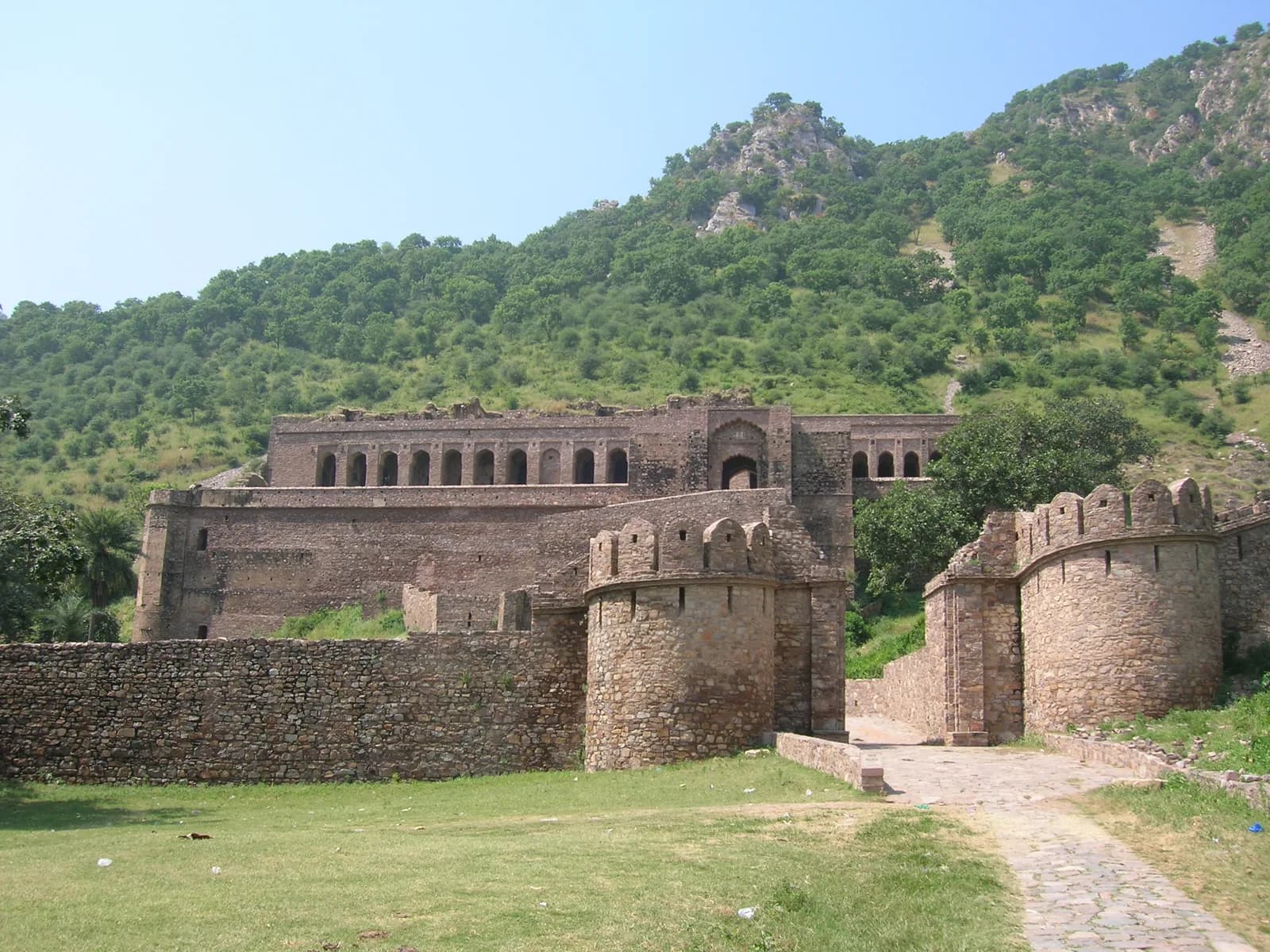
But strip away the ghost stories and Bhangarh is remarkable in its own right: a complete 16th-century fortified settlement, with gates, a market street, temples, palaces and havelis, abandoned and frozen in time. For the traveller, it offers a rare chance to walk through an entire ruined town rather than a single monument, with the Aravalli hills rising around it and the boundary of the Sariska Tiger Reserve close by. It is one of the most atmospheric of the hidden places to visit in Jaipur and its surroundings.
The haunted fame is the hook, but the history, the architecture and the setting are the real reward. Visitors who come for the thrill of a ghost town usually leave struck by the beauty and melancholy of the place, and by the genuine mystery of how a prosperous town came to be so completely abandoned. It is one of the most memorable things to do in Jaipur region for anyone drawn to history with an edge.
Who Built Bhangarh Fort and Its History
The real history of Bhangarh is grand and well documented. The town was founded in 1573 by Raja Bhagwant Das, the ruler of Amber, the great Kachhwaha stronghold near Jaipur, and it was built for his younger son, Madho Singh. Nestled in a valley surrounded by the Aravalli hills, near what is now the border of the Sariska Tiger Reserve, Bhangarh grew into a substantial fortified town that once housed thousands of residents, with its own markets, temples and palaces.
For a time it flourished, a planned settlement of the Amber house complete with defensive walls, grand gates and fine temples in the regional style. Then, over the following centuries, it declined and was ultimately abandoned, falling into the spectacular ruin we see today. The exact reasons for its decline are debated by historians, and include shifting fortunes, water scarcity and famine, but it is this very mystery, a whole town simply emptying out, that gave rise to the supernatural legends. The connection to Amber also ties Bhangarh to the wider story of the dynasty that built Jaipur, the same rulers behind the great fort of Amer.
Understanding this history matters, because it frames Bhangarh as what it truly is: not a cursed anomaly but a real Rajput town, built with ambition and skill, that outlived its purpose. That makes the ruins more poignant, not less, and it is the foundation for appreciating everything you see there.
How a Thriving Town Came to Be Abandoned
The most intriguing question at Bhangarh is not whether it is haunted but why a prosperous, well-built town was so completely abandoned, and here history offers a more plausible answer than any curse. Towns in this part of Rajasthan lived or died by water, and Bhangarh's valley, for all its beauty, was vulnerable to the droughts and famines that periodically struck the region. A sustained failure of water and harvests could empty a settlement within a generation, as people drifted away to more reliable land.
Shifting political fortunes played their part too. As the power and attention of the Amber and later Jaipur rulers moved elsewhere, a secondary town like Bhangarh could lose its patronage, its garrison and its reason to exist. Historians point to a combination of these pressures, environmental and political, rather than a single dramatic event, as the likeliest cause of the slow decline into ruin. By the time the great famines of later centuries had passed, Bhangarh was effectively a ghost town in the literal, unmysterious sense: simply emptied of people.
That real story is, in its way, more haunting than the legends. An entire community of thousands, with its markets and temples and homes, quietly ceasing to be, leaving only stone behind, is a sobering thing to walk through, and it gives Bhangarh a melancholy that no ghost story can match. Keeping this history in mind turns a spooky day out into something genuinely moving.
The Legends of Bhangarh
Of course, most visitors come for the legends, and Bhangarh has two famous ones, both told as folklore rather than fact. The first is the Sadhu's curse. The story goes that a holy man named Baba Balau Nath meditated on the hill above the site and granted permission for the town to be built only on one condition: that no building should ever cast its shadow over his dwelling. When a later ruler's expansion raised structures tall enough to throw a shadow across the sadhu's home, he is said to have cursed the town to be destroyed and left forever roofless and deserted.
The second and more dramatic legend concerns Princess Ratnavati, said to have been a beautiful princess of Bhangarh, and a tantric magician named Singhia who was obsessed with her. The tale tells that Singhia tried to bewitch her using an enchanted oil, but the princess discovered the plot and poured the oil onto a boulder, which rolled down and crushed the magician. As he died, the story goes, he cursed the fort and all who lived in it, and soon afterward the town met its end. These stories are vivid, and they are a genuine part of Bhangarh's cultural identity, but they are legends, passed down and embellished over generations, not recorded history.
Such tales are common around dramatic ruins across the world, where human imagination reaches for a story to explain a place that feels heavy with the past. At Bhangarh they are especially rich, and hearing them on the spot, with the empty town around you, is part of the experience. Enjoy them for what they are, folklore that gives the ruins their atmosphere, while keeping a clear head about what is myth and what is history.
Reality Versus Folklore: Why Bhangarh Is Closed at Night
It is worth being clear and honest about the "haunted" reputation. There is no scientific proof of any paranormal activity at Bhangarh, none, and the stories, however entertaining, remain stories. The famous ASI board forbidding entry between sunset and sunrise has fuelled the legend, but the real reasons for the night ban are entirely practical, and knowing them makes a visit more sensible, not less exciting.
There are three down-to-earth reasons the ruins are closed after dark. First, there is zero artificial lighting anywhere in the sprawling complex, so after sunset it is pitch black and genuinely dangerous to move around. Second, the ruins are extensive and uneven, full of broken steps, open wells, loose stone and sudden drops, which are hazardous to navigate without light. Third, and importantly, Bhangarh sits right on the edge of the Sariska Tiger Reserve, so the surrounding area has genuine wildlife, including the possibility of leopards and other animals moving through at night. A ban on night entry is simply responsible site management, protecting visitors from injury and wildlife encounters, and protecting the fragile monument too.
So the honest picture is this: Bhangarh is not dangerous because of ghosts; it is a safe, rewarding and genuinely fascinating place to visit by day, and it is closed at night for the same common-sense reasons that any unlit, ruined, wildlife-adjacent site anywhere would be. Come in daylight, with the right expectations, and you get all of the atmosphere and none of the real risk.
What to See Inside Bhangarh
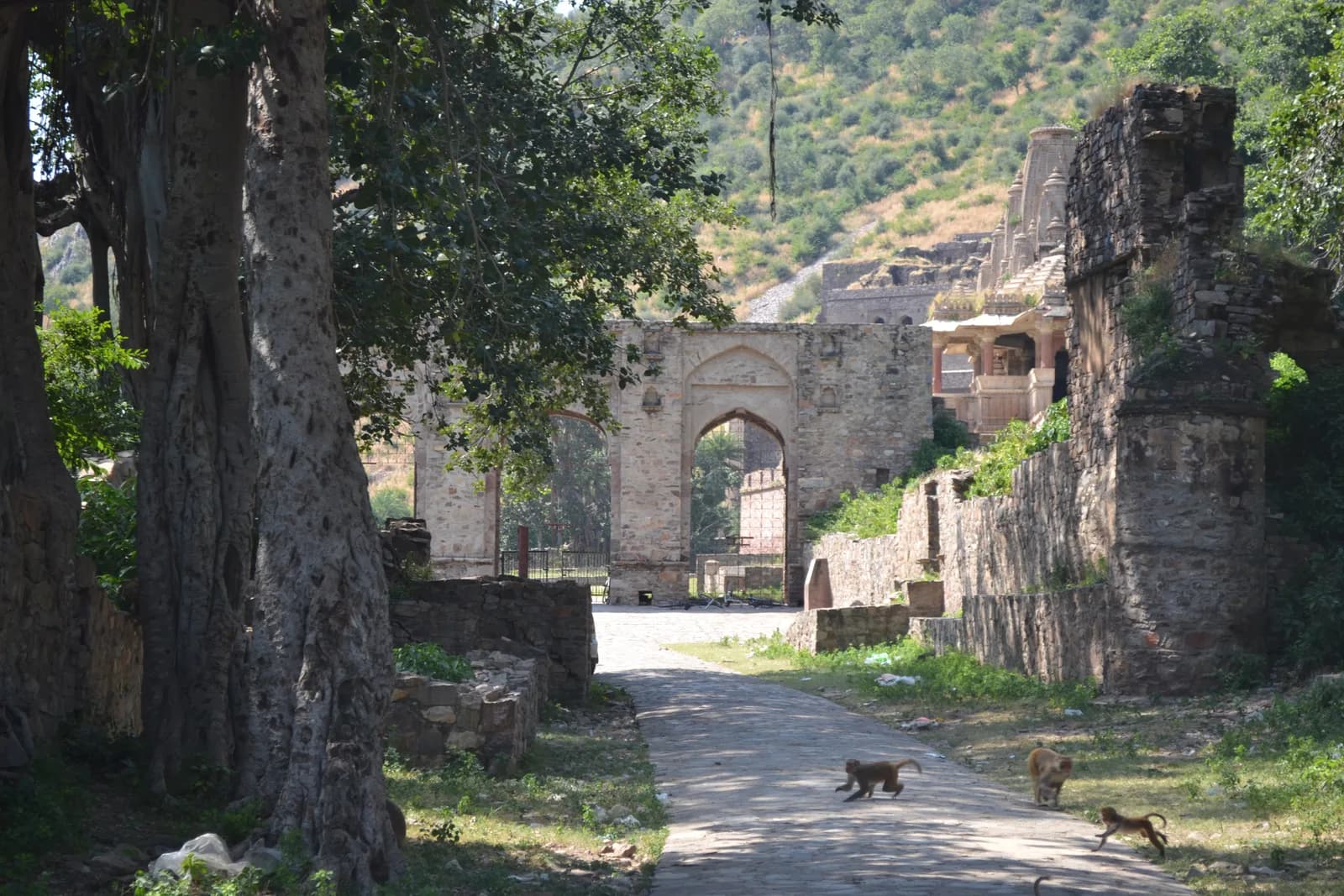
Bhangarh is a whole town to explore, and it rewards an unhurried walk. The complex is protected by multiple fortification walls and a series of historic gates, including the Lahori, Ajmeri, Phulbari and Delhi gates, through which you pass as you move up toward the hill. These gateways set the scale of the place and mark the approach to the heart of the ruined town.
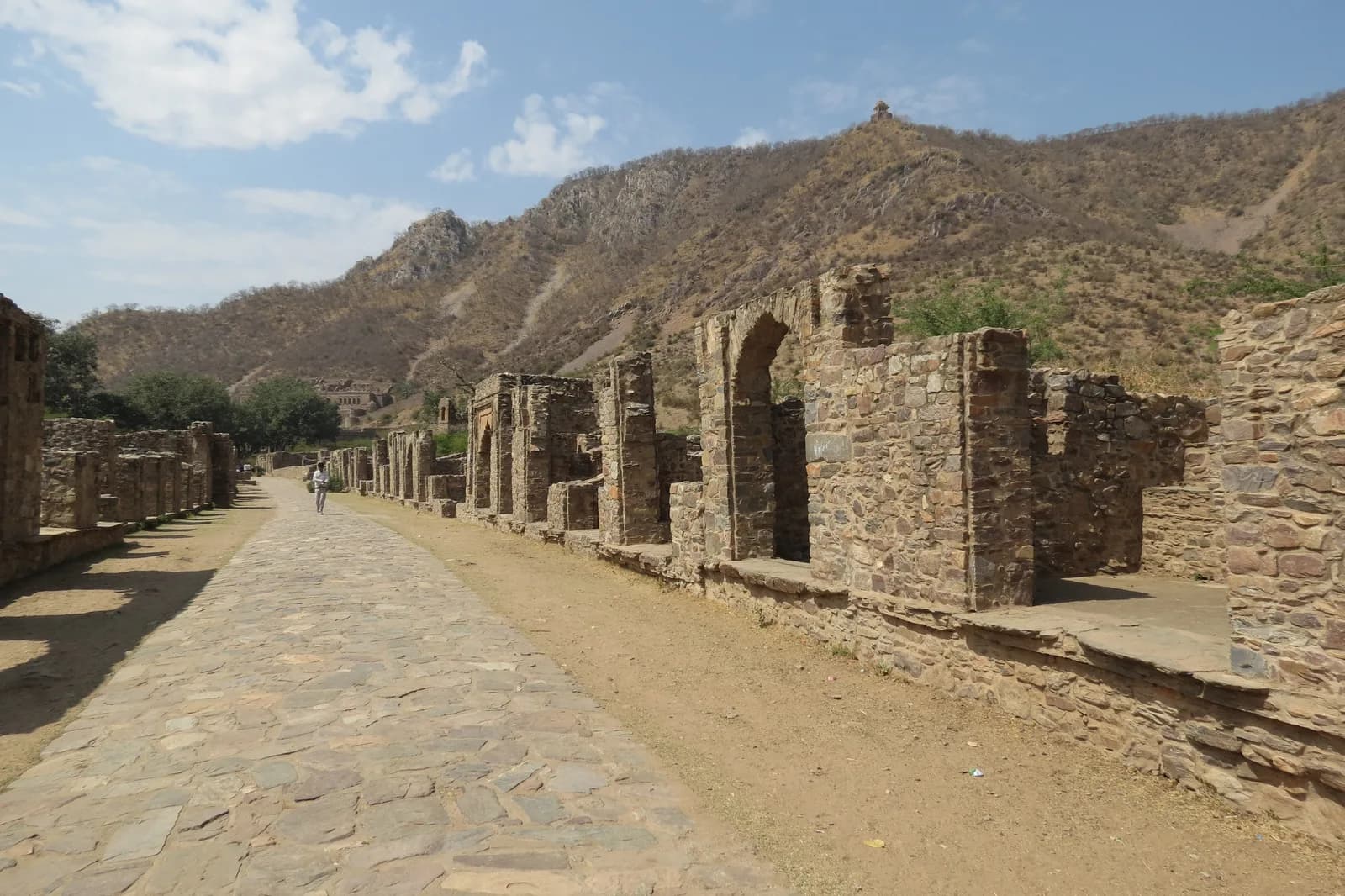
Running through the middle is the Jauhari Bazar, the main ruined market street, lined with rows of identical roofless stone shops, an evocative reminder that this was once a busy commercial town full of people and trade. Beyond the bazaar stand the temples, which are among the best-preserved structures on site: handsome Nagara-style Hindu temples dedicated to Gopinath, Someshwar, Keshav Rai, Mangla Devi and Ganesh, their carved stonework still clear. At the base of the hill are the multi-storeyed ruins of the royal palace, along with historic mansions such as the Purohitji Ki Haveli and the Nartakiyon Ki Haveli, the dancers' mansion.
Walking from the gates, up the bazaar, past the temples and to the palace, you trace the shape of a complete medieval town, and the scale of it surprises most first-time visitors. Allow time to wander and absorb the atmosphere rather than rushing; the quiet, the carvings and the mountain backdrop are what make Bhangarh linger in the memory long after you leave.
The temples repay a closer look in particular, because they are the best-surviving part of the town and they reveal how fine Bhangarh once was. The Nagara style, with its soaring curved spire, or shikhara, over the sanctum, was the classic North Indian temple form, and even in ruin the proportions and the carved detail of the Gopinath and Someshwar shrines are clear to see. Standing inside one of them, looking out through a stone doorway at the empty town and the hills beyond, is one of the quietly powerful moments of a visit. Nearby, the stepped tank and the water structures that once served the town hint at just how carefully it was planned, and how much its life depended on a supply that may, in the end, have failed it. Give the temples and the palace zone the time they deserve, and Bhangarh reveals itself as a serious piece of architecture, not merely a spooky backdrop.
Timings, Entry Fee and Rules
Bhangarh Fort is open daily from 6 AM to 6 PM, and the single firm rule is that guards strictly clear all visitors out before dusk, in line with the ASI ban on entry between sunset and sunrise. There is no exception to this, so plan to be well finished before evening; do not expect to linger for sunset or to attempt any kind of night visit, which is both prohibited and genuinely unsafe.
The entry fee is modest. It is 25 rupees for Indian citizens and 200 to 300 rupees for foreign nationals, with children often entering free, while extra charges may apply if you want to use a video camera. Tickets are bought at the gate on the day. Because the ruins are extensive, allow 1.5 to 3 hours to walk through the gates, the bazaar, the temples and the palace at a comfortable pace, more if you like to explore and photograph thoroughly. Note that amenities inside the ruins are minimal, so come prepared, as covered in the safety tips below.
How to Reach Bhangarh Fort
Bhangarh lies in the Rajgarh tehsil of Alwar district, around 85 km from Jaipur, a drive of 2 to 2.5 hours, which makes it a very feasible day trip from the city. By car or taxi is by far the most convenient way to go, as the fort sits in a rural valley and keeping your own vehicle lets you explore at your own pace and return comfortably. Alwar is the nearest major town, with local taxis and buses, and the fort is also reachable with a little planning by public transport.
By train, the nearest useful railheads are at Dausa and at Alwar, from where you take a local taxi or bus for the final leg to the fort. For travellers coming from the Braj region, the drive from Mathura takes 4.5 hours by road via Bharatpur and Dausa, and trains and buses connect the region with those same rail hubs before a local transfer; our Jaipur to Mathura and Vrindavan distance guide helps plan that side of the journey, while arrivals from the capital or from Agra can use our Delhi to Jaipur distance and Agra to Jaipur distance guides for the first leg. Most of our guests reach Bhangarh as a chauffeur-driven day trip from Jaipur, which is comfortably the easiest option.
Best Time to Visit
The best time to visit Bhangarh is from October to March, when Rajasthan's daytime temperatures are pleasant and comfortable for walking the sprawling, largely shadeless ruins. The peak summer months from April to June bring punishing heat that makes exploring the open complex hard going, so the cooler season is strongly preferable, aligning with the best time for a wider trip, as our best time to visit Jaipur guide explains.
Within the day, aim to arrive in the morning rather than the late afternoon. This gives you the cooler hours, the best light for photography, and, importantly, plenty of time to explore before the guards begin clearing the site ahead of dusk, since you cannot stay past sunset. A morning visit also leaves the afternoon free for the drive back and other sights, and it fits neatly into a day-trip plan built from our Jaipur trip planner or a wider two-to-three day Jaipur itinerary. For those with only a short stay, it can even be slotted into a busy one day Jaipur itinerary, though a dedicated half-day suits it better.
Safety and What to Carry
Bhangarh is safe to visit by day, but its remote, ruined character means you should come prepared. Pack the essentials, including drinking water, snacks, sun protection and sturdy walking shoes, as amenities inside the ruins are minimal and the ground is uneven. The site is large and exposed, so being self-sufficient makes the visit far more comfortable.
A few practical points make the day go smoothly:
- Carry cash. Mobile network signals can be weak inside the valley, so cash is reliable for tickets and for any vendors outside the gate.
- Watch for wildlife. Wild monkeys inhabit the ruins, so keep food tucked away and do not feed them, and stay alert in the forested stretches near the Sariska buffer zone.
- Mind the ruins. The uneven steps, open wells and loose stone call for careful footing, especially with children.
- Respect the night ban. Never attempt to enter after dusk; it is prohibited, unlit and genuinely unsafe.
With these simple precautions, a daytime visit to Bhangarh is both safe and thoroughly enjoyable, and the eerie atmosphere stays firmly in the realm of fun rather than fear.
Bhangarh and Kuldhara: Rajasthan's Ghost Towns
Travellers researching Bhangarh often come across Kuldhara, and it is worth knowing how the two relate, as they are frequently mentioned in the same breath. Kuldhara is a different abandoned village, far to the west near Jaisalmer, whose Paliwal Brahmin community is said to have vanished overnight in the 19th century, leaving another famous "cursed" ruin. Between them, Bhangarh and Kuldhara are the two most talked-about ghost towns in Rajasthan, and both have become magnets for visitors drawn to the eerie and the unexplained.
The two are, however, very different to visit. Bhangarh is a grand, hilly, fortified town of gates, temples and palaces near Jaipur, with its drama heightened by the official night ban. Kuldhara is a flatter, more modest cluster of village houses in the Thar Desert, closer to Jaisalmer, and much farther from the Golden Triangle. For a traveller based in Jaipur, Bhangarh is by far the more accessible and architecturally impressive of the two, while Kuldhara suits those already exploring the far western desert. Both share the same essential truth: their abandonment has a human, historical explanation, and the ghost stories, though fun, are folklore layered on afterward.
Knowing this helps you set expectations and choose well. If the ghost-town idea fascinates you and you are near Jaipur, Bhangarh is the one to see, richer, closer and grander, and a far better fit for most Golden Triangle itineraries.
Is Bhangarh Fort Worth Visiting
Bhangarh is well worth visiting for travellers who enjoy history, ruins, legends and atmosphere. Few places let you wander through an entire abandoned medieval town, with its gates, market, temples and palace still standing in a dramatic mountain setting, and the famous "haunted" reputation, enjoyed with a pinch of salt, only adds to the sense of occasion. As a day trip from Jaipur, it offers something genuinely different from the city's forts and palaces, and it is a firm favourite with those who like their sightseeing a little offbeat.
It is fair to set expectations. Bhangarh is a ruin, not a restored palace, so you come for atmosphere and history rather than grandeur or amenities; it involves a fair drive and a good deal of walking on rough ground; and anyone expecting actual ghosts will, of course, be disappointed. But for the open-minded traveller, it is one of the most memorable and distinctive outings in the region, and it pairs well with the broader 3 day trips from Jaipur or an exploration of the quieter places to visit in Jaipur and beyond. I recommend it warmly to the curious, with the firm advice to go by day, to carry the real history with you alongside the legends, and to let the melancholy beauty of the place, rather than any ghost story, be what stays with you afterward.
Travel Tips for Your Visit
A few pointers make a Bhangarh trip smooth and rewarding. Go between October and March, and arrive in the morning so you have the cool hours and plenty of time before the site closes at dusk. Travel by private car or taxi, around 85 km and 2 to 2.5 hours from Jaipur, and keep the vehicle for the day, as the fort sits in a rural valley far from reliable transport. Carry drinking water, snacks, sun protection and sturdy shoes, since amenities are minimal and the ground is uneven, and bring cash, as the mobile signal in the valley is weak. Keep food away from the resident monkeys, stay alert near the Sariska buffer, and never attempt a night visit, which is banned and unsafe. Treat the legends as the folklore they are, enjoy the atmosphere, and give yourself time to walk the whole town rather than rushing. If you are planning the wider trip, our guides to where to stay in Jaipur, places to eat in Jaipur and famous foods in Jaipur help you make the most of your base, and the floodlit forts and markets among the places to visit in Jaipur at night make a lively contrast to a day among the ruins.
Plan Your Trip With Us
A day trip like Bhangarh is at its best when the driving and timing are handled for you, and that is what we do. As Delhi Agra tours specialists, we build private, chauffeur-driven day trips and Jaipur itineraries that get you to the fort in the cool morning hours, with a driver who knows the rural roads and the site, so you can simply explore the ruins and soak up the atmosphere. We handle the logistics; you enjoy the legend.
Tell us your travel dates, group size and what you most want from your Rajasthan trip, and we will put together a plan and a price built around you. Message us on WhatsApp at +91 7302265809 and we will take it from there.
Related Guides
Enquire Now
What our travellers say
“Our Golden Triangle honeymoon was flawless. Sunrise at the Taj with a private guide felt like a dream — every detail was handled.”
“As a first-time visitor to India, I felt completely safe and looked after. The driver and guide were superb professionals.”
“Travelling with two kids is hard, but they made it effortless. Great pacing, clean cars and zero surprises on price.”
“Booked the Agra day trip on short notice and it went off without a hitch. The guide's history knowledge made the Taj come alive.”
“Best decision of our India trip. Car was spotless, driver was punctual every single day, and the itinerary never felt rushed.”
“Organised a same-day Agra trip for my parents. Communication before and during the trip was excellent — genuinely stress-free.”
“Sunrise at the Taj Mahal was magical. Our guide spoke great English and answered every question with patience.”
“Three generations travelling together and everyone was comfortable — good vehicle, sensible stops, and no hidden costs.”
“I've used a few tour operators across Asia and this was among the smoothest. Fair pricing and they actually answer the phone.”
“Our custom Rajasthan-Agra combo was planned around our budget without cutting corners on comfort. Highly recommend.”
“Solo female traveller here — I felt safe throughout. The driver was respectful and the whole trip was timed perfectly.”
Ready to Explore
The Pink City?
Experience the Amber Fort, Hawa Mahal, City Palace, and the colorful bazaars of Jaipur with our expert-guided premium tours of Rajasthan's capital.

Jaipur
Premium Tour Package
Questions
Frequently asked questions
What is Bhangarh Fort famous for?
Bhangarh Fort is famous as India's most "haunted" place, a ruined 16th-century fortified town in Alwar district where the Archaeological Survey of India bans entry between sunset and sunrise. Beyond the ghost stories, it is a remarkable complete medieval town, with gates, a market street, temples, palaces and havelis set in a dramatic Aravalli valley near the Sariska reserve.
Who built Bhangarh Fort and when?
Why is Bhangarh Fort closed at night?
Is Bhangarh Fort really haunted?
What are the timings and entry fee for Bhangarh Fort?
How do I reach Bhangarh Fort from Jaipur?
Can you visit Bhangarh Fort at night?
What is there to see inside Bhangarh Fort?
Is Bhangarh Fort safe to visit?
Is Bhangarh Fort worth visiting?
Explore more
Plan your Bhangarh Fort trip with us

Interested in Bhangarh Fort: Visiting India's Most Haunted Place?
Chat with our travel team for a custom quote, or browse every package.
Related Attractions
9Bhangarh Fort on the map
Open in Google MapsReady to explore Bhangarh Fort: Visiting India's Most Haunted Place?
Book your private tour today and experience the magic of India's rich heritage.