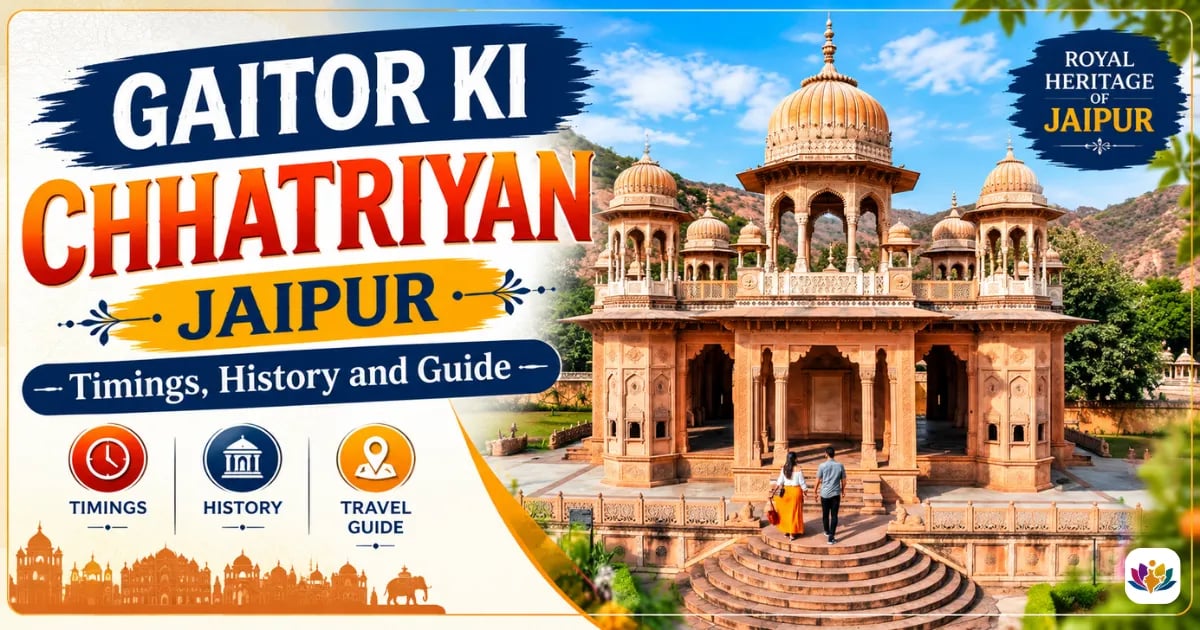
Quick Answer
Gaitor Ki Chhatriyan is the royal crematorium of Jaipur's Kachwaha kings, a peaceful garden of exquisitely carved marble cenotaphs at the foot of the Nahargarh hills. It is open 9:30 AM to 5:00 PM daily, with a small entry fee of around 30 rupees. Delhi Agra Tour Packages, a unit of Experience My India, plans Jaipur trips.
Tucked away at the foot of the Nahargarh hills, Gaitor Ki Chhatriyan is one of Jaipur's most beautiful and least-visited gems, a serene garden of royal cenotaphs where the kings of the Pink City were laid to rest beneath domes of exquisitely carved marble. While tour buses queue at Amber Fort and the City Palace, this tranquil site sits quietly nearby, offering some of the finest carved marble in the city with barely a crowd in sight. This guide from Delhi Agra Tour Packages covers its history, its remarkable architecture, the timings, entry fee and address and how to fit it into a Jaipur day, ideally as part of a Golden Triangle tour.
I was born in Delhi and in more than 11 years guiding the Golden Triangle for Experience My India I have brought many travellers to this quiet, moving place. Here is the clear, practical, honest guide, spelled Gaitor or Gatore, both refer to the same royal site.
Gaitor Ki Chhatriyan at a glance
Detail | Information |
What it is | The royal cenotaphs of Jaipur's Kachwaha kings |
Location | Krishna Nagar, Brahampuri, at the foot of Nahargarh hills |
Timings | 9:30 AM to 5:00 PM, all days |
Entry fee | Around 30 rupees per person |
Built in | White marble and sandstone, in Rajput-Mughal style |
Highlight | The cenotaph of Maharaja Sawai Jai Singh II |
Best for | Heritage, architecture and quiet photography |
What is Gaitor Ki Chhatriyan?
Gaitor Ki Chhatriyan is the royal crematorium and memorial ground of the Kachwaha dynasty, the ruling family who founded and reigned over Jaipur. A chhatri, meaning umbrella or canopy, is an elevated, dome-shaped pavilion and here a collection of these graceful marble structures stands as cenotaphs marking the spot where each Maharaja was cremated.
The name Gaitor is believed to be a shortened form of the phrase Gaye ka Thor, meaning the resting place of the departed. Set against the backdrop of the rugged Nahargarh hills and surrounded by quiet gardens, it is a place of great peace and beauty, a striking contrast to the bustle of the city and one of the most atmospheric heritage sites in Jaipur.
Unlike a cemetery in the Western sense, these chhatris do not mark graves but the spots of cremation, each raised as a memorial pavilion to honour a departed king. Cremation is the Hindu tradition, so what you see is a garden of remembrance rather than a burial ground, an important distinction that shapes the whole feel of the place. It is dignified, open and serene, more a celebration of lives lived and a dynasty's continuity than a place of mourning.
The history of Gaitor Ki Chhatriyan
The site was established as the royal cremation ground when Maharaja Sawai Jai Singh II founded the city of Jaipur in the early 18th century. From then on, it became the final resting place of the male rulers of the Kachwaha line, each honoured with a cenotaph built in his memory after his cremation.
Jai Singh II himself was one of the most remarkable rulers in Indian history, a warrior, statesman, astronomer and city planner who laid out Jaipur as one of the first planned cities of India and built the great Jantar Mantar observatories. It is fitting that his own cenotaph is the grandest here. The kings who followed him and their descendants, continued to be memorialised at Gaitor, so the site grew over the generations into a gathering of chhatris spanning the whole history of the dynasty.
Walking among the chhatris is like walking through the history of Jaipur's kings, each monument reflecting the style, wealth and taste of its era. The tradition of building these royal cenotaphs continued for generations, making Gaitor a living record of the dynasty that shaped the Pink City. It is worth noting that the cenotaphs here honour the kings, while the queens of Jaipur have their own memorial, the Maharani Ki Chhatri, located separately in the city.
The architecture and the cenotaphs
The real magic of Gaitor lies in its architecture, a beautiful blend of Rajput and Mughal styles, executed in white marble and local sandstone. Each cenotaph is a work of art in its own right:
The domes and pillars: graceful marble domes rest on intricately carved pillars, in the classic chhatri form, creating an elegant, airy quality across the whole site.
The carvings: the marble is covered in exquisitely detailed carvings, from floral and geometric patterns to mythological scenes and figures, showing the extraordinary skill of Rajasthan's craftsmen.
The cenotaph of Jai Singh II: the most elaborate and celebrated is that of Maharaja Sawai Jai Singh II, the founder of Jaipur, a masterpiece of white marble carved with peacocks and intricate detail and the highlight of any visit.
The variety: the earlier cenotaphs tend to be simpler sandstone structures, while the later ones grow more ornate and marble-rich, so the whole site traces the evolution of the craft.
Together they make Gaitor an open-air gallery of Rajput funerary architecture, quietly rivalling the city's grander palaces for sheer artistry.
The chhatri form itself is central to Rajput architecture, an elevated dome resting on ornate pillars and here it is used to sublime effect. The white marble of the finest cenotaphs is worked so finely that in places it looks almost like lace, with lattice screens or jaalis and relief panels that catch the light through the day. The craftsmen who created these were the same lineage of artisans whose skill you see across Jaipur's palaces and, further afield, in the great Mughal monuments and here they turned their art to honouring the dead. The result is a place that feels both grand and intimate, monumental in ambition yet human in its quiet, garden setting.
Gaitor Ki Chhatriyan timings and entry fee
The site keeps simple, consistent daily hours, making it easy to fit into a morning or afternoon.
Detail | Information |
Timings | 9:30 AM to 5:00 PM, Monday to Sunday |
Entry fee | Around 30 rupees per person |
Address | Krishna Nagar, Brahampuri, Jaipur 302002 |
The entry fee is very modest and separate charges may apply for cameras, so carry a little cash. Timings and fees can change, so it is always worth reconfirming the current details before your visit. The morning hours, soon after opening, are the most peaceful and the best for photography, before the light grows harsh.
What to see and do at Gaitor
Gaitor rewards an unhurried, contemplative visit:
Admire the cenotaph of Jai Singh II: spend time with the founder's marble masterpiece and its peacock carvings, the site's crowning glory.
Wander the chhatris: stroll among the many cenotaphs, comparing the styles and eras, from simple sandstone to ornate marble.
Study the carvings: look closely at the detailed marble work, the mythological figures and the floral motifs.
Enjoy the setting: take in the quiet gardens and the dramatic Nahargarh hills rising behind, a wonderfully serene backdrop.
Photograph the light: the play of light and shadow through the domes and pillars is a photographer's delight, especially in the morning.
The royal cenotaphs of Jaipur
Gaitor is the most important of Jaipur's royal cenotaph sites, but it is part of a wider tradition of chhatris across the city and its surroundings. The most notable counterpart is the Maharani Ki Chhatri, the cenotaphs of the queens and royal women of the Kachwaha family, set in their own memorial ground on the Amer road. Together, these sites tell the fuller story of the dynasty, the kings at Gaitor beneath the Nahargarh hills and the queens in their own graceful pavilions elsewhere.
This separation reflects the customs of the era and visiting both gives a rounded sense of how the royal family honoured its departed. For most visitors, though, Gaitor is the essential one, both for the beauty of its marble work and for the presence of the founder's own cenotaph. It is a reminder that behind the forts and palaces of Jaipur lie these quieter, deeply personal monuments, where the grandeur of the living city gives way to reflection and remembrance. For travellers who take the time to seek them out, they add a layer of meaning that the headline sights alone cannot.
Why visit Gaitor Ki Chhatriyan?
In a city famous for its forts and palaces, Gaitor offers something different: peace, intimacy and a sense of history away from the crowds. It is one of Jaipur's true hidden gems, rarely busy and all the more moving for its quiet.
For lovers of architecture and photography, the carvings and the setting are exceptional and for anyone wanting to understand the city, standing among the memorials of the very kings who built Jaipur is a powerful experience. The site sees a fraction of the crowds that throng Amber Fort or the City Palace, so you can often have a corner of it almost to yourself, which is rare for a monument of this quality. It appears among the quieter spots in our hidden places to visit in Jaipur guide and it is exactly the kind of place that turns a good Jaipur trip into a memorable one, the sort of spot you remember long after the famous forts blur together.
How to reach Gaitor Ki Chhatriyan
Gaitor lies in the Brahampuri area, at Krishna Nagar, at the foot of the Nahargarh hills in the north of the city. A taxi or auto reaches it easily from the centre, a ride of around twenty minutes from the walled city and there is parking near the entrance. It sits close to some of Jaipur's most famous sights, which makes it simple to combine into a day.
It is very near the road up to Nahargarh Fort and close to Jal Mahal on the way to Amer, so it slots naturally into a north-Jaipur circuit. For a peaceful garden to pair it with, our Sisodia Rani ka Bagh Jaipur guide covers another lovely, lesser-known spot and for the great central park and museum, our Ram Niwas Garden Jaipur guide is a good companion.
Combining Gaitor with your Jaipur trip
Because of its position, Gaitor pairs beautifully with the north-Jaipur sights. A classic plan is to visit Gaitor in the morning when the light is soft and the site is quiet, continue to Jal Mahal for photos of the water palace and head up to Nahargarh Fort for sweeping city views, all in one smooth loop that packs a lot of Jaipur's beauty into a half-day. Our Jaipur 1 day itinerary shows how to weave the quieter gems around the headline sights and for the royal palace at the heart of the city, see our Chandra Mahal Jaipur guide.
If your evening is free, the same northern area comes alive after dark, with the illuminated Jal Mahal and the city-lights view from Nahargarh, both covered in our places to visit in Jaipur at night guide.
When is the best time to visit?
The best time to visit Gaitor Ki Chhatriyan is October to March, when Jaipur's weather is pleasant for wandering the open-air site and the surrounding gardens. Within the day, the early morning, soon after the 9:30 AM opening, is lovely, with soft light on the marble, cooler temperatures and the fewest visitors, ideal for photography and for soaking in the calm.
Summers, from April to June, are hot for an open site with little shade, so aim for the opening hour and carry water and sun protection. The monsoon brings a fresh green backdrop to the Nahargarh hills, a beautiful if occasionally wet time to visit, when the marble looks especially luminous against the greenery. Allow around 45 minutes to an hour for an unhurried visit, longer if you love photography or architecture. After your visit, our famous foods in Jaipur guide points to great places to eat nearby.
Travel tips for Gaitor Ki Chhatriyan
Visit soon after the 9:30 AM opening for the best light and quiet.
Do not miss the ornate cenotaph of Maharaja Sawai Jai Singh II.
Carry cash for the entry fee and any camera charge.
Combine it with Jal Mahal and Nahargarh Fort in a north-Jaipur loop.
Wear comfortable shoes and carry water, as there is little shade.
Visit October to March for the most comfortable weather.
Want Gaitor Ki Chhatriyan and the north-Jaipur sights planned into a smooth day? Message us on WhatsApp and Experience My India will build it for you.
Plan your trip with us
Jaipur's quieter treasures are best enjoyed when the route, the timing and the guiding all come together and that is what we do, the hidden gems worked in around the headline sights, a licensed guide to tell their stories and the transport sorted, so your day flows.
Tell us your dates and group size and we will price it honestly around your standard rather than a fixed figure. Explore the full circuit with our Golden Triangle tours or add the Taj at its finest with our Sunrise Taj tour. We can build it all within our wider Delhi Agra Tour Packages.
Related guides
Things to do in Jaipur: the Pink City's highlights.
Haunted places in Jaipur: the city's forts and their legends.
New Delhi tour: the capital's landmarks on a wider trip.
Old Delhi tour: the Red Fort, Jama Masjid and Chandni Chowk.
Experience My India has personally hosted 50,000+ travelers and the service he leads is rated 4.9 from 2,600+ reviews, operating since 2015. Delhi Agra Tour Packages is a unit of Experience My India.
Book Your Delhi - Agra Trip Today 📞 +91-7302265809 💬 WhatsApp: +91-7302265809 Rated 4.9★ / 2600+ Reviews Explore all: Delhi Agra Tour Packages |
What a Experiance My India
Complete Delhi-Agra services
Private AC Cabs
Comfortable AC cars with experienced local drivers for Delhi, Agra and Jaipur tours.
Local Expert Guides
Explore the Taj Mahal and historic monuments with knowledgeable local guides.
Handpicked Hotels
Comfortable stays near the Taj Mahal and prime locations across Delhi and Agra.
Delhi–Agra Tours
Well-planned same-day and multi-day tours covering the best attractions.
Golden Triangle
Experience Delhi, Agra and Jaipur together with carefully planned itineraries.
24/7 Travel Support
Get assistance throughout your journey from booking to your return.
Plan Your Trip
Get a free quote in 30 mins
100% Trusted & Verified
by 50,000+ Travellers since 2018
Why travellers choose Experience My India
What makes us different from other agencies
We plan and run every trip ourselves, so you get a private AC car, a local expert guide, an honest fixed price, and no reseller or touts in between. We have guided travelers and families since 2018 and hold a 5.0 star rating across 3 verified reviews.
What Our Travellers Say
Real reviews from real Travellers
““Gaitor Ki Chhatriyan was one of my favourite stops in Jaipur. The place is peaceful and far less crowded than the main tourist attractions. Our guide from Experience My India explained the history of the Kachwaha rulers and pointed out the small details in the marble carvings that I would have completely missed on my own. The whole visit felt relaxed and personal. A beautiful place for anyone who enjoys history and architecture.””
Arjun Mehta
Mumbai· 2026-08-30
““We included Gaitor Ki Chhatriyan in our Jaipur sightseeing with Experience My India, and I’m really glad we did. The cenotaphs are incredibly detailed, especially the marble work and domes. Our guide gave us enough historical background without turning it into a long lecture, which made the visit very enjoyable. The driver was on time and the itinerary was well organised. It was a quiet and memorable part of our Jaipur trip.””
Sarah Williams
London· 2026-03-05
““I had seen Amber Fort and City Palace on previous trips, so this time I wanted to see some of Jaipur’s quieter heritage sites. Experience My India suggested Gaitor Ki Chhatriyan and it turned out to be an excellent recommendation. The surroundings were calm, the architecture was beautiful and our guide knew the history really well. Everything from pickup to drop-off was handled smoothly. Definitely worth adding if you want something beyond the usual Jaipur sightseeing.””
Vivek Malhotra
Chandigarh· 2026-03-29
“Gaitor Ki Chhatriyan was one of my favourite stops in Jaipur. The place is peaceful and far less crowded than the main tourist attractions. Our guide from Experience My India explained the history of the Kachwaha rulers and pointed out the small details in the marble carvings that I would have completely missed on my own. The whole visit felt relaxed and personal. A beautiful place for anyone who enjoys history and architecture.”
Arjun Mehta
Mumbai
“We included Gaitor Ki Chhatriyan in our Jaipur sightseeing with Experience My India, and I’m really glad we did. The cenotaphs are incredibly detailed, especially the marble work and domes. Our guide gave us enough historical background without turning it into a long lecture, which made the visit very enjoyable. The driver was on time and the itinerary was well organised. It was a quiet and memorable part of our Jaipur trip.”
Sarah Williams
London
“I had seen Amber Fort and City Palace on previous trips, so this time I wanted to see some of Jaipur’s quieter heritage sites. Experience My India suggested Gaitor Ki Chhatriyan and it turned out to be an excellent recommendation. The surroundings were calm, the architecture was beautiful and our guide knew the history really well. Everything from pickup to drop-off was handled smoothly. Definitely worth adding if you want something beyond the usual Jaipur sightseeing.”
Vivek Malhotra
Chandigarh
“Gaitor Ki Chhatriyan was one of my favourite stops in Jaipur. The place is peaceful and far less crowded than the main tourist attractions. Our guide from Experience My India explained the history of the Kachwaha rulers and pointed out the small details in the marble carvings that I would have completely missed on my own. The whole visit felt relaxed and personal. A beautiful place for anyone who enjoys history and architecture.”
Arjun Mehta
Mumbai
“We included Gaitor Ki Chhatriyan in our Jaipur sightseeing with Experience My India, and I’m really glad we did. The cenotaphs are incredibly detailed, especially the marble work and domes. Our guide gave us enough historical background without turning it into a long lecture, which made the visit very enjoyable. The driver was on time and the itinerary was well organised. It was a quiet and memorable part of our Jaipur trip.”
Sarah Williams
London
Frequently Asked Questions
Quick answers to common questions
Gaitor Ki Chhatriyan is the royal crematorium and memorial ground of Jaipur's Kachwaha kings, a peaceful site of carved marble cenotaphs or chhatris, at the foot of the Nahargarh hills, marking where each Maharaja was cremated.
Gaitor Ki Chhatriyan is open from 9:30 AM to 5:00 PM every day of the week. The early morning, soon after opening, is the most peaceful and the best for photography.
The entry fee is around 30 rupees per person and there may be a separate charge for cameras. Fees can change, so carry a little cash and reconfirm the current charges before your visit.
It is at Krishna Nagar, in the Brahampuri area, at the foot of the Nahargarh hills in the north of Jaipur, close to Jal Mahal and the road up to Nahargarh Fort.