Quick Answer
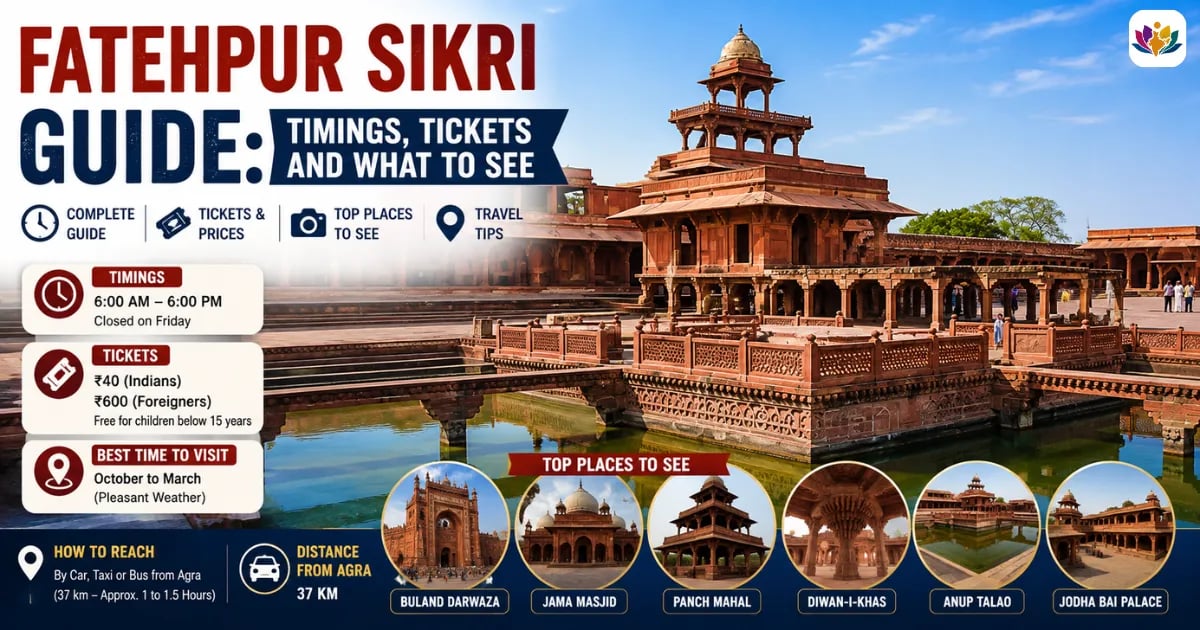
Fatehpur Sikri is a UNESCO World Heritage Site about 40 km west of Agra, the red sandstone Mughal capital Emperor Akbar built in 1571 and abandoned after just 14 years. It has two parts: a ticketed palace complex (₹50 for Indians, ₹610 for foreigners) and the free Jama Masjid with the 54-metre Buland Darwaza and the marble tomb of Salim Chishti, open daily from sunrise to sunset.
I was born in Delhi and I have brought travelers to Fatehpur Sikri for 11 years with Experience My India and I still think it is the most underrated stop on the whole circuit. People give the Taj a full morning and then rush this in forty minutes or they pay for the palace and never walk across to the free mosque, which is the most beautiful part of all. Fatehpur Sikri is a complete sixteenth-century Mughal city frozen in time and it rewards you far more if you understand what you are looking at. So this guide goes building by building, with the history behind them, the practical details and exactly how I would spend the visit.
Book our Delhi Agra Tour Packages, a unit of Experience My India. Or message on WhatsApp at +91 7302265809, any day from 8 AM to 9 PM.
What is Fatehpur Sikri? The story behind the ghost city
Fatehpur Sikri is the imperial capital that the Mughal emperor Akbar built from 1571 on a ridge of red sandstone near the village of Sikri, about 40 km west of Agra. For roughly 14 years it was the political heart of one of the richest empires on earth and then Akbar left it and it was gradually abandoned. Because it was never rebuilt or lived in again at scale, it survives as an unusually complete Mughal city rather than a set of scattered ruins, which is exactly why it is so special and why UNESCO inscribed it in 1986.
Why Akbar built it here
The reason is a very human one. Akbar had no surviving male heir and he came to the Sufi saint Shaikh Salim Chishti, who lived at Sikri, for a blessing. When a son was born in 1569, Akbar named the boy Salim, the future emperor Jahangir, in the saint's honour and resolved to build his capital on the spot. After his victory over Gujarat in 1573 he named it Fatehpur, the City of Victory and crowned the mosque with the towering Buland Darwaza to mark the conquest. So the whole city grew out of gratitude to one holy man, which is why the saint's tomb still sits at its spiritual centre.
It was also where Akbar tried something remarkable. In 1575 he built the Ibadat Khana, the House of Worship and invited scholars of Islam, Hinduism, Jainism, Zoroastrianism and Christianity to debate faith in front of him. Out of those debates he shaped Din-i-Ilahi, his own syncretic religion and that spirit of blending traditions runs right through the architecture, where Hindu post-and-beam construction, Islamic arches, Persian pavilions and Jain carving all sit together in the same red stone.
Why it was abandoned
Akbar moved his court away around 1585 and within a few decades Fatehpur Sikri was largely empty. The most widely accepted reason is water: the lake that supplied the city could not keep up and the supply failed. Historians also point to its position, the pull of campaigns in the north-west and possibly disease, but the failing water is the explanation you will hear most and standing on the dry ridge today it is easy to believe.
Fatehpur Sikri timings and ticket price in 2026
The site splits into two zones with two very different tickets and this catches out more visitors than anything else, so it is worth getting straight before you go.
Area | Entry (Indian / Foreigner) | Notes |
Royal palace complex | ₹50 / ₹610 | Children under 15 free |
Jama Masjid, Buland Darwaza & Salim Chishti's tomb | Free | Voluntary donations at the dargah |
Timings | Sunrise to sunset (approx. 6 AM to 6 PM) | Open daily; busy Fridays at the mosque |
The ₹50 or ₹610 ticket covers the royal palace complex, which is the Archaeological Survey of India's protected archaeological zone. The entire mosque side, the Buland Darwaza, the Jama Masjid and the marble tomb of Salim Chishti, is free to enter, with only voluntary donations at the dargah. In other words, even a traveller on the tightest budget sees the single most impressive part of Fatehpur Sikri at no cost at all. Buying the palace ticket online in advance, where available, saves you the counter queue.
What to see in Fatehpur Sikri
Fatehpur Sikri is not one monument but a whole planned city of palaces, courts, a great mosque and service buildings. These are the ones worth your time, roughly in the order a good visit takes them.
Buland Darwaza
Begin, if you can, with the Buland Darwaza, the Gate of Magnificence, the towering southern entrance to the mosque. At about 54 metres including its plinth it is the tallest gateway in the world, built by Akbar to commemorate his Gujarat campaign. A long flight of steps climbs to it and set into the archway is a Persian inscription of a saying attributed to Jesus: that the world is a bridge, to be passed over but not built upon. Standing beneath it, dwarfed, is one of the great arrival moments in Indian travel.
Jama Masjid and the Tomb of Salim Chishti
Through the gate opens the vast courtyard of the Jama Masjid, one of the largest mosques in India and still very much in use. Set within it, glowing white against all the red sandstone, is the marble tomb of Salim Chishti, the saint whose blessing began the whole story. The carved marble lattice screens or jalis, around it are among the finest anywhere, supported on delicate serpentine brackets and pilgrims still tie threads to them and make a wish, traditionally for a child. This is the emotional heart of Fatehpur Sikri and the part too many tour groups skip entirely.
Diwan-i-Khas and Ankh Michauli
In the palace complex, the Diwan-i-Khas, the Hall of Private Audience, is a plain square building hiding an extraordinary interior: a single, richly carved central pillar with a square base and octagonal shaft, crowned by a ring of 36 serpentine brackets that support a circular platform, reached by four diagonal stone walkways from the corners. Akbar is said to have sat on that central throne to hear ministers or, some historians argue, to inspect his jewels, since the building stands in the treasury precinct beside the Ankh Michauli, the gold and silver treasury whose playful name means blind man's buff.
Diwan-i-Am and the Pachisi Court
The Diwan-i-Am, the Hall of Public Audience, is a long pavilion around an open court, with a screened seat from which the emperor met the common people and dispensed justice. Just beside it, laid out across the courtyard paving, is the giant Pachisi Court, a full-size board for the ancestor of ludo, on which, the stories go, Akbar played using slave girls as the living pieces.
Panch Mahal and Anup Talao
The Panch Mahal is the building everyone photographs after the Buland Darwaza: a five-storey open pavilion, entirely columnar, each tier smaller than the one below until it finishes in a single domed kiosk. It has 176 carved columns in all, 84 on the ground floor alone and once had screens between them so the royal women could sit in the breeze and watch the city unseen. It looks out over the Anup Talao, the Peerless Pool, an ornamental square tank with a central platform reached by four little bridges, where the legendary musician Tansen is said to have performed for the court.
Jodha Bai's Palace, Birbal's House and the royal quarters
The residential heart includes the largest palace on the site, popularly called Jodha Bai's, a serene courtyard building with richly carved pillars and an azure-blue glazed-tile roof that mixes Hindu and Islamic forms. Nearby stand the elegant House of Birbal, home of Akbar's quick-witted Hindu minister, with its deep sloping stone sunshades, the exquisitely carved little pavilion of the Turkish Sultana and the Khwabgah, the House of Dreams, Akbar's own sleeping quarters. Take your time here; the carving is the whole point and it rewards a slow, close look.
Hiran Minar and the outer city
Out beyond the palaces are the working parts of the city that most visitors miss: the Naubat Khana or drum house at the imperial entrance, where musicians announced the emperor, the mint, the record office, the caravanserai and the Hiran Minar, a strange circular tower studded with hundreds of stone spikes shaped like elephant tusks, said to be a memorial to Akbar's favourite elephant. You do not need to see all of it, but knowing it is there tells you this was a real city, not just a palace.
A suggested route through the site
The palace complex and the mosque sit a short walk apart, so plan a simple loop rather than doubling back. Start in the palace zone at the Diwan-i-Am and the Pachisi Court, move to the Diwan-i-Khas and Ankh Michauli, then the Khwabgah and Anup Talao, up into the Panch Mahal for the views and on through Jodha Bai's Palace, Birbal's House and the Turkish Sultana's pavilion. Then cross to the mosque, climb to the Buland Darwaza and finish quietly at the Jama Masjid and the tomb of Salim Chishti. Ending at the dargah, rather than starting there, leaves you with the calmest part last.
How to reach Fatehpur Sikri
Fatehpur Sikri is about 40 km west of Agra on the Agra to Jaipur road, roughly an hour to an hour and a half by car, which is far and away the easiest way to visit.
If you are coming from the capital first, our guide on how to get to Agra from Delhi covers every route, train and toll; once you are in Agra, a car and driver to Fatehpur Sikri and back is simple. On a budget, Uttar Pradesh Roadways buses leave Agra's Idgah bus stand through the day and reach the Fatehpur Sikri bazaar in about ninety minutes for a modest fare. From the bazaar and the lower car park, shared tempos and e-rickshaws run the last kilometre or so up to the monument for a few rupees, since larger vehicles cannot go all the way. The small Fatehpur Sikri railway station is about a kilometre from the site and handles a limited number of trains.
Best time to visit and how long you need
Come between October and March, when the weather is kind; April to June is brutally hot for climbing steps in the open and the monsoon brings some rain from July to September. Arrive early, by about 8:00 or 8:30 in the morning, to beat both the heat and the tour buses that roll in mid-morning from Agra. Give the site at least two to three hours and closer to three and a half if you love your history, because rushing it in an hour is the single biggest regret I hear from travellers afterwards.
What to carry, photography and other practicalities
Travel light. Large bags and food are not allowed inside, though there is a cloakroom at the entrance and there is little decent food on site, so eat in Agra before or after. Still cameras and phones are fine for photography, but tripods and drones are not. Wear proper shoes with grip, since the stone is uneven and the steps are steep in places and access is only partial for wheelchairs and prams for the same reason. Carry water and a hat. The bazaar outside sells marble-inlay souvenirs, often better value than the shops in Agra city, but bargain firmly and buy from an established shop rather than a hawker on the steps.
A word on the touts
Be ready for this, because it is the one thing that sours people's visit. Fatehpur Sikri has some of the most persistent unofficial "guides", self-appointed "custodians" and souvenir sellers of any monument in India and they are heaviest on the climb to the Buland Darwaza and around the dargah, where donations and "chadar" money are pushed hard. Be politely firm, do not hand cash to anyone who is not at an official counter and hire only an ASI-approved guide who carries an identity card. The buildings are beautiful but genuinely cryptic without their stories, so a good guide is worth every rupee and Experience My India uses only licensed local guides who tell you the real history rather than the invented legends the touts trade in.
Want Fatehpur Sikri done properly, with a licensed guide, the right timing and no tout hassle? Message me on WhatsApp with your dates and I will plan it around the rest of your Agra trip.
Combining Fatehpur Sikri with Agra and Jaipur
Almost nobody comes only for Fatehpur Sikri and you should not either. It sits right on the road between Agra and Jaipur, which makes it the perfect thing to see either as a half-day trip out of Agra or as the morning stop when you drive on towards the Pink City.
Pair it with the Taj Mahal and Agra Fort on an Agra overnight tour and read our guide to the best places to visit in Agra so you do not miss the Baby Taj or Mehtab Bagh while you are there. Do check the Taj Mahal's timings and ticket prices before you go, since the Taj is closed on Fridays while Fatehpur Sikri stays open. If you are carrying on west, line it up with a 2 to 3 day Jaipur itinerary or let us join the dots for you on the Golden Triangle tour. You can also browse our full range of Delhi Agra tours to build the trip your own way.
Experience My India. He has personally hosted 50,000+ travelers and the service he leads is rated 4.9 from 2,600+ reviews, operating since 2015. Delhi Agra Tour Packages is a unit of Experience My India.
Book Your Delhi - Agra Trip Today 📞 +91-7302265809 💬 WhatsApp: +91-7302265809 Rated 4.9★ / 2600+ Reviews Explore all: Delhi Agra Tour Packages |
What a Experiance My India
Complete Delhi-Agra services
Private AC Cabs
Comfortable AC cars with experienced local drivers for Delhi, Agra and Jaipur tours.
Local Expert Guides
Explore the Taj Mahal and historic monuments with knowledgeable local guides.
Handpicked Hotels
Comfortable stays near the Taj Mahal and prime locations across Delhi and Agra.
Delhi–Agra Tours
Well-planned same-day and multi-day tours covering the best attractions.
Golden Triangle
Experience Delhi, Agra and Jaipur together with carefully planned itineraries.
24/7 Travel Support
Get assistance throughout your journey from booking to your return.
Plan Your Trip
Get a free quote in 30 mins
100% Trusted & Verified
by 50,000+ Travellers since 2018
Why travellers choose Experience My India
What makes us different from other agencies
We plan and run every trip ourselves, so you get a private AC car, a local expert guide, an honest fixed price, and no reseller or touts in between. We have guided travelers and families since 2018 and hold a 4.7 star rating across 3 verified reviews.
What Our Travellers Say
Real reviews from real Travellers
“Our Fatehpur Sikri visit was perfectly planned by Experience My India. Abhay Sharma's itinerary made sure we explored every important monument without feeling rushed. The private car was comfortable, the licensed guide explained the history beautifully, and the hotel arrangements were excellent. The entire tour was smooth, professional, and worth every rupee.”
Amit Deshpande
Nagpur· 28/2/2026
“We booked our Delhi-Agra tour through Experience My India after reading Abhay Sharma's guide, and everything exceeded our expectations. The driver was punctual, the hotel was clean, and the local guide shared fascinating stories about Fatehpur Sikri that made the visit unforgettable. Their planning saved us both time and unnecessary hassle.”
Shreya Mukherjee
Kolkata· 15/3/2026
“Experience My India delivered a truly premium travel experience. Abhay Sharma planned a perfect itinerary covering Agra and Fatehpur Sikri with enough time at every attraction. The comfortable car, knowledgeable guide, and well-selected hotel made our family vacation relaxing and enjoyable. Their customer support stayed connected throughout the journey”
Prakash Reddy
Hyderabad· 12/7/2026
Our Fatehpur Sikri visit was perfectly planned by Experience My India. Abhay Sharma's itinerary made sure we explored every important monument without feeling rushed. The private car was comfortable, the licensed guide explained the history beautifully, and the hotel arrangements were excellent. The entire tour was smooth, professional, and worth every rupee.
Amit Deshpande
Nagpur
We booked our Delhi-Agra tour through Experience My India after reading Abhay Sharma's guide, and everything exceeded our expectations. The driver was punctual, the hotel was clean, and the local guide shared fascinating stories about Fatehpur Sikri that made the visit unforgettable. Their planning saved us both time and unnecessary hassle.
Shreya Mukherjee
Kolkata
Experience My India delivered a truly premium travel experience. Abhay Sharma planned a perfect itinerary covering Agra and Fatehpur Sikri with enough time at every attraction. The comfortable car, knowledgeable guide, and well-selected hotel made our family vacation relaxing and enjoyable. Their customer support stayed connected throughout the journey
Prakash Reddy
Hyderabad
Our Fatehpur Sikri visit was perfectly planned by Experience My India. Abhay Sharma's itinerary made sure we explored every important monument without feeling rushed. The private car was comfortable, the licensed guide explained the history beautifully, and the hotel arrangements were excellent. The entire tour was smooth, professional, and worth every rupee.
Amit Deshpande
Nagpur
We booked our Delhi-Agra tour through Experience My India after reading Abhay Sharma's guide, and everything exceeded our expectations. The driver was punctual, the hotel was clean, and the local guide shared fascinating stories about Fatehpur Sikri that made the visit unforgettable. Their planning saved us both time and unnecessary hassle.
Shreya Mukherjee
Kolkata
Frequently Asked Questions
Quick answers to common questions
Fatehpur Sikri is famous as Emperor Akbar's abandoned red sandstone capital, a UNESCO World Heritage Site near Agra. Its highlights are the 54-metre Buland Darwaza, the tallest gateway in the world, the marble tomb of the saint Salim Chishti and remarkably complete palaces like the Panch Mahal and Diwan-i-Khas.
Entry to the royal palace complex is ₹50 for Indians and ₹610 for foreign tourists, with children under 15 free. The mosque side, including the Buland Darwaza and Salim Chishti's tomb, is free to enter.
Fatehpur Sikri is open daily from sunrise to sunset, roughly 6:00 AM to 6:00 PM. The Jama Masjid is a working mosque, so Fridays bring large prayer crowds, but the site does not close the way the Taj Mahal does on Fridays.
Yes, the site is open daily, which makes it a good choice for a Friday when the Taj Mahal is closed to tourists. Expect the mosque to be busy with worshippers at prayer times.